Vessel Magic
A vessel gives magical work a place to be held, changed, sealed, carried, or kept.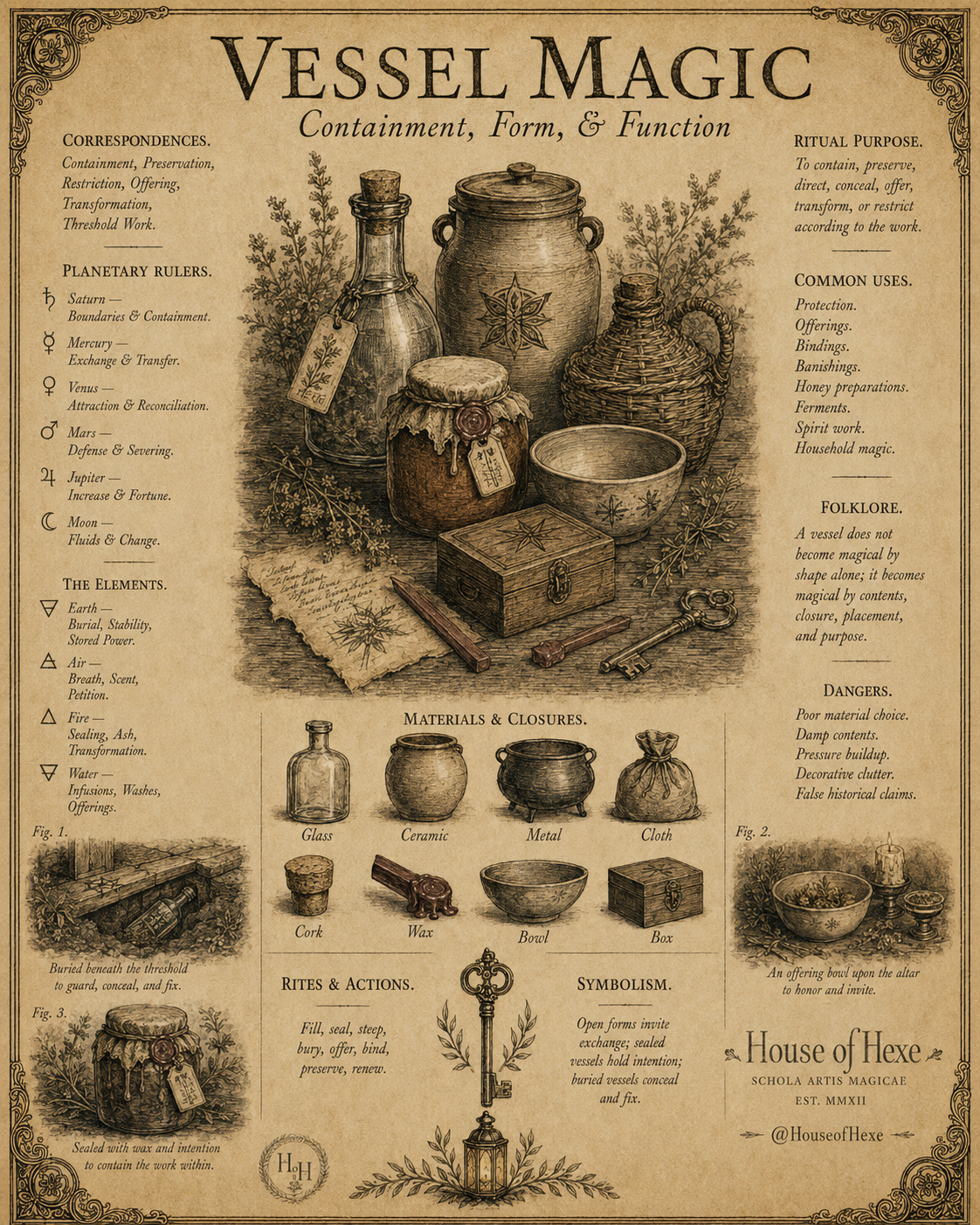
Containers are so ordinary that their magical usefulness can be easy to overlook. A jar on a pantry shelf, a covered crock, a wooden box, a bottle beside the sink, or a bowl waiting on a worktable already performs an important physical function by creating an interior space and separating whatever is placed there from the surrounding environment.
Witchcraft can make use of that function without requiring the vessel itself to be unusual.
A vessel may hold ingredients together for the duration of a working, preserve something intended to remain active over time, isolate material that should not move freely, conceal a working, permit fermentation or another form of transformation, receive offerings, or provide a defined physical place for something that would otherwise be difficult to contain. The role of the vessel depends upon what is being placed inside it, how the container behaves, and what the practitioner expects to occur there.
Modern witchcraft frequently associates vessel work with jars and bottles, but the principle is broader. Bowls, crocks, cups, boxes, baskets, pots, packets, tins, and many other forms of containment can become magical vessels when their material, structure, closure, placement, and intended purpose suit the work being performed.
✦ ✦ ✦
Origins
Containers belong first to ordinary human technology. They allow food to be stored, water to be carried, grain to be protected, medicines to be prepared, liquids to ferment, valuable objects to be hidden, and materials to remain together rather than becoming scattered. Once containers became part of everyday household life, they were also available for ritual, religious, medicinal, and magical purposes.
One of the clearest surviving examples from early modern England is the practice now commonly described as the witch-bottle. Seventeenth-century written accounts describe bottles used as counter-magic against suspected bewitchment. These workings commonly involved the urine of the afflicted person placed into a vessel with pins, nails, hair, salt, or other materials. Depending upon the method being followed, the bottle might then be heated, buried, concealed beneath a floor, or positioned elsewhere as part of the working.
Research into surviving texts places this practice firmly within seventeenth-century English counter-witchcraft and magical healing. The bottle created a contained relationship between the afflicted person, the materials placed inside it, and the person believed responsible for the harm. Contemporary writers understood the practice through systems of sympathetic medicine and magic rather than through the modern category of the jar spell. University of Cambridge / PMC
Archaeological evidence supports the written accounts. MOLA has documented glass and stoneware vessels containing pins, nails, thorns, hair, urine, and other materials, with examples discovered beneath floors, around thresholds, near hearths and chimneys, and in other deliberately concealed locations. MOLA
The vessels used in these workings were not necessarily manufactured as magical tools. Some were ordinary household bottles or stoneware containers that were repurposed after another use. A late seventeenth-century example held by the Salisbury Museum, for instance, appears to have begun as a bottle intended for beer or another alcoholic drink before being reused for counter-magic and buried with bent pins and nails inside it. Wessex Museums
This history provides a documented example of vessel-based magic, but it does not establish a direct historical line from early modern witch-bottles to every contemporary jar spell. Modern bottle and jar workings draw from many sources, including regional folk practices, contemporary occultism, individual innovation, and traditions in which containers developed their own particular ritual uses.
What the surviving evidence does show is that an ordinary household vessel could be made part of magical work through its contents, preparation, placement, and intended function.
One of the clearest surviving examples of vessel-based magical practice in early modern England.
Written accounts describe bottles prepared as counter-magic against suspected bewitchment, often within systems of sympathetic medicine and magical healing.
Surviving accounts and archaeological examples include urine, pins, nails, hair, salt, thorns, and other deliberately chosen materials.
Examples have been found beneath floors, around thresholds, near hearths and chimneys, and in other deliberately concealed locations.
The bottles themselves were not necessarily manufactured as magical tools. Household vessels could be reused when their form suited the working.
Documented witch-bottles do not establish a single uninterrupted lineage for every modern jar spell. Contemporary vessel magic draws from many folk, occult, regional, traditional, and personal sources.
Core Principles
A vessel creates a boundary between an interior and an exterior, and that boundary provides much of its usefulness in magical work. Materials placed together inside a container occupy a defined space in which they can remain in contact without dispersing into the surrounding environment. Depending upon the working, the vessel may remain open, be loosely covered, sealed, hidden, buried, displayed, shaken, periodically reopened, or maintained over an extended period.
Different forms of vessel magic make use of that boundary in different ways. A protective working may hold materials intended to remain near the household, while a restrictive working may be constructed to prevent something symbolically or magically from moving beyond the container. A prosperity vessel might remain accessible so additional materials can be added over time, while a fermenting preparation requires a container that allows the desired physical transformation to continue safely.
The vessel therefore contributes more than storage. Its physical behavior, method of closure, accessibility, and relationship with the surrounding space can all become part of the structure of the working.
For this reason, choosing the container is part of designing the magic rather than an afterthought once the ingredients have already been selected.
A vessel creates an interior and an exterior. What happens at that boundary can become part of the working.
Keeps ingredients, petitions, charms, offerings, or other materials together within one defined space.
Creates a boundary between what is inside the working and the environment around it.
Supports preparations intended to remain stable, useful, or active over time.
Provides a place where materials may ferment, dissolve, dry, combine, sour, or otherwise change.
Closure and access determine whether something remains contained, can be tended, or is allowed to move.
What Makes a Vessel Magical?
An ordinary container does not become permanently magical because it has once been used by a witch. The same jar may hold dried beans at one point and later be cleaned, prepared, and incorporated into a working without requiring the object itself to possess an inherent occult identity.
What distinguishes magical use is the deliberate relationship established between the container and the work. A vessel may be prepared through cleansing, blessing, consecration, inscription, anointing, spoken instruction, dedicated placement, repeated feeding, ritual use, or another method appropriate to the practitioner's craft.
Some witches maintain containers used exclusively for magical practice, while others intentionally repurpose ordinary household vessels because their familiar function contributes something useful to the working. Both approaches can be coherent when the choice is deliberate.
A fermentation crock, for example, already provides a physical environment intended to support controlled transformation. A locking box controls access, while a narrow-necked bottle limits how easily its contents can be reached or removed. A woven basket contains larger materials while allowing air to circulate through them, and a tin can provide an opaque, reusable enclosure for something that needs to be protected from light or handled repeatedly.
The practical qualities of the vessel give the practitioner information about what kinds of magical work it may support.
Material, Form & Function
The material from which a vessel is made affects both its practical behavior and the way it may be understood within a working.
Glass allows the contents to remain visible and is suitable for many dry materials and household preparations, although it is breakable and not appropriate for every substance or process. Ceramic vessels may be opaque and physically stable, and some are suitable for heat or fermentation when they have been designed and glazed appropriately. Metal introduces the qualities of the specific metal into the working but can react with acidic liquids or other ingredients. Wood, paper, cloth, basketry, and similar materials create different relationships with moisture, airflow, durability, concealment, and permeability.
Form matters for similar reasons. An open bowl allows easy access and continuous exchange with the surrounding environment, while a narrow-necked bottle restricts that access. A box creates a defined enclosed chamber and may be locked, whereas a basket holds material together without cutting it off from airflow. A lidded crock can protect its contents while still supporting a preparation that continues changing inside it.
Closures add another layer. Cork, wax, thread, fitted lids, tied cloth, locks, or the deliberate absence of any closure determine how easily the interior can be accessed and whether the working is intended to remain open, periodically tended, or kept shut.
These physical qualities do not dictate a single magical interpretation, but they give the witch a functional basis for deciding what kind of container belongs in a particular working.
The physical qualities of a container do not dictate one magical meaning, but they help determine what kinds of work the vessel can practically support.
Keeps contents visible and suits many dry materials and household preparations, but remains breakable and inappropriate for some substances or processes.
Can provide opacity and physical stability. Properly designed and glazed vessels may also suit heat or fermentation.
Introduces the qualities of the specific metal, but some metals may react with acidic liquids or other ingredients.
Create different relationships with moisture, airflow, permeability, durability, concealment, and handling.
Allows easy access and continuous exchange with the surrounding environment.
Restricts how easily the contents can be reached, removed, or altered.
Creates a defined enclosed chamber and may also control access through a lock.
Holds larger materials together without completely cutting them off from airflow.
Protects contents while still supporting preparations that continue changing inside.
Closes the vessel while remaining relatively easy to remove or replace.
Can mark deliberate sealing or completion, but may be unsuitable for work that requires continued access.
Provides a removable closure whose tying or binding may itself become part of the construction.
Controls physical access and may support work concerned with enclosure, privacy, or restriction.
Deliberate lack of closure can preserve exchange, access, airflow, or continued tending.
Containment, Preservation & Transformation
Containment is one of the most obvious functions of a vessel, although containment does not necessarily imply imprisonment. A container may simply keep materials together long enough for them to remain in relationship with one another. Herbs, written petitions, stones, powders, personal concerns, coins, bones, charms, and other components can occupy the same defined space without requiring the working to remain spread across an altar or work surface.
Preservation introduces a related but different use. Honey, vinegar, salt, drying, fermentation, and other preservation technologies alter the conditions in which food or medicinal material is kept, allowing some materials to remain useful beyond their fresh state. When those processes are deliberately incorporated into witchcraft, the vessel becomes part of the practical conditions that allow the preservation to occur.
This is especially important when the magical working contains an actual herbal preparation. An oxymel requires a container appropriate for acidic liquids. An electuary requires a clean vessel suitable for honey and powdered plant material. A ferment needs enough space, appropriate headroom, and a closure that accounts for gas production according to the method being used.
The presence of magical intention does not replace any of those practical requirements.
Transformation may also be the desired action rather than something incidental to the working. Materials can sour, ferment, soften, dissolve, combine, separate, dry, preserve, or otherwise change within a container. When that physical process is intentionally incorporated into the spell, the witch is working with a transformation that is actually occurring rather than using change only as metaphor.
This is particularly useful in work that sits between herbalism and witchcraft, although vessel magic itself is not limited to herbal preparations.
Sealing, Burial & Concealment
Sealing alters the relationship between the contents of a vessel and the environment surrounding it. Within magical practice, a seal may mark completion, prevent further interference, maintain privacy, restrict movement, hold a particular condition in place, or indicate that nothing further should be added to the work.
Modern jar magic often uses wax for this purpose, although a fitted lid may perform the necessary physical function perfectly well. The useful question is not whether the vessel looks properly sealed according to the conventions of contemporary spell imagery, but what the act of sealing is intended to accomplish within that specific working.
Not every vessel benefits from permanent closure. A working intended to be fed, refreshed, stirred, adjusted, opened for offerings, or dismantled after a particular period needs continued access. Covering such a vessel permanently in wax can interfere with the structure of the spell rather than strengthening it.
Burial introduces another set of considerations. Historically documented witch-bottles were sometimes buried beneath floors, near thresholds, in open ground, or in other locations where concealment and placement formed part of the operation. Archaeological context is one of the factors researchers use when identifying possible ritual vessels.MOLA
Contemporary witches may also choose burial as part of vessel work, but the method should account for what is being placed into the land. Glass, metal, wax, plastics, salt, oils, toxic plant material, and other ingredients can remain in soil or create ecological problems. A working that requires concealment can often be hidden, stored, or buried within a removable container on private property without abandoning permanent material in the landscape.
Protective, Benefic & Baneful Workings
Vessel magic appears across protective, benefic, coercive, and baneful forms of witchcraft because the usefulness of containment is not limited to one kind of intention.
Protective work may use a vessel to hold materials associated with household defense, spirit restriction, return work, or the containment of an unwanted influence. A container positioned near an entrance may participate in threshold protection, while one hidden elsewhere within the household can be assigned to a particular room, person, spirit, or concern.
Benefic workings can use the same basic structure for prosperity, affection, reconciliation, household harmony, fertility, healing, devotion, or other purposes. Some of these vessels are designed to remain accessible so that offerings, petitions, coins, herbs, or other materials can be added as the relationship with the working develops.
Baneful work may use containment to restrict, sour, bind, isolate, confuse, decay, expose, or otherwise act upon the condition represented within the vessel. The ingredients and treatment depend upon the practitioner's tradition and purpose, and may involve sharp objects, bitter materials, personal concerns, written petitions, decomposition, or other components whose role is understood within the work.
Historical witch-bottles complicate any attempt to divide vessel magic neatly into benevolent and harmful categories. They were generally prepared as counter-magic for a person believed to be suffering from bewitchment, yet contemporary explanations describe methods intended to cause pain or even death to the suspected witch in order to break the affliction.University of Cambridge / PMC
Protective purpose and aggressive method have therefore existed beside one another in vessel magic for centuries, and the ethical character of a working depends upon what is being done rather than upon the use of a bottle or jar itself.
Planetary & Elemental Correspondences
Vessel magic does not require a planetary or elemental system. These correspondences are useful when they clarify a working already being built.
Containment, restriction, boundaries, permanence.
Exchange, movement, communication, transfer.
Affection, reconciliation, attraction, pleasure.
Defense, conflict, severing, aggressive work.
Increase, prosperity, expansion, household fortune.
Fluids, cycles, spirit work, changeability.
Stability, burial, long-term containment, land, household stores, and material security.
Spoken charms, petitions, breath, scent, powders, sound, and vessels left open to exchange.
Safe heat-based methods, ashes, candle work, destruction, and transformation.
Liquids, washes, infusions, offerings, cleansing, emotional work, and fluid exchange.
How It Is Practiced
Vessel work begins by determining what is expected to happen within the container and whether the vessel itself is meant to participate in that process.
The practitioner then chooses a container suited to both the magical purpose and the physical materials involved. A dry charm has different requirements from a vinegar preparation, ferment, incense bowl, spirit vessel, offering cup, or container intended to remain outdoors for a season.
Materials may be added according to inherited method, correspondence, planetary timing, spoken prayer, petition, intuition, ritual sequence, or another structure already present within the practitioner's craft. Some vessels are assembled once and left undisturbed, while others are shaken, turned, opened, fed, refreshed, prayed over, exposed to particular weather or lunar conditions, or dismantled after a set period.
The exterior of the vessel may also become part of the working. Names, sigils, prayers, seals, planetary characters, protective marks, cloth, thread, paint, carvings, or other additions can identify the purpose of the container or extend the magical construction beyond its contents.
Placement deserves the same consideration as ingredients and closure. A vessel kept on a household altar occupies a different relationship with the home from one concealed near a threshold, stored in a cupboard, carried on the body, positioned in a garden, or hidden within a workspace.
The physical location of the vessel can therefore become part of how the spell operates and how often the practitioner interacts with it.
House of Hexe Perspective
At House of Hexe, vessel magic is approached through both function and witchcraft.
Understanding how a container behaves gives the practitioner useful information before magical symbolism is added. The width of an opening, the permeability of the material, the type of closure, the durability of the vessel, and whether the contents are visible or concealed can all influence the way a working is designed.
This does not mean that every magical use of a vessel needs to be explained through its mundane properties. A bottle can be dedicated to a spirit because that is the method of the practitioner's tradition. A box may be prepared through prayer, sympathetic magic, inherited instruction, or correspondence without requiring its physical construction to provide the entire magical explanation.
The practical and magical understandings can exist together.
For work that crosses into herbalism, fermentation, preservation, or household craft, the physical behavior of the vessel becomes especially useful because the container is already participating in a real process. In other workings, its magical role may come primarily from ritual instruction, relationship, symbolism, or the practitioner's established method.
House of Hexe does not treat one of these approaches as more legitimate than the other. The purpose is to understand what the vessel is being asked to do and to choose or prepare it accordingly.
The practical and magical understandings can exist together.
Opening width, permeability, closure, durability, visibility, heat tolerance, moisture, and access can all affect how a vessel behaves within the work.
Ritual instruction, sympathetic magic, prayer, spirit relationship, inherited method, correspondence, and symbolism may give the vessel a role that extends beyond its material properties.
Warnings & Misuse
Modern jar magic sometimes encourages practitioners to begin with appearance rather than function. Ingredients may be layered because the result is visually appealing, wax poured over lids regardless of whether the vessel needs to be opened again, and numerous correspondences combined without enough attention to whether the magical instructions attached to them actually agree.
Vessel work benefits from clarity, but it also requires ordinary material safety.
The container must be suitable for what is placed inside it. Acidic preparations can react with certain metals, fermentation can create gas and pressure, damp plant material can mold inside sealed containers, and oils, alcohol, heat, flame, or wax each create practical concerns that remain relevant during magical use.
Historical claims require similar care. A contemporary jar spell should not automatically be described as a direct continuation of seventeenth-century English witch-bottle practice merely because both involve bottles. Witch-bottles belonged to a specific body of counter-witchcraft and healing practice with documented ingredients, methods, and beliefs of its own.
Likewise, not every concealed historic vessel was magical. Archaeologists evaluate contents, placement, documentary evidence, comparison with similar finds, and the broader context of the building or site before interpreting an object as ritual.
Modern witches can develop contemporary vessel work without inventing an ancient lineage for every method they use. Knowing which practices are documented, which have been adapted, and which belong to modern or personal craft gives the work clearer context without diminishing its magical value.
Magical intention does not suspend the physical behavior of the vessel, its contents, or the historical record.
Acidic liquids may react with certain metals. Heat, oils, alcohol, flame, wax, and other materials require vessels suited to their actual physical behavior.
Sealing damp plant matter inside a container does not preserve it. Moisture remains relevant whether the contents are medicinal, culinary, or magical.
Active fermentation can create gas. Headroom, closure, container strength, and the method being used must account for that physical process safely.
Layered ingredients and wax-coated lids may look appealing, but appearance should not override whether the working needs access, movement, airflow, or continued tending.
A modern jar spell is not automatically a direct continuation of seventeenth-century English witch-bottle practice simply because both use a container.
Historic vessels are interpreted through contents, placement, documentary evidence, comparison, and archaeological context, not concealment alone.
Modern practice does not become less magical when we are clear about what is historical, what is adapted, and what is contemporary.