Binding
The traditional magical art of restraining influence, limiting movement, or placing symbolic boundaries upon a person, force, spirit, or unfolding situation.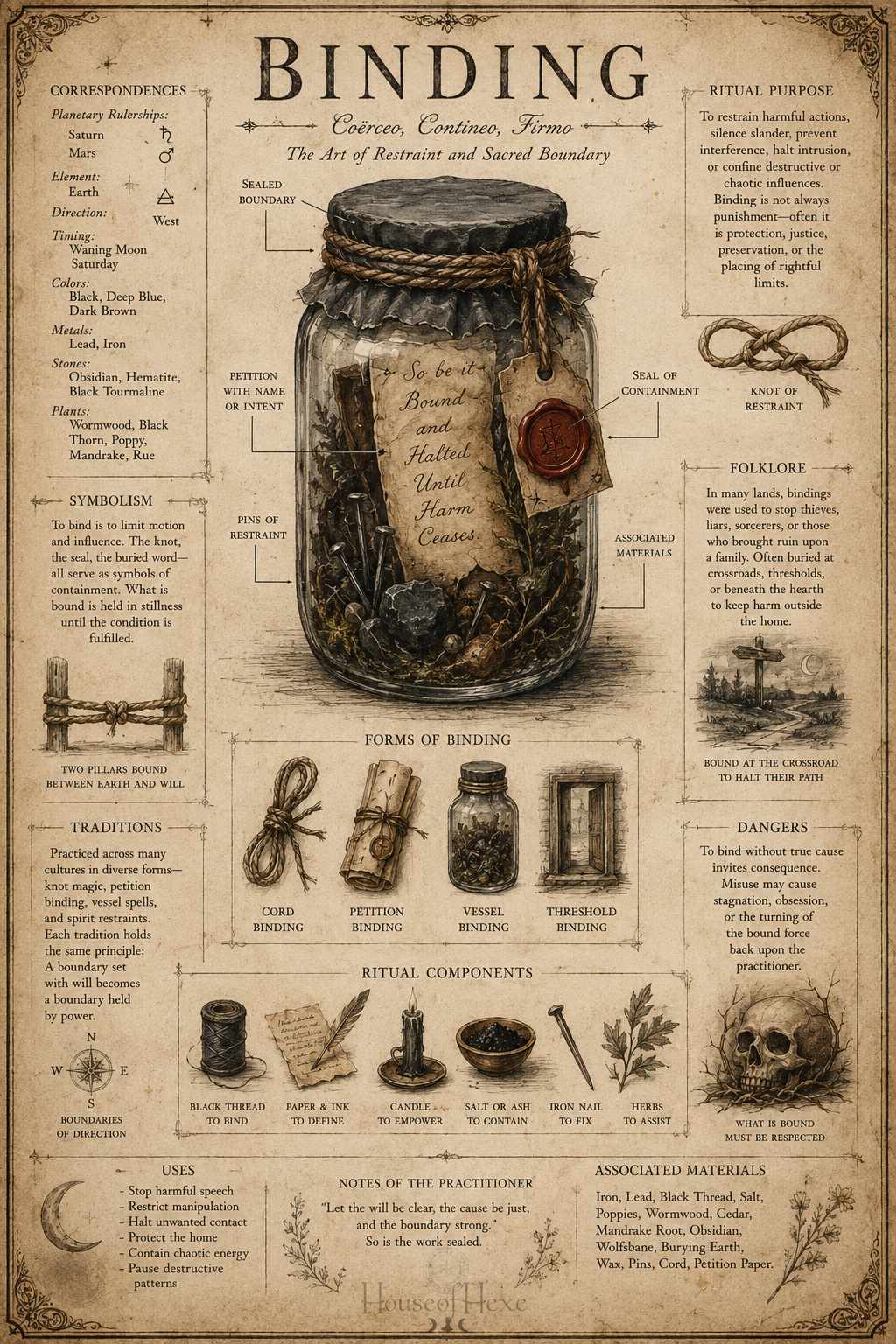
Binding is among the oldest and most misunderstood forms of magical practice. Found across folk traditions, court records, whispered prayers, and cunning rites, binding exists wherever human beings have sought to limit harm, halt unwanted influence, or preserve order. Though modern discussion often reduces it to revenge or control, traditional binding was just as often an act of defense, justice, preservation, or sacred restraint.
Origins
Among older systems of practice, few workings appear as consistently across cultures as acts of magical restraint. Long before modern occultism gave names to systems of correspondences, people were already tying knots, burying written petitions, sealing names in wax, and placing symbolic limits upon those believed to cause harm.
Archaeologists have uncovered ancient curse tablets from the Greek and Roman worlds, thin sheets of lead inscribed with names, grievances, and commands, then folded, pierced, or buried in liminal places. These workings were not always intended to destroy. Many were meant to silence slander, halt legal enemies, prevent betrayal, or restrict harmful rivals. In this sense, binding was often closer to spiritual litigation than simple malice.
In European folk magic, cunning practitioners might bind illness, bind gossip, bind drunkenness, or even bind a restless spirit from crossing a threshold. Farmers sometimes performed symbolic bindings against blight, predators, or theft. Midwives, healers, and household practitioners occasionally used cords, pins, ribbons, knots, or spoken charms to restrain what was seen as disruptive influence.
Across traditions, one truth remains: binding was rarely performed lightly. To restrict movement, whether physical, emotional, spiritual, or symbolic was understood as serious work requiring clarity, purpose, and consequence.
✦ ✦ ✦
Core Principles
At its heart, binding is not always punishment. More often, it is limitation.
Traditional binding usually operates through several core ideas:
Like influences like - what is tied symbolically may become restricted energetically.
Name carries power - a written name, personal object, photograph, or signature may serve as a representative link.
Containment creates boundary - jars, boxes, cloth, cord, wax, and knots create symbolic restriction.
Focused intent directs movement - the practitioner determines what is being restrained, and in what manner.
Every restraint has consequence - to interfere with motion is to enter relationship with outcome.
Binding may seek to:
Stop harmful speech
Restrict manipulation or obsession
Slow conflict from escalating
Prevent spiritual intrusion
Contain chaotic energy
Halt self-destructive patterns
A true binding does not always seek silence. Sometimes it seeks pause.
✦ ✦ ✦
Common Forms of Binding
Though methods vary by culture, several forms appear repeatedly throughout magical history.
Cord Binding
Perhaps the most recognized form. A cord, thread, ribbon, or natural fiber is wrapped, knotted, or braided while spoken words define the restriction.
Examples may include:
Binding harmful speech
Binding interference
Binding obsession or unwanted contact
Binding compulsive behavior
The knot itself becomes a physical anchor for the working.
Petition Binding
A name, symbol, or written petition is folded inward repeatedly, then tied, pinned, sealed, or buried.
This is often found in folk justice workings.
Jar or Vessel Binding
Objects associated with the target influence are placed inside a container designed to restrict movement.
This may include:
Paper petitions
Thread or cord
Nails or pins
Wax seals
Protective herbs
Salt, ash, or earth
The vessel becomes a symbolic prison, boundary, or pause.
Threshold Binding
A space, doorway, land boundary, or home is ritually marked to prevent unwanted energies or individuals from crossing.
This form often overlaps with protection work.
✦ ✦ ✦
Planetary & Symbolic Correspondences
Binding often aligns with forces associated with restriction, consequence, and boundary.
Common Correspondences
| Influence | Virtue |
|---|---|
| Saturn | Restriction, justice, structure, consequence |
| Mars | Defense, confrontation, protection |
| Earth | Stability, weight, grounding |
| Iron | Authority, warding, firmness |
| Black Thread | Absorption, containment |
| Lead | Burden, limitation, old justice |
Timing Often Used
Waning Moon - diminishing influence
Saturday - Saturnian restraint
Dusk or Midnight - liminal authority
Winter months - stillness, containment, preservation
Binding is often strongest when performed during natural cycles of contraction.
✦ ✦ ✦
How Binding Is Practiced
A traditional binding often begins not with anger but with definition.
What exactly is being restrained?
The person? The behavior? The obsession? The gossip? The intrusion? The chaos?
An experienced practitioner rarely binds “someone” broadly. They bind specific actions, patterns, influences, or outcomes. This distinction matters deeply.
A working may involve cleansing, grounding, petition writing, knotwork, spoken declaration, sealing with wax, burial, or placement in hidden spaces. Some workings are temporary. Others are maintained seasonally until conditions change.
In many traditions, a binding concludes with a clear statement of condition:
“Until harm ceases.”
“Until truth is restored.”
“Until my home stands undisturbed.”
The working is not merely cast.
It is witnessed.
✦ ✦ ✦
House of Hexe Perspective
At House of Hexe, binding is not approached as vengeance for wounded pride, online drama, or emotional impulse.
Binding is viewed as an act of spiritual boundary.
Just as a gate may be closed, a wound stitched, or a dangerous animal fenced from the garden, there are times when influence must be limited before greater harm unfolds.
A true binding asks difficult questions:
Are you protecting peace or controlling discomfort?
Are you preserving safety or avoiding confrontation?
Are you acting from sovereignty or from wounded ego?
Sometimes the most powerful binding is not placed upon another.
It is placed upon the parts of ourselves that refuse discipline.
✦ ✦ ✦
Warnings & Misuse
Modern discussions often confuse binding with hexing, domination, or aesthetic spellcraft. This oversimplification strips away the ethical weight and traditional seriousness of the practice.
A poorly defined binding may create stagnation, obsession, emotional fixation, or unintended entanglement. Binding broadly (without precision) can create more confusion than resolution.
Traditional practitioners understood that to restrict another force is to create relationship with it.
What you bind… you often remain responsible for observing.
For this reason, many older practitioners paired bindings with:
Cleansing
Protective household rites
Offerings or prayers
Seasonal release work
Honest mundane action
Magic rarely replaces difficult conversations, legal boundaries, or personal responsibility.
✦ ✦ ✦
Related Entries
Binding vs Baneful Work
Knot Magic
Protection Magic
Banishing
Threshold Magic
Saturn in Folk Magic