Garlic Allium sativum
Pronunciation: GAR-lik | AL-ee-um SAT-ih-vum
Botanical Latin pronunciations vary; this is a practical English rendering.
Hot bulb of the hearth, the blood, and the guarded thresholdGarlic is a pungent bulb in the Amaryllidaceae family with a remarkably long history as food, household medicine, and protective plant. It has traditionally been used for digestion, respiratory complaints, circulation, intestinal parasites, and general support during illness. Modern research has focused especially on cardiovascular and metabolic effects, including modest changes in cholesterol, blood pressure, and blood glucose markers. In magical practice, Garlic is strongly associated with protection, cleansing, banishment, courage, and the defense of the household.
Quick Correspondence Block
Planet: Mars
Element: Fire
Zodiac: Aries, Scorpio
Primary Actions: Circulatory stimulant, carminative, expectorant, diaphoretic, antimicrobial, mild cardiovascular support
Parts Used: Bulb, cloves, scapes
Preparation Style: Food, fresh crushed bulb, tincture, vinegar, oxymel, honey, syrup, broth
Magical Uses: Protection, warding, cleansing, banishment, uncrossing, courage, threshold magic
Spirit of the Herb: The hot bulb that guards the hearth and drives corruption outward.
Overview
Garlic is one of the oldest cultivated medicinal foods still used regularly in the modern kitchen. Its bulb is composed of individual cloves wrapped in papery skins, and its characteristic heat and sulfurous scent become much stronger when the tissue is cut or crushed.
Much of Garlic’s chemistry centers on sulfur-containing compounds. Intact cloves contain alliin and the enzyme alliinase in separate cellular compartments. Crushing the clove brings them together and allows the rapid formation of allicin, a reactive sulfur compound associated with the characteristic odor of fresh Garlic and many of its studied biological effects.
Garlic has been cultivated for thousands of years across Asia, the Mediterranean, the Middle East, Europe, and later much of the rest of the world. Ancient Egyptian, Greek, Indian, Chinese, and Mediterranean medical traditions all preserve records of its use as both food and medicine.
Herbalists generally classify Garlic as warming, stimulating, dispersive, aromatic, and antimicrobial. It has particular relevance to circulation, digestion, and the respiratory tract, especially where coldness, congestion, sluggishness, or poor peripheral circulation are part of the picture.
Modern clinical research has focused heavily on cardiovascular health. Garlic preparations have shown modest effects on blood pressure, cholesterol, and several metabolic markers, although results depend heavily on the preparation used, dosage, study population, and duration of treatment.
Magically, Garlic has a similarly forceful reputation. It is one of the classic plants of household protection and has been used in folk practice for warding, banishment, cleansing, protection from hostile forces, and strengthening the boundary between the household and what lies beyond it.
Botanical Identification
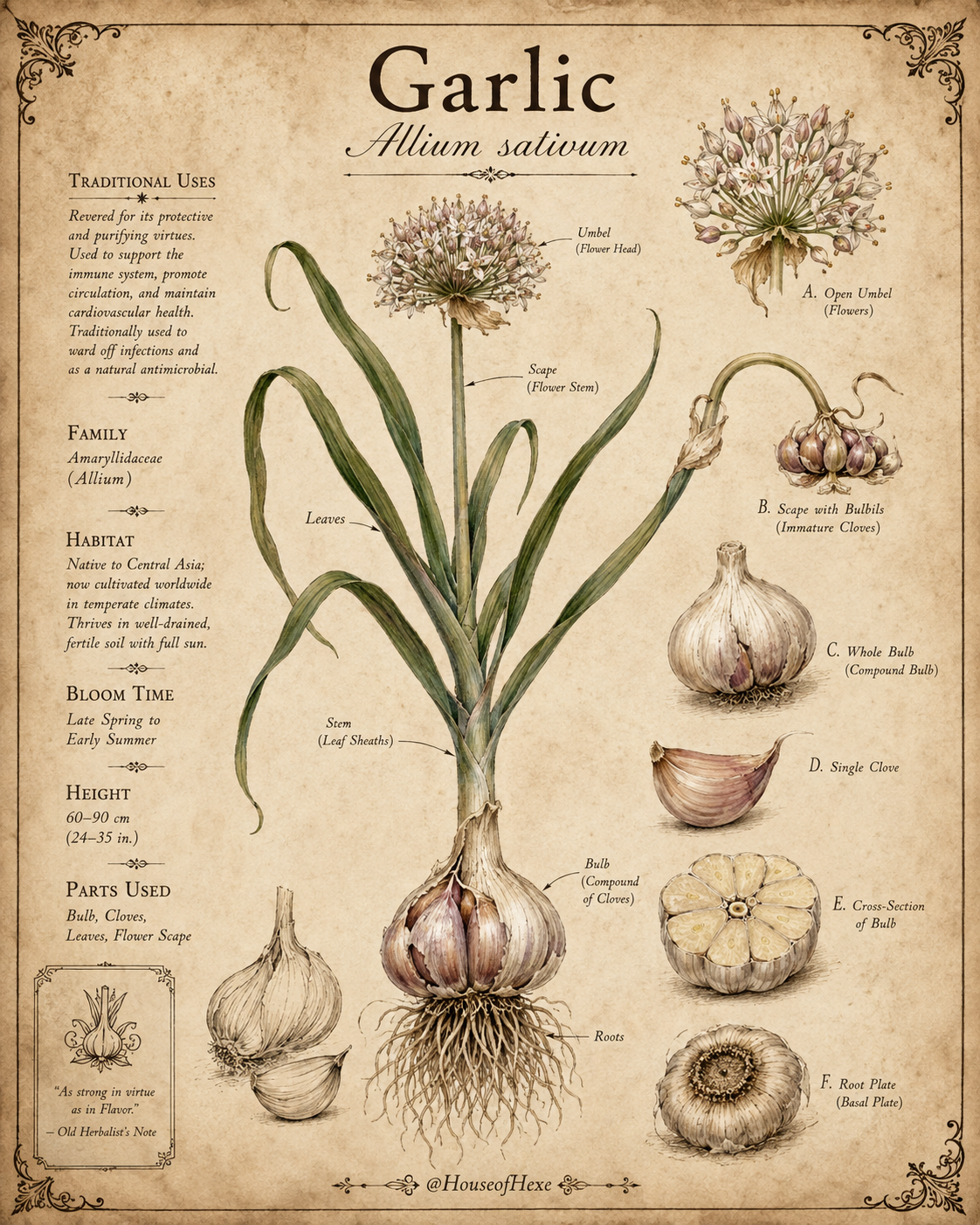
Garlic, Allium sativum, is a bulbous perennial usually cultivated as an annual crop. It belongs to the Amaryllidaceae family and the genus Allium, alongside onions, shallots, leeks, chives, and numerous wild relatives.
The familiar Garlic head is a compound bulb composed of individual cloves arranged around a short basal stem. Each clove is wrapped in its own papery skin, while several additional layers surround the whole bulb. Depending on cultivar, these outer skins may be white, cream, rose, purple, or strongly streaked.
Growth Habit
Garlic grows upright from the planted clove and typically reaches about 30–60 cm in height, although cultivar and growing conditions influence final size.
Leaves
The leaves are long, narrow, flat, and strap-like. They emerge from the base in overlapping layers and are usually medium green to blue-green.
Flowers and Scapes
Hardneck Garlic produces a round flowering stalk called a scape. The young scape often curls as it grows and later straightens as the reproductive structures mature.
At the top, the scape produces an umbel enclosed within a papery sheath. Many cultivated forms produce bulbils among the flowers, and viable seed production may be limited.
Softneck Garlic generally does not produce a prominent flowering scape under ordinary garden conditions.
Bulb and Roots
The bulb develops underground from enlarged leaf bases. Fibrous roots emerge from the basal plate beneath it.
The number and size of cloves vary considerably. Some cultivars produce a small number of large cloves, while others form many smaller cloves.
Scent
Freshly crushed Garlic has a strong sulfurous aroma caused by the rapid production and transformation of volatile sulfur compounds.
Habitat
Cultivated Garlic is primarily encountered in gardens, farms, orchards, and agricultural fields. It prefers fertile, well-drained soil and full sun.
Bloom Season
Flowering generally occurs in late spring or summer depending on cultivar, climate, and planting schedule.
Lookalikes and Confusion Species
Cultivated Garlic grown from known planting stock is generally straightforward to identify.
Greater caution is needed when harvesting wild plants believed to be edible members of the Allium genus. Several toxic monocots can resemble wild onions or Garlic at certain stages.
Death camas species, now commonly placed within the genus Toxicoscordion, are especially important confusion plants because ingestion can be severe or fatal.
Wild edible bulbs should be identified through several botanical characteristics rather than scent alone.
Traditional Uses
Garlic has been used as both food and medicine across a wide range of historical cultures.
In ancient Mediterranean medicine, Garlic was valued as a warming and stimulating food. Greek and Roman writers described its use for digestive complaints, respiratory illness, intestinal parasites, fatigue, and other conditions associated with weakness or obstruction.
Garlic also appears in Indian, Middle Eastern, Chinese, European, and later North American household medicine.
Common traditional uses included:
Coughs and chest congestion
Colds and seasonal respiratory illness
Intestinal parasites
Poor appetite
Digestive gas
Sluggish digestion
Poor peripheral circulation
General weakness
Wounds and skin infections
Fevers
Support during epidemic illness
Historical references to Garlic as an anti-infective or plague herb should be understood within the medical systems of their time. Some of the plant’s antimicrobial chemistry is well established experimentally, while many older disease-specific claims have not been supported by modern clinical evidence.
Garlic also became a common domestic remedy because it was inexpensive, easily stored, widely grown, and already part of daily food preparation. It entered broths, vinegars, syrups, cooked foods, medicinal wines, and other household preparations.
Its ritual history is equally extensive. Garlic has been carried, hung in houses, placed near doors and windows, incorporated into protective charms, and used in rites intended to repel dangerous spirits, illness, witchcraft, the evil eye, or other forms of harmful influence.
Modern Herbal Actions
Garlic is generally considered a warming, stimulating herb with affinities for the cardiovascular, digestive, and respiratory systems.
Circulatory and Cardiovascular Support
Garlic has been extensively studied for its effects on cardiovascular risk markers.
A 2025 systematic review and meta-analysis of 108 randomized trials involving more than 7,000 participants found modest improvements in several markers, including total cholesterol, LDL cholesterol, blood pressure, and some measures of glucose metabolism and inflammation.
The overall evidence supports Garlic as a complementary cardiovascular herb rather than a primary treatment for hypertension, hyperlipidemia, or cardiovascular disease.
Preparation strongly affects the chemistry of the finished product. Fresh Garlic, dried Garlic powder, aged Garlic extract, Garlic oil, and standardized supplements cannot be assumed to have identical actions or dosages.
Circulatory Stimulant
Traditional herbalists classify Garlic as a circulatory stimulant.
This refers to its warming and dispersive character and its historical use where cold hands and feet, sluggish peripheral circulation, or a general pattern of cold stagnation are present.
Antimicrobial
Garlic and its sulfur compounds, particularly allicin and related compounds, have demonstrated antibacterial and antifungal activity in laboratory research.
These effects are well established in vitro, but laboratory antimicrobial activity does not mean that ordinary Garlic preparations can replace antibiotics, antifungal drugs, or other appropriate treatment for serious infections.
Garlic remains useful as a traditional antimicrobial herb, particularly in food and household preparations, but clinical claims should remain proportionate to the available evidence.
Carminative
A carminative helps relieve intestinal gas and supports digestive movement.
Garlic’s pungency and warmth can stimulate digestion and make it useful alongside heavy, rich, or gas-forming foods.
People with reflux, gastritis, ulcers, or highly sensitive digestion may find raw Garlic irritating.
Expectorant
An expectorant helps loosen or move mucus from the respiratory tract.
Garlic has a long history in warming chest remedies, broths, syrups, and other preparations used during congested respiratory illness.
It is most suited to cold, damp, heavy congestion rather than very dry or irritated respiratory states.
Diaphoretic
Diaphoretic herbs encourage peripheral circulation and sweating.
Garlic has traditionally been included in warming foods and respiratory preparations during chills and the early stages of respiratory illness.
Its diaphoretic use is generally mild and supportive.
Metabolic Support
Modern clinical research has also examined Garlic for effects on glucose metabolism.
Several systematic reviews have found modest improvements in fasting glucose, HbA1c, cholesterol, and related metabolic markers in some study populations.
These findings support Garlic’s role as a medicinal food with metabolic relevance, while remaining insufficient to treat it as a replacement for conventional management of diabetes or metabolic disease.
Preparations
Garlic can be prepared in many forms, and the chemistry changes considerably depending on whether the bulb is fresh, crushed, cooked, aged, dried, or extracted.
Fresh Crushed Garlic
Crushing or chopping fresh Garlic activates alliinase and promotes the formation of allicin.
Fresh crushed Garlic provides the strongest expression of the raw bulb’s pungency and sulfur chemistry.
It can also irritate the mouth and gastrointestinal tract, particularly in larger amounts.
Food
Culinary use remains one of the most practical ways to work with Garlic.
It may be roasted, minced, sautéed, simmered, fermented, pickled, mashed, or incorporated into sauces, soups, broths, vegetables, grains, beans, and meat dishes.
Cooking reduces some of the reactive compounds found in raw Garlic while producing other sulfur compounds and a much milder flavor.
Tincture
Fresh Garlic may be tinctured in alcohol for a concentrated and shelf-stable preparation.
Tinctures are generally used in small amounts and may be combined with other warming respiratory or circulatory herbs.
Homemade tinctures should not be assumed to have the same concentration or pharmacological profile as standardized extracts used in clinical trials.
Vinegar
Garlic extracts well into vinegar and has a long place in medicinal kitchen preparations.
Garlic vinegar may be used in foods, dressings, sauces, respiratory formulas, and traditional warming tonics.
Oxymel
Garlic combines well with vinegar and honey in an oxymel.
Common companion herbs include thyme, sage, rosemary, horseradish, ginger, and other warming aromatic plants.
Honey
Fresh Garlic may be infused in honey for a traditional respiratory-season preparation.
The honey softens Garlic’s sharpness while creating a preparation that can be taken by the spoonful or added to foods and warm drinks.
Honey should not be given to infants under twelve months of age.
Syrup
Garlic has historically been included in cough syrups and other respiratory preparations.
Its strong flavor is usually balanced with honey or other aromatic herbs.
Broth
Garlic is especially well suited to medicinal broths.
Combined with onion, herbs, vegetables, mushrooms, meat, or bones, it contributes warmth, pungency, flavor, and fluid to preparations intended for nourishment during illness or recovery.
Garlic Oil
Garlic-infused cooking oil requires careful handling.
Fresh Garlic submerged in oil creates a low-oxygen environment in which Clostridium botulinum may grow if the preparation is stored incorrectly.
Homemade fresh Garlic oils should be refrigerated promptly and discarded according to current food-safety recommendations rather than stored indefinitely.
Topical Preparations
Raw Garlic has a history of topical use, including poultices and applications to skin infections, warts, and other conditions.
Fresh Garlic can cause significant irritation and chemical burns, especially when crushed and held against the skin beneath a dressing.
Direct topical use of raw Garlic is not generally recommended for home treatment.
Magical Uses
Garlic is one of the most enduring protective plants in European and Mediterranean folk practice.
Its magical associations center on defense, repulsion, cleansing, and the protection of the household.
Garlic has been placed near doors and windows, hung within homes and kitchens, carried for personal protection, buried at boundaries, and added to charms or ritual preparations intended to keep harmful influences away.
Its strong odor, warming nature, medicinal reputation, and ability to preserve well through winter all contributed to its protective symbolism.
Use Garlic for:
Household protection
Threshold wards
Banishing
Uncrossing
Protective floor washes
Boundary reinforcement
Personal protection
Courage
Cleansing after conflict
Protection during spirit work
Repelling hostile influence
Guarding the hearth
Protecting food stores
Severing unwanted attachments
Protective kitchen magic
Whole Garlic bulbs are well suited to permanent or seasonal household wards.
Individual cloves may be added to protection jars, charm bags, boundary workings, cleansing preparations, or spells intended to remove persistent influence.
Garlic braids may also be incorporated into household protection. The finished braid combines the protective reputation of the plant with the binding and structural symbolism of woven or twisted fiber.
Garlic is particularly appropriate to threshold magic. It may be placed near entrances, incorporated into workings around gates or property lines, or included in protective preparations for the kitchen and hearth.
In kitchen magic, Garlic can be used in meals prepared for protection, courage, strength, recovery, and household stability.
Its more adversarial applications include banishing, reversal, uncrossing, and workings intended to repel someone or something that has repeatedly crossed a boundary.
Garlic is generally better suited to active protection and repulsion than to attraction work.
Astrological Correspondences
Garlic is traditionally associated with Mars.
Its heat, pungency, strong odor, stimulating action, connection with blood and circulation, and longstanding use in protection all support the correspondence.
Planet: Mars
Mars governs heat, blood, defense, courage, conflict, severing, physical force, and protection through action.
Garlic reflects these qualities in both herbal and magical practice.
Element: Fire
Garlic is strongly aligned with the element of Fire.
Its pungency, warming action, stimulating character, and traditional use in expelling cold, congestion, and unwanted influence all fit the elemental association.
In household magic, Fire also connects Garlic to the hearth, cooking, protection, and preservation of domestic space.
Zodiac: Aries and Scorpio
Aries reflects Garlic’s direct, hot, protective, and active qualities.
Scorpio, under its traditional rulership by Mars, connects well with Garlic’s role in severing attachments, uncrossing, dealing with hidden threats, and protecting against harmful spiritual influence.
Seasonal Timing
Garlic is commonly planted in autumn and harvested the following summer.
This growth cycle makes it useful symbolically for protection established during the dark half of the year and strengthened slowly beneath the soil.
Autumn planting may be incorporated into workings involving long-term protection, preparation, household boundaries, or resilience.
Summer harvest aligns with strength, active defense, preservation, and storing resources for the year ahead.
Planetary and Lunar Timing
Tuesday, the traditional day of Mars, is appropriate for Garlic workings involving protection, banishing, courage, and boundary enforcement.
A waning moon may be used for uncrossing, banishing, or clearing unwanted influence.
Protective workings may also be timed according to practical need rather than lunar phase.
Growing & Harvesting
Garlic is well suited to the home garden and stores well after proper curing.
Soil
Garlic prefers loose, fertile, well-drained soil with good organic matter.
Dense or compacted soil may restrict bulb development, while waterlogged soil increases the risk of rot.
Sun
Full sun is best.
Water
Garlic needs regular moisture during active growth, especially while leaves and bulbs are developing.
Watering should be reduced as the crop approaches maturity.
Climate
Garlic can be grown across a wide range of climates, but cultivar selection is important.
Hardneck Garlic generally performs well in colder climates and produces a flowering scape.
Softneck Garlic is well suited to many milder climates and usually stores longer after harvest.
Planting
Garlic is normally propagated by planting individual cloves.
Separate the bulb shortly before planting and place each clove with the pointed end upward.
In cold climates, Garlic is commonly planted in autumn so that roots can establish before winter dormancy.
Mulch may be applied to moderate soil temperatures, conserve moisture, and protect the planting through freeze-thaw cycles.
Scape Harvest
Hardneck Garlic scapes are generally harvested while still young and curled.
Scapes are edible and can be used fresh, cooked, fermented, pickled, or preserved.
Removing the scape may also encourage the plant to direct more energy toward bulb growth.
Bulb Harvest
Garlic is generally harvested when several lower leaves have browned while the upper portion of the plant remains partly green.
If left too long, bulbs may begin to split and lose protective wrappers.
Lift the bulbs carefully with a garden fork or similar tool rather than pulling hard on the stems.
Curing
Freshly harvested Garlic should be cured in a dry, shaded place with good airflow.
Keep bulbs intact during the initial curing period.
Once the neck, roots, and outer wrappers are thoroughly dry, the bulbs may be cleaned and trimmed for storage.
Storage
Store cured Garlic in a cool, dry, dark, well-ventilated location.
Softneck cultivars generally store longer than hardneck types, although storage life varies by cultivar and conditions.
Warnings & Contraindications
Garlic is generally safe in normal culinary quantities.
Concentrated medicinal use requires additional caution.
Bleeding Risk
Garlic supplements may increase bleeding risk.
Use caution with anticoagulant or antiplatelet medications and before surgery or invasive procedures.
Blood Pressure and Blood Sugar
Medicinal Garlic preparations may lower blood pressure or blood glucose.
People using antihypertensive or glucose-lowering medication should use concentrated Garlic preparations with appropriate professional guidance.
Digestive Irritation
Raw Garlic may cause:
Heartburn
Reflux
Abdominal pain
Gas
Nausea
Diarrhea
Irritation of the mouth or stomach
Cooked Garlic is often better tolerated by people with sensitive digestion.
Allergy
Allergy or contact sensitivity to Garlic is possible.
People with known reactions to Garlic or other members of the Allium genus should use caution.
Topical Burns
Raw crushed Garlic can irritate or burn the skin.
Do not leave raw Garlic against the skin beneath an occlusive dressing.
Pregnancy and Breastfeeding
Garlic used as a normal culinary food is generally considered acceptable during pregnancy and breastfeeding.
Safety data are more limited for high-dose medicinal preparations and concentrated supplements.
Garlic in Oil
Fresh Garlic stored in oil presents a botulism risk if handled improperly.
Homemade Garlic oils should be refrigerated promptly and used within the period recommended by current food-safety guidance.
Serious Infection
Garlic should not be used as the sole treatment for serious bacterial or fungal infections.
High fever, worsening respiratory illness, spreading skin redness, infected wounds, systemic symptoms, or other signs of significant infection require appropriate medical evaluation.
Final Thoughts
Garlic has remained close to human life because it is useful in nearly every form it takes. It grows easily, stores through winter, flavors ordinary food, carries measurable medicinal chemistry, and has accumulated centuries of protective folklore.
Medicinally, it is a warming ally for circulation, digestion, and respiratory congestion, with modern evidence supporting modest cardiovascular and metabolic effects.
Magically, Garlic belongs to the guarded house: the kitchen, the hearth, the doorway, the gate, and the line that should not be crossed.
It is practical medicine and practical protection, kept close because both are needed often.
SOURCES / FURTHER READING
National Center for Complementary and Integrative Health. Garlic: Usefulness and Safety.
European Medicines Agency. Allii sativi bulbus — European Union Herbal Monograph and Assessment Materials.
Royal Botanic Gardens, Kew. Plants of the World Online: Allium sativum L.
Zhao, X. et al. “Effects of Garlic on Glucose Parameters and Lipid Profile: A Systematic Review and Meta-Analysis on Randomized Controlled Trials.” Nutrients, 2024.
“Effects of Garlic Supplementation on Cardiovascular Risk Factors in Adults: A Comprehensive Updated Systematic Review and Meta-Analysis of Randomized Controlled Trials.” 2025.
Borlinghaus, J. et al. “Allicin: Chemistry and Biological Properties.” Molecules, 2014.
Hoffmann, David. Medical Herbalism.
Mills, Simon & Kerry Bone. Principles and Practice of Phytotherapy.
Chevallier, Andrew. Encyclopedia of Herbal Medicine.
Grieve, Maud. A Modern Herbal.
Dioscorides. De Materia Medica.
Culpeper, Nicholas. Culpeper’s Complete Herbal.