Doorway Wards
The door does not merely open. It decides what is permitted to enter.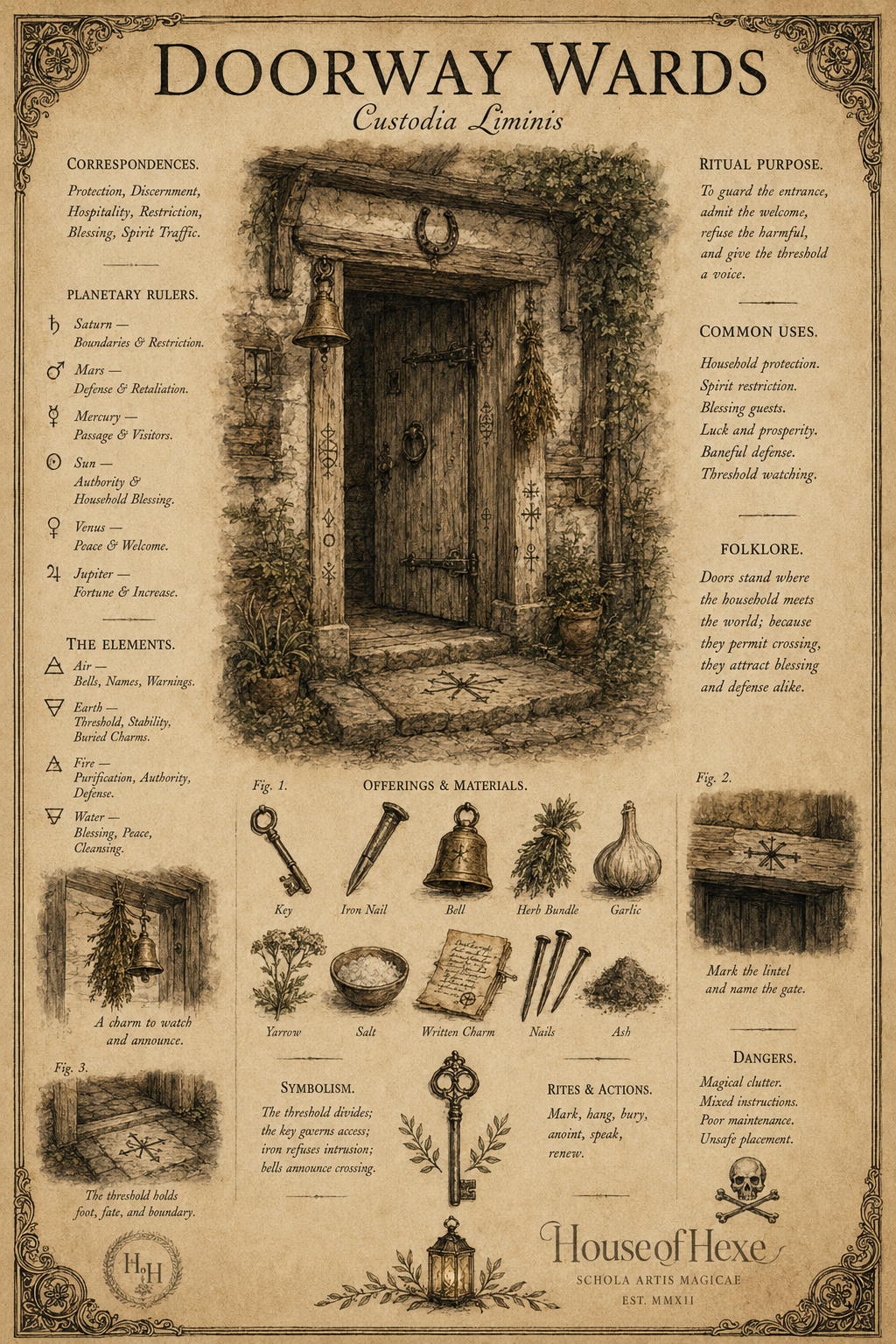
A doorway is one of the most ordinary structures in a house and one of the most persistent sites of protective magic. It interrupts a wall and creates a controlled point of passage between one space and another. People, animals, food, money, illness, gifts, arguments, news, spirits, and luck all enter the household through openings, and protective customs have gathered around those openings across many cultures and periods.
Doors, lintels, thresholds, windows, chimneys, and other points of entry have been marked, covered, crossed, buried beneath, hung with objects, and built around concealed materials intended to guard the household. Some protections were clearly religious. Others belonged to folk custom, household superstition, or magical practice. Many survived because they were repeated without anyone leaving behind a formal explanation of what was being done.
The doorway ward belongs to this larger family of practices. It may repel, admit, warn, confuse, bless, bind, redirect, or obstruct depending on what the practitioner expects the doorway to govern. A front entrance may be treated differently from a bedroom door, ritual room, nursery, garden gate, or the entrance to a place where spirit work is conducted.
The work begins before an herb, nail, bell, or symbol is chosen. The witch first decides what authority the doorway is being given.
✦ ✦ ✦
Origins
Across historical household practice, entrances repeatedly appear as sites of protection. Archaeologists and architectural historians have documented protective marks and concealed objects around doors, windows, fireplaces, chimneys, and other openings in historic structures throughout Britain and parts of Europe.
Among the better-known examples are marks now commonly described as apotropaic marks. These include hexafoils or daisy wheels, intersecting lines, Marian marks, pentangles, repeated cuts, and other deliberate symbols. Many appear near openings or other architecturally significant areas. Their interpretation is not always certain, and historians caution against treating every unusual scratch as evidence of magical protection, but the repeated placement of many such marks suggests that at least some were intended to avert harmful supernatural forces. Historic England
Protection also appears in the form of objects concealed within buildings. Shoes, garments, iron implements, written materials, bottles, and other objects have been found beneath floors, inside walls, near chimneys, and around thresholds. Some discoveries can be clearly connected to known protective traditions, while others remain difficult to interpret. What survives archaeologically is often only the object itself; the spoken charm, prayer, intention, or household explanation disappeared with the people who placed it there.
Iron became particularly associated with household protection in parts of European folklore. Horseshoes were placed over doors, while knives, nails, shears, keys, hooks, and other iron objects were sometimes incorporated into domestic protections. The familiar English legend of Saint Dunstan describes him shoeing the Devil and forcing him to promise never to enter a place displaying a horseshoe, although the broader use of iron against supernatural danger extends beyond that particular story. English Heritage
The evidence does not point to one universal doorway-warding tradition. Instead, it shows households repeatedly treating openings as places where supernatural danger, luck, spirits, and other outside influences might require deliberate management. Modern doorway warding continues to work with that same basic concern while drawing its methods from the practitioner's own magical tradition.
✦ ✦ ✦
Core Principles
A doorway ward works with an existing boundary. A wall separates two spaces, while a doorway creates a place where passage becomes possible. This makes the entrance useful for magic concerned with permission, restriction, recognition, hospitality, interference, and control.
A household ward may be broad enough to cover an entire home or property. A doorway ward is more specific. It is assigned to a point of passage and given responsibility for what happens there.
Some doorway wards are designed primarily for exclusion. They are meant to prevent unwanted people, spirits, influences, conditions, or magical interference from entering. Others are intended to recognize and admit what belongs while refusing what does not. A ward may also function as an alarm, drawing the practitioner's attention to disturbance at the boundary.
More forceful workings may interfere with what approaches by confusing, weakening, turning aside, binding, or redirecting hostile influence. A doorway can also be used for containment when the concern is not what comes inside, but what must remain within.
Not every doorway ward needs to be defensive. Entrances have also been blessed for hospitality, prosperity, peace, health, fertility, and good fortune. A charm placed above a family entrance may welcome invited guests and encourage harmony while another working beneath the same threshold restricts harmful intent.
A doorway ward becomes more coherent when its function is clearly understood. A charm intended to welcome good company is doing different work from a protection against spirit intrusion. A ward placed outside the house may engage something before it crosses, while a working placed inside may be intended to act only after someone or something has entered. Materials, placement, and method can then be selected according to that purpose.
✦ ✦ ✦
Marks, Objects, and Materials
Doorway wards can be visible or concealed. They may be built into the structure of the house, hidden beneath trim, suspended from the door, drawn on the frame, buried beneath the threshold, or placed nearby as part of the entrance itself.
Iron
Iron appears frequently in European protective folklore and remains useful in modern witchcraft for work involving restriction, defense, authority, and resistance to intrusion.
A horseshoe may be hung above the entrance. Nails can be driven into or placed around the frame. Keys, blades, hooks, shears, or other iron objects may be incorporated into a charm where their form and purpose suit the work.
An iron object can be chosen for more than its reputation as a protective material. A key governs access. A nail fastens and fixes. Shears divide. A blade cuts. A hook catches. These physical functions provide the witch with a basis for deciding what role the object will perform magically rather than treating every piece of iron as interchangeable.
Protective Marks
Marks placed around entrances are among the surviving forms of household protection that can remain visible after the people who made them and the explanations attached to them are gone.
A modern doorway ward may use a personal sigil, religious symbol, planetary character, written charm, repeated geometric pattern, name, prayer, or another sign meaningful within the practitioner's own tradition.
Historical symbols should be approached with context. A modern witch can learn from the placement and probable function of older apotropaic marks without claiming an exact lineage or copying symbols whose original meaning remains uncertain.
Placement can itself contribute to the working. A symbol above a doorway may oversee passage, while marks repeated along the frame may define the protected opening. A sign concealed beneath paint, trim, or flooring becomes part of the hidden magical architecture of the house rather than a visible declaration.
Plants
Plants can be hung above a doorway, braided into cords, tucked into bundles, laid beneath a threshold, woven into wreaths, placed in pots beside the entrance, or incorporated into another protective object.
Their use depends on the plant and the working. Plants associated with protection may guard an entrance, while thorn-bearing species can contribute a harsher defensive quality. Aromatic plants may be used in blessing, purification, or hospitality. Sweet plants may appear in workings concerned with affection, household harmony, or welcome. Bitter or otherwise severe plants may be chosen when the ward is intended to discourage or repel.
The plant should be understood as more than a word on a correspondence list. Its history, household use, folklore, temperament, and the practitioner's relationship with it all shape the role it takes within the ward.
Salt, Ash, Dirt & Powders
The threshold provides a useful place for loose materials because anyone entering the household must physically cross it.
Salt may be used in protective or purifying work. Ash may be incorporated into workings involving endings, destruction, cleansing, remains, or what has already been burned away. Powders can be laid beneath mats, worked into cracks, or placed discreetly along an entrance.
Dirt may be used when place and relationship matter. Soil gathered from the home, garden, property boundary, graveyard, crossroads, churchyard, workplace, courthouse, or another meaningful location carries a different magical context according to where it came from and why it was collected.
Foot-track traditions make particularly direct use of thresholds because a person may unknowingly step across or through material placed there. This principle appears in protective, coercive, love, luck, and baneful work depending on the tradition and intention involved.
Bells, Keys & Hanging Objects
Hanging objects are especially suited to doors because the entrance itself moves and is repeatedly disturbed.
A bell may sound when someone crosses the boundary, becoming both a practical signal and a magical one. Keys belong naturally to entrance work because they govern locking, opening, permission, and access. Knotted cords, woven pieces, beads, bones, charms, written petitions, metal objects, and small talismans may all be incorporated into doorway work when their purpose suits the larger ward.
The magical function comes from the work assigned to the object, its placement, and the method through which it is incorporated into the ward rather than from its appearance alone.
✦ ✦ ✦
Building a Doorway Ward
The first stage of building a doorway ward is deciding what the entrance is expected to do.
The practitioner may want it to guard, welcome, restrict, observe, expose, confuse, repel, bind, bless, or retaliate. More than one function can be combined, but every additional instruction should make sense beside the others.
Placement becomes part of the design. A working above the lintel may oversee everyone who passes beneath it. Something buried or placed below the threshold requires the entrant to cross over it. A charm behind the door may be intended to act once entry has already occurred. A working outside the house confronts what approaches from beyond the household, while a ward installed inside may defend the interior after something has reached the entrance.
Some wards are intentionally visible. A horseshoe, wreath, bell, charm, or marked lintel may become part of the visual language of the household. Others are kept private beneath flooring, behind trim, inside walls, under mats, or within nearby objects.
Once constructed, the ward may be spoken over, prayed over, breathed upon, smoked, anointed, marked, fed, sealed, buried, tied, nailed, or otherwise worked according to the practitioner's method.
There is no requirement that doorway warding involve elaborate ritual. A practitioner may speak the work plainly while installing it, while another may build it during a particular lunar phase, planetary hour, festival, household blessing, or period of spirit work. The method depends on the witch and the tradition being practiced.
✦ ✦ ✦
Protective, Restrictive & Baneful Workings
Doorway magic has never belonged exclusively to gentle forms of protection.
A restrictive ward may refuse entry without doing anything further. A harsher one may turn harmful intent back toward its source, bind what someone attempts to bring inside, expose deception, create discomfort for a hostile visitor, or attach consequence to deliberate intrusion.
Materials used for these workings often reflect the desired action. Thorns can catch or deter. Nails can fix, pin, or restrict. Bitter plants may repel. Ash can mark destruction or ending. Thread may bind. Sharp iron may defend or threaten. Written petitions can state the conditions under which the ward operates.
Protective and baneful work overlap most clearly when the practitioner decides what should happen after the boundary has been violated. A ward intended to prevent harm remains primarily defensive. A ward designed to punish the attempt introduces retaliatory or baneful action. Both approaches exist within witchcraft, and treating them as distinct allows the practitioner to choose deliberately rather than hiding one beneath the language of the other.
Thresholds can also be used offensively without serving a protective purpose. Powders placed where someone will walk, petitions buried beneath an entrance, concealed charms, and materials worked into a threshold appear in traditions of coercive, influence, love, luck, justice, and hostile magic. Because doorways are repeatedly crossed, they provide a direct point of contact between a working and the person intended to encounter it.
✦ ✦ ✦
Planetary & Elemental Correspondences
Doorway wards do not require planetary or elemental correspondences, but these systems can help shape the character of a working when they are already part of the practitioner's craft.
| Force | Traditional Virtue |
|---|---|
| Saturn | Boundaries, restriction, endurance, prohibition |
| Mars | Defense, aggression, force, retaliation |
| Mercury | Movement, passage, communication, visitors |
| Sun | Authority, vitality, blessing, household protection |
| Venus | Welcome, affection, peace, hospitality |
| Jupiter | Prosperity, expansion, household fortune |
Common Elemental Correspondences
Earth is well suited to foundations, buried charms, permanence, thresholds, land, and household stability.
Air appears through bells, spoken charms, warnings, names, communication, and movement through the entrance.
Fire may be used for authority, purification, destruction, aggressive protection, and transformation.
Water lends itself to blessing, cleansing, peace, hospitality, and workings concerned with emotional atmosphere within the home.
The correspondence system should support the ward rather than complicate it. A Saturnian restriction intended to keep something out does not require every planet or element to be represented simply for balance.
✦ ✦ ✦
How It Is Practiced
Doorway warding often begins with the entrance itself. The area may be cleaned, repaired, swept, washed, or otherwise prepared before the magical work is installed. This is not necessary because cleanliness somehow makes magic more legitimate; it allows the practitioner to deliberately tend the physical boundary that will carry the working.
The practitioner then prepares the chosen object, mark, plant material, powder, iron piece, written charm, or other components. The work may be placed directly upon the frame, suspended above the door, buried beneath the threshold, tucked behind trim, worked beneath a doormat, built into a nearby planter, or concealed elsewhere within the entrance.
Spoken instructions can be particularly useful in doorway work because the ward governs conditions. The practitioner may name who is welcome, what is refused, which spirits may pass, what behavior is prohibited, what should occur when someone approaches with malicious intent, or under what circumstances the ward should remain inactive.
Some doorway wards remain in place for years and become part of the magical architecture of the household. Others are temporary. A working installed during illness, conflict, travel, grief, ritual activity, spirit work, or another specific circumstance may be dismantled when that condition ends. The intended duration should suit the reason the ward was created.
✦ ✦ ✦
House of Hexe Perspective
At House of Hexe, doorway warding is treated as household witchcraft without requiring scientific justification before the practice can be taken seriously. A witch may ward a doorway because the household is understood as magical territory and the entrance to that territory deserves deliberate attention.
Doors already govern access through their ordinary function. They open, close, lock, admit, refuse, conceal, expose, and divide. Doorway magic extends those functions into the magical structure of the household.
The ward may welcome invited people, prohibit particular influences, alert the practitioner to disturbance, restrict spirit traffic, bless those who enter, or retaliate against deliberate intrusion. The appropriate function depends on the household, the doorway, and the witch responsible for maintaining it.
Elaborate construction is not necessary for strong doorway magic. A simple working with a clear purpose may remain useful for years, while a crowded protection assembled from unrelated symbols and correspondences may become difficult even for its maker to interpret or maintain.
✦ ✦ ✦
Warnings & Misuse
One of the easiest mistakes in doorway magic is layering protective objects until the entrance becomes difficult to read. A horseshoe, bells, sigils, salt, herbs, black thread, railroad spikes, crystals, protective eyes, keys, witch bottles, and several unrelated sacred symbols do not automatically strengthen one another. Each object introduces another instruction, tradition, relationship, or magical function, so the practitioner should be able to explain why it belongs in the working.
Historical language also requires care. The phrase “witch mark” is widely used today, but many surviving apotropaic marks were probably made by people attempting to protect themselves from witchcraft, demons, spirits, misfortune, or other supernatural threats. The people who created them would not necessarily have understood their actions as witchcraft, and many individual marks cannot be interpreted with certainty. Historic England
Borrowing from historical household protection does not require pretending that every old custom belonged to witches. A practitioner can study the surviving evidence, understand the principles behind it where those principles are reasonably clear, and still build contemporary witchcraft from that knowledge without inventing a lineage.
Physical safety remains part of household practice. Toxic plants should not be placed where children or animals can reach them. Powders should not be scattered where pets will lick them from their paws. Heavy iron should be secured properly, and candles or burning materials should never be placed near doors, curtains, dried herbs, or other obvious fire hazards.
A ward also does not need to remain simply because it once served a purpose. Households, relationships, and magical practices change, and a working built for one period may eventually become unnecessary or poorly suited to the people now living behind the door. Dismantling, replacing, or retiring an old ward is therefore part of maintaining the magical structure of the home.
✦ ✦ ✦
Related Entries
Crossings & Thresholds
Wards
Apotropaic Magic
Vessel Magic
House Spirits
Banishing
Protective Magic
Spirit Offerings
Iron
Materia Medica: Garlic
Materia Medica: Yarrow
*If links are not active…it is a future post yet to be published. Thank you for understanding!