Last Sheaf Traditions
Last Sheaf Traditions
The final grain in the field was sometimes treated differently because finishing the harvest carried its own customs, obligations, and luck.
The final grain in the field was sometimes treated differently because finishing the harvest carried its own customs, obligations, and luck.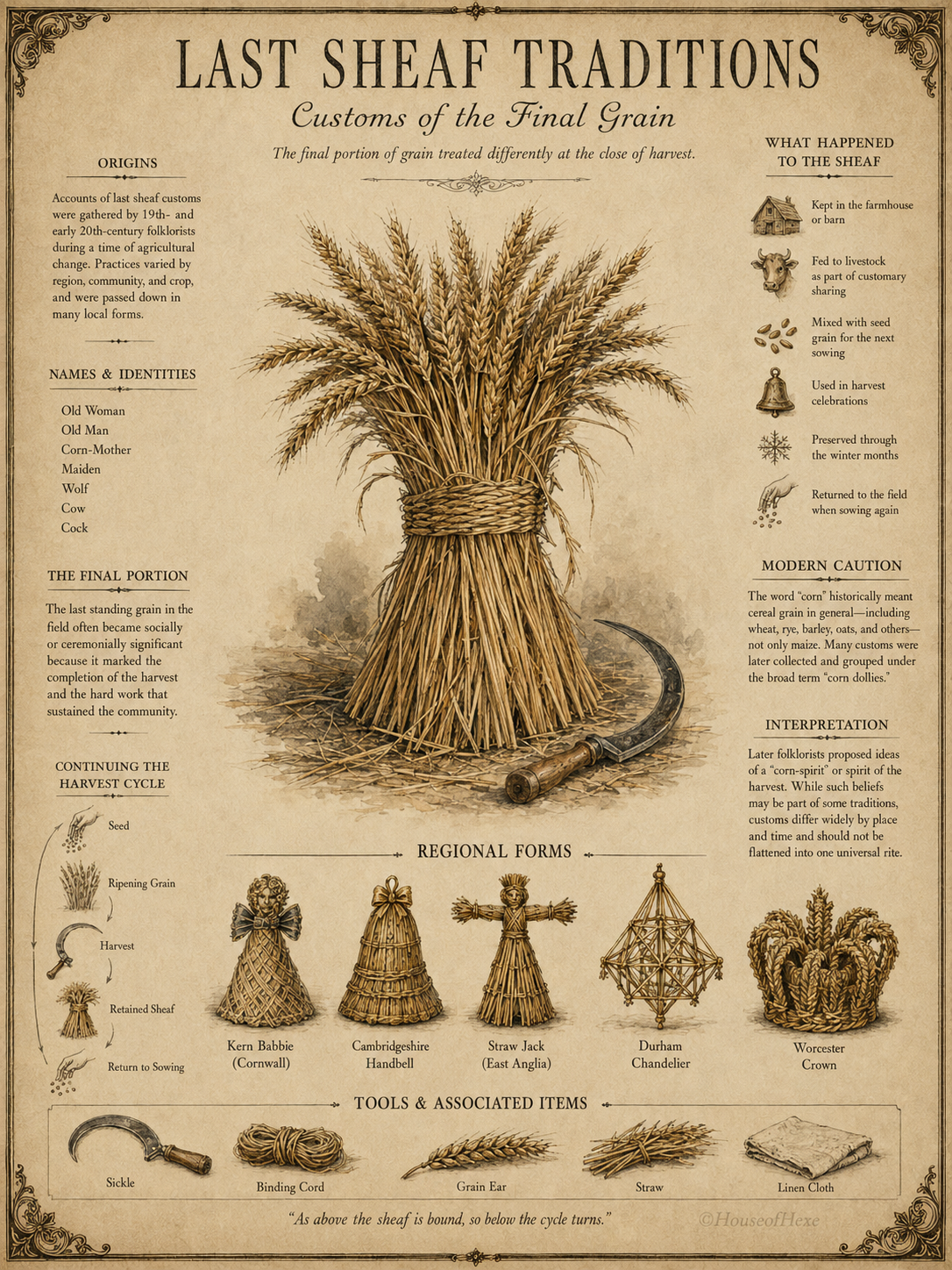
Across parts of Britain and continental Europe, the final portion of a grain harvest could receive treatment that distinguished it from everything cut before it. The last standing stalks might be bound into a special sheaf, shaped into a figure, decorated, carried home, kept through winter, fed to livestock, returned to the field later, or incorporated into the harvest celebration.
The names and forms varied widely. English traditions include regional figures now grouped under the broad modern label of corn dollies, while Scottish and continental customs used names referring to maidens, old women, mothers, animals, and other local figures. English Heritage notes that forms such as kern babbies, the Cambridgeshire handbell, Straw Jack, the Durham Chandelier, and the Worcester Crown belong to distinct regional traditions rather than one standardized design. (english-heritage.org.uk)
The word corn also needs to be read historically. In older British usage, corn referred broadly to cereal grain and could mean wheat, oats, barley, or another locally important crop rather than specifically American maize. The narrower American meaning developed later. (etymonline.com)
These customs are best understood as a family of harvest-ending traditions rather than as one ancient ritual practiced uniformly across Europe. Similar features appear in many places, but the names, materials, actions, and explanations attached to them differ considerably.
Follow the custom from the final standing grain through regional forms, folklore interpretation, preservation, and modern magical practice.
Origins
Many of the best-known written records of European last-sheaf customs come from nineteenth- and early twentieth-century folklorists who collected agricultural traditions while mechanized farming was already changing older harvest practices. The surviving descriptions are therefore valuable records of custom, but they often document traditions relatively late in their history rather than preserving an unquestioned account of their earliest origins.
Folklorists such as Wilhelm Mannhardt and James George Frazer gathered examples from Germany, Britain, Scandinavia, eastern Europe, and elsewhere in which the final portion of grain was personified, decorated, carried home, mocked, honored, or retained after harvest. Frazer recorded names such as the Corn-Mother, Old Woman, Maiden, Old Man, Wolf, Cow, Cock, and other human or animal figures associated with the last sheaf or with the person responsible for cutting or binding it. (sacred-texts.com)
The records show considerable variation even between neighboring regions. In some places the last sheaf was treated ceremonially, while elsewhere responsibility for it invited teasing or social embarrassment. Some figures were feminine, others masculine, and animal forms could appear alongside human ones. The grain might be preserved carefully in one community and consumed, distributed, or otherwise used in another.
Early folklorists often tried to explain these similarities through a single underlying religious system. That interpretation became highly influential, especially through Frazer's work, but the customs themselves and the theories later used to explain them should be kept separate.
The Final Portion of the Harvest
Harvesting a field by hand gradually reduces the standing crop until only a small section remains. The final patch would have been obvious to everyone involved in the work because the group could see who would make the last cut or bind the last bundle.
In some communities, that moment acquired social and folkloric importance. The final portion might be cut in a particular way, bound separately, decorated, or carried home with the harvesters. The person who completed the work could also become temporarily associated with the final sheaf and inherit its name, role, or the teasing attached to it.
These customs should not be imagined as uniformly solemn. Harvest brought communal labor together with food, competition, humor, status, celebration, and sometimes religious or magical observance. A custom could be playful in one setting and treated more seriously in another, while the same action might hold several meanings within the community practicing it.
The importance of the last sheaf came partly from the fact that it marked the completion of agricultural work that had occupied the household and community for much of the growing season.
The surviving descriptions and the theories later built around them are related, but they are not the same kind of evidence.
Folklore records preserve repeated examples of the final grain being treated differently from the rest of the harvest.
- Final sheaves given local names or identities.
- Grain shaped, dressed, decorated, enlarged, or carried home.
- Reapers or binders temporarily receiving the name of the final sheaf.
- Customs involving teasing, celebration, retention, feeding, or later reuse.
- Different treatments appearing even between neighboring communities.
Nineteenth-century comparative folklorists often tried to explain these varied customs through a shared underlying religious or agricultural system.
- Mannhardt developed vegetation-spirit theories.
- Frazer compared harvest figures across Europe and beyond.
- Similar names and actions were sometimes treated as survivals of one older belief system.
- Later scholarship challenged many of these broad reconstructions.
- Interpretation should therefore be distinguished from the custom being documented.
The custom is evidence that the custom occurred. An explanation proposed by a later folklorist is evidence of how that scholar interpreted it.
Names, Figures & Regional Forms
The final sheaf appears under a remarkable range of local names and forms.
Frazer's collections describe parts of Germany and neighboring regions where the last sheaf could be called the Old Woman, Old Man, Corn-Mother, or Maiden. In some places it was shaped into a human figure, dressed, decorated with flowers, enlarged beyond the size of an ordinary sheaf, or carried home by the person who finished the harvest. (sacred-texts.com)
Other traditions gave the final grain an animal identity. Recorded figures include wolves, cows, bulls, cocks, and other animals, with the reaper or binder sometimes receiving the same name as the sheaf. Frazer documented examples in which harvesters spoke of catching the Wolf in the final grain or referred to the person finishing the field as the Wheat-cow or Corn-cow. (sacred-texts.com)
British traditions developed their own regional forms. English Heritage identifies kern babbies, handbell forms, Straw Jack, chandelier-shaped constructions, crowns, and other designs now commonly grouped under the category of corn dollies. (english-heritage.org.uk)
Modern retellings often emphasize the human-shaped straw figure, but historical harvest constructions were much more varied. They could be geometric, animal-shaped, crowned, bundled, woven, dressed, or built according to a regional pattern whose local name mattered more than the modern umbrella term applied afterward.
The final grain could acquire a local name, a human or animal identity, or a particular regional form without belonging to one standardized tradition.
- Old Woman — recorded in parts of Germany and neighboring regions.
- Old Man — another human identity attached to the final crop or worker.
- Corn-Mother — one of several maternal harvest names collected by folklorists.
- Maiden — a feminine figure appearing in some regional harvest traditions.
- Wolf — sometimes spoken of as being caught in the final grain.
- Cow — appearing in names such as Wheat-cow or Corn-cow.
- Bull — another animal form found in comparative harvest collections.
- Cock — among the animal figures connected with last-sheaf material.
- Kern Babbies
- Cambridgeshire Handbell
- Straw Jack
- Durham Chandelier
- Worcester Crown
- Names could change from one region or community to another.
- The figure could be human, animal, geometric, or abstract.
- The sheaf might be dressed, enlarged, woven, bundled, or crowned.
- The worker who finished the field could inherit the same name as the sheaf.
These are not alternate names for one universal harvest being. Local terminology, construction, crop, and custom should be preserved wherever the source allows it.
The Last Reaper or Binder
The person who completed the harvest could become part of the tradition alongside the grain itself.
In some regions, no one wanted responsibility for the final sheaf because the person might be mocked, given an unwanted title, wrapped in straw, required to carry a heavy bundle, or made the focus of the harvest gathering. Frazer's collections preserve several examples in which the person who bound or threshed the last grain was called the Old Woman, Old Man, Wolf, Cow, or another name also attached to the final crop. (sacred-texts.com)
This part of the tradition is useful because it shows how agricultural folklore could be performed collectively rather than privately. Harvesters worked alongside one another, and the completion of the field created an opportunity for communal joking, competition, ceremony, and the assignment of temporary roles.
Nineteenth-century folklorists sometimes interpreted the relationship between the worker and the sheaf as evidence that both represented the same underlying harvest being or spirit. The social custom itself does not require that interpretation in order to be understood. The person finishing the field clearly occupied a distinct role in some communities, whether that role was comic, ceremonial, unlucky, or some combination of these.
What Happened to the Sheaf
The last grain did not always remain in the field after cutting.
Some final sheaves were brought into the farmhouse or barn and retained after harvest. Others were incorporated into harvest celebrations, fed to livestock, used during later seasonal observances, or preserved until some portion of the grain could be returned to agricultural use.
Frazer recorded European examples in which grain from the final sheaf was mixed with seed grain for the following year's sowing. Other customs involved keeping the sheaf in the farmhouse for a period of time or eventually giving the grain to animals. (sacred-texts.com)
Because the treatments vary so widely, retention is more useful as a recurring feature than as evidence for one fixed explanation. Grain from the final harvest could still function as seed, fodder, food, decoration, or ritual material depending on the community and the custom.
Keeping some portion of it also created a material connection between the completed harvest and whatever followed, especially when the grain later returned to the field or entered another stage of household use.
In some traditions, the final grain continued participating in household and agricultural life after the field was cut.
The final portion of standing grain is cut, bound, decorated, or otherwise set apart.
The sheaf may be carried home, placed in the farmhouse or barn, displayed, or retained for later use.
Grain may remain stored, enter a feast or seasonal observance, become fodder, or continue as household material.
In some recorded customs, retained grain was later mixed with seed for the following sowing.
Corn Dollies & Modern Terminology
The term corn dolly is now used broadly for decorative objects woven from cereal straw, including reproductions of historical forms as well as contemporary straw craft.
That modern category can make the older traditions appear more standardized than they were.
English regional examples carried their own names and constructions, and many were not doll-shaped. English Heritage's examples include bells, crowns, chandeliers, and local named figures alongside forms that more closely resemble a human body. (english-heritage.org.uk)
Modern straw workers have also developed elaborate designs inspired by older harvest craft without necessarily reproducing a documented last-sheaf custom. Contemporary craft can develop beyond historical forms without losing its value, but the distinction becomes important when discussing provenance.
A straw weaving made today may reasonably be called a corn dolly in the modern craft sense while still being a contemporary design rather than a reconstruction of a specific agricultural custom. Likewise, an old photograph of a straw figure does not automatically tell us what its maker believed about it or how it was used.
The object and its historical context need to be considered together.
The Corn-Spirit Interpretation
Much of the modern occult explanation of last-sheaf customs comes through nineteenth-century comparative folklore.
Mannhardt and later Frazer argued that European harvest traditions preserved belief in a vegetation or corn spirit that moved through the standing crop as harvesting progressed and became concentrated in the final remaining grain. Within this interpretation, bringing the last sheaf home preserved that spirit through winter, while returning grain from it to the field helped restore fertility during the next growing cycle.
Frazer used this model to connect a large number of customs involving figures called the Corn-Mother, Maiden, Old Woman, Wolf, Cock, Cow, and other names. (sacred-texts.com)
The theory became highly influential in later pagan and witchcraft writing, but it should not be treated as though nineteenth-century folklorists had simply recorded farmers explaining a shared theology in their own words.
Later folklorists questioned the attempt to interpret the many harvest figures as survivals of an older fertility religion. C. W. von Sydow, for example, argued that some supposed grain spirits identified by earlier scholars were better understood as folkloric beings, social customs, or figures used in stories and warnings rather than evidence for a surviving agricultural cult. Modern folklore scholarship therefore approaches broad reconstructions of a universal European corn-spirit belief with much more caution. (folklore.ee)
For the purposes of studying last-sheaf traditions, the recorded custom can be treated as evidence while the corn-spirit explanation remains one influential scholarly interpretation of that evidence.
A highly influential explanation of last-sheaf traditions, but not the only way the historical evidence can be read.
Comparative folklorists argued that a vegetation or corn spirit inhabited the standing crop and became concentrated in the final remaining grain.
- Harvesting progressively displaced the spirit.
- The final sheaf became its temporary resting place.
- Bringing the sheaf home preserved continuity through winter.
- Returning grain to the field helped restore fertility in the next agricultural cycle.
- Human and animal figures were compared as expressions of the same underlying idea.
Later scholars challenged the tendency to treat varied regional figures as surviving pieces of one ancient agricultural religion.
- Similar customs do not automatically prove one shared theology.
- Some figures may belong to storytelling, social custom, teasing, or warning traditions.
- Regional meanings can be lost when every figure is treated as the same being.
- Agricultural custom and religious belief are not interchangeable categories.
- Modern scholarship generally approaches universal reconstructions more cautiously.
The interpretation became enormously influential in later pagan and witchcraft writing. It remains worth understanding precisely because its influence is greater than the certainty of the evidence behind it.
Continuing the Harvest Cycle
One of the most useful features of these traditions is the physical continuity they sometimes created between one harvest and the next stage of agricultural life.
Grain could leave the field, remain within the household through part of the winter, and later return as seed, animal feed, ritual food, decoration, or another useful material. Even without assuming a universal belief in a crop spirit, this movement establishes a clear relationship between preservation and renewal.
The final portion of the crop was not necessarily the least valuable material left after everything important had been gathered. In some traditions it became something intentionally set apart because its position at the end of the harvest gave it a particular social or ritual role.
Keeping grain also had obvious practical value. Seed retained for the following year represented future planting, while successfully stored grain continued to provide food or fodder after the field itself had become empty.
Last-sheaf customs gave visible form to an agricultural cycle in which material from one season could continue participating in another.
How It Is Approached in Modern Witchcraft
Modern witches frequently encounter last-sheaf traditions through harvest magic, straw craft, seasonal altars, grain-spirit discussions, and autumn observances.
The historical record provides enough material for modern practice without requiring all of these customs to be collapsed into one ritual. A witch growing grain may choose to retain part of the final harvest and determine what role it will have in the household or magical practice. Someone who does not grow cereal crops may study the traditions historically, recreate a documented regional straw form, or work with the broader agricultural themes without pretending to reproduce the original custom.
Contemporary witchcraft may also find useful relationships with continuity, household stores, seed, agricultural luck, preservation, and the movement from one growing season into another. These meanings fit comfortably beside the historical material when they are identified as modern magical interpretation rather than presented as a single ancient explanation for every recorded harvest practice.
Working this way allows the tradition to remain useful without making it uniform.
House of Hexe Perspective
At House of Hexe, last-sheaf traditions are approached first as agricultural folklore and then as material available for thoughtful modern witchcraft.
The surviving customs show communities treating the completion of harvest as worthy of particular attention. Depending on the region, the final grain might become a named figure, an object carried home, a source of communal humor, material kept for later use, part of a feast, or grain retained into another stage of the agricultural year.
The magical possibilities come from that history rather than from simplifying it.
A modern witch may find significance in keeping the final usable portion of something cultivated, retaining seed for another growing season, incorporating grain into household prosperity work, or making a harvest figure based on a documented regional form. None of these practices requires a claim that every historical community believed a literal corn spirit lived in the final standing stalks.
Historical tradition and contemporary witchcraft can inform one another without being treated as identical. Clear provenance gives the practitioner more to work with because it preserves the differences between what was recorded, what later scholars proposed, and what modern witches choose to build from that material.
The magical possibilities come from the history rather than from simplifying it.
Start with the crop, region, local name, source, construction, and recorded treatment of the final sheaf before assigning a broader magical meaning to it.
Corn-spirit and fertility interpretations may be useful and influential, but they should be identified as interpretations rather than presented as the custom itself.
Modern witches can work with retained seed, household prosperity, harvest completion, continuity, and documented straw forms without pretending every tradition was identical.
Warnings & Misuse
The most common problem in modern discussions of last-sheaf traditions is the tendency to combine distinct regional customs into one supposedly ancient harvest rite.
A corn dolly is not one universal object, and names such as Maiden, Old Woman, kern baby, Straw Jack, Corn-Mother, Wolf, and similar figures come from different regions and sources. They should not automatically be treated as alternate names for one supernatural being or one standardized tradition.
Frazer remains influential and useful as a collector of comparative material, but his interpretations belong to an older period of anthropology and folklore scholarship. The Golden Bough had enormous influence on later occult, pagan, literary, and anthropological thought, while its sweeping comparative method has also received substantial criticism. His descriptions and his explanations therefore need to be read as related but separate parts of the source.
Care is also necessary when British sources use the word corn, since older usage often refers to cereal grain generally rather than maize. Translating every historical corn custom into an American maize context can substantially alter what the original source is describing. (etymonline.com)
A careful reading begins with the region, crop, historical source, local name, and recorded treatment of the final sheaf before moving into interpretation. Modern magical practice can then develop from that information without requiring several different harvest traditions to become one story.
Last-sheaf traditions become less useful, not more, when regional customs and later theories are flattened into one convenient story.
Maiden, Old Woman, Corn-Mother, Wolf, kern babbie, Straw Jack, and other figures come from different regions and sources. Similarity does not make them alternate names for one universal being or ceremony.
Frazer preserved valuable comparative material, but his broad theories belong to an older period of anthropology and folklore scholarship. His collected descriptions and his explanations should not be treated as the same thing.
In older British sources, corn commonly means cereal grain generally and may refer to wheat, oats, barley, or another locally important crop. Translating every historical use as American maize can materially change the custom being described.
Modern witchcraft does not need a fabricated universal past in order to make meaningful use of historical harvest traditions.
Harvest Omens & Keeping the Last Sheaf
September's Patreon study takes this history beyond the Lexicon entry and looks more closely at harvest luck, regional figures, grain spirits, omens, what was deliberately retained after harvest, and how these traditions can inform modern magical practice without flattening them into one universal custom.
Patreon supports the deeper lessons while directly helping keep the free House Library researched, maintained, and growing.
Enter the Patron Library →The historical custom, later folklore interpretation, modern terminology, and language notes in this entry draw from the sources below.
British harvest traditions and regional straw forms, including kern babbies, handbell forms, Straw Jack, chandeliers, and crowns.
Historical development of the word corn and its older use for cereal grain rather than maize alone.
Comparative accounts of last-sheaf customs, Corn-Mothers, Maidens, Old Women, human and animal figures, and retained grain.
Comparative material concerning wolves, cows, and other animal identities associated with the final grain or harvester.
Discussion of later folklore scholarship and criticism of broad grain-spirit and fertility-cult reconstructions.
Recorded custom, later interpretation, regional terminology, and modern magical adaptation are treated as related but distinct layers of evidence.
Return to the shelves for more entries on folk practice, magical theory, household witchcraft, seasonal tradition, and the strange things people have been doing around their homes and fields for a very long time.
Back to the House Lexicon →