Banishing
The traditional magical art of removal, severance, and the deliberate clearing of unwanted influence.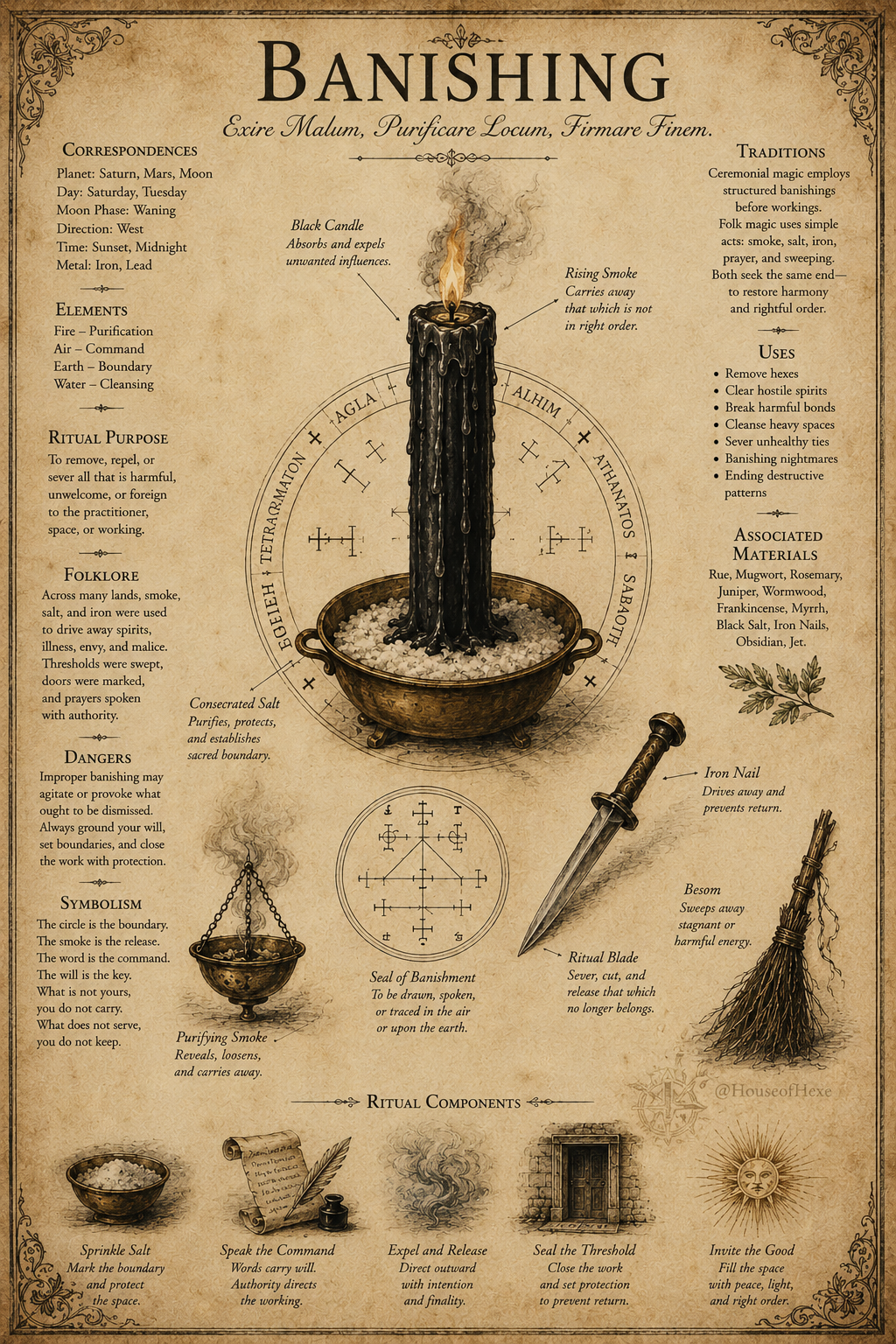
Banishing is one of the oldest and most practical rites found across magical traditions. At its core, banishing is the intentional removal of unwanted influence—whether that influence is spiritual, emotional, environmental, relational, or internal. Though often dramatized in modern occult spaces, true banishment is rarely theatrical. Traditionally, it is an act of discipline, boundary, and spiritual hygiene.
For centuries, cunning folk, priests, witches, ceremonial magicians, and household practitioners developed rites to drive out illness, malice, stagnant energy, hostile spirits, curses, intrusive thoughts, and even self-destructive patterns. Banishing remains relevant because life itself constantly introduces what does not belong.
Origins
Long before banishing was discussed in occult books or internet circles, it existed as a household necessity.
In village traditions across Ireland, Scotland, parts of Germany, and throughout Mediterranean magical systems, families maintained protective rites meant to clear illness, envy, wandering spirits, and malicious intention. Salt was cast across thresholds. Smoke was carried room to room. Iron was placed near doorways. Psalms, prayers, chants, and spoken charms were used to command departure.
In ceremonial traditions, banishing evolved into highly structured ritual systems. Sacred circles were cast, elemental quarters were addressed, divine names invoked, and spiritual space deliberately cleared before any magical working began.
In folk practice, however, banishing often remained simpler and more intimate: a broom at the threshold, smoke in the corners, herbs in the hearth, or a whispered command spoken with conviction.
Across cultures, one truth remained consistent: before something new may enter, something old must leave.
✦ ✦ ✦
Core Principles
True banishing is not fueled by fear. It is fueled by authority.
Traditional banishment works through several observed principles:
Naming - identifying what must leave
Severance - cutting energetic, spiritual, or emotional ties
Expulsion - directing the unwanted force outward
Boundary Setting - preventing return
Replacement - filling the cleared space with desired virtue
Without replacement, emptiness often invites repetition.
Banishing is not always about spirits or curses. One may banish:
Stagnation
Obsessive thought patterns
Unhealthy attachments
Lingering grief
Environmental heaviness
Malicious gossip
Spiritual intrusion
Habitual self-sabotage
At its deepest level, banishing is often a rite of sovereignty.
✦ ✦ ✦
Planetary Correspondences
Banishment is often strengthened through planetary timing and symbolic correspondence
| Planet | Traditional Virtue | Banishing Use |
|---|---|---|
| Saturn | Restriction, boundaries, endings | Severance, removal, spiritual closure |
| Mars | Force, command, defense | Breaking opposition, asserting will |
| Moon | Release, cycles, purification | Emotional clearing, endings |
Traditional Timing
Waning Moon - release, clearing, endings
Saturday - Saturnian removal work
Tuesday - Mars-driven protective force
Sunset or midnight - liminal thresholds often used for banishing rites
Elemental Correspondences
Fire - purification, transformation
Air - smoke, command, spoken authority
Earth - salt, ash, boundaries
Water - cleansing, dissolution
✦ ✦ ✦
Tools, Symbols & Traditional Materials
Many banishing workings use practical physical anchors.
Common traditional tools include:
Iron nails or blades
Black candles
Salt circles
Protective cord
Brooms or besoms
Charcoal or ritual ash
Protective sigils
Threshold oils
Common botanical allies may include:
Rue
Mugwort
Rosemary
Juniper
Wormwood
Each carries different virtues depending on tradition, temperament, and intent.
Traditional Banishing Formula
A classic working often includes:
Smoke to reveal and cleanse
Spoken command to direct removal
Salt or iron to establish boundary
Prayer, charm, or sigil to seal the rite
This combination addresses both removal and protection.
✦ ✦ ✦
How Banishing Is Practiced
A traditional banishing often begins long before smoke is lit or words are spoken. In many folk and ceremonial systems alike, the first act is physical preparation. Floors are swept. Windows are opened. Dust is cleared from neglected corners. Thresholds are examined. Objects that carry stagnant memory or unnecessary clutter are removed. Across older traditions, it was commonly observed that spiritual heaviness often settles where physical neglect has already taken root. To restore order in one often supports order in the other.
Once the space has been prepared, the ritual itself may begin. Depending on lineage, region, or personal practice, the practitioner may carry smoke from room to room, light candles or lamp flame, ring bells through the corners of the home, recite psalms or prayers, or mark doors and windows with salt, ash, protective oils, blessed water, or herbal infusions. Some traditions work clockwise to establish order, while others move toward doorways or open thresholds to actively direct unwanted influence outward. Though the tools may differ, the intention remains consistent: what does not belong must be identified, confronted, and removed.
Words hold particular weight within banishing work. In traditional practice, banishment is rarely approached as a request. It is not a negotiation, nor a plea made from fear. It is a declaration made from authority. Whether spoken aloud, whispered under breath, sung through prayer, or carried silently through focused intent, the language of banishment establishes both command and boundary.
A practitioner may speak words such as:
“What is not mine, what is not welcome, what is not in right order - leave now.”
When the removal has been completed, the rite is rarely left open. In many traditions, the final act is one of sealing, blessing, or restoration. The cleared space may be marked with oil, prayer, flame, salt, iron, or protective herbs so that what has been removed does not easily return. Peace may be invited where conflict once lingered. Clarity may be called where confusion once settled. Strength may be restored where exhaustion had taken root.
Banishing does not simply create emptiness. When practiced well, it creates rightful order.
✦ ✦ ✦
House of Hexe Perspective
At House of Hexe, banishing is not approached as an act of aggression, revenge, or spiritual theatrics. It is understood as maintenance…an essential discipline of both magical and mundane life. A home is swept before guests arrive. A blade is sharpened before it dulls beyond use. A wound is cleaned before infection has the chance to settle deeper. Spirit, body, and household deserve the same vigilance.
In our tradition, banishing is not rooted in paranoia, nor in the constant suspicion that unseen enemies are lurking behind every shadow. Rather, it is the cultivated ability to recognize when something has overstayed its rightful season. Sometimes that presence is external: a draining relationship, a disruptive influence, a home that feels heavy with conflict, or a space that no longer supports clear thought. Other times, what must be removed lives much closer.
Some of the most demanding banishments are not directed toward spirits, curses, or hostile forces at all. They are directed inward, toward the habits that quietly erode discipline, the fears that keep the voice small, and the patterns of passivity that slowly convince a person to abandon their own authority. To banish well is not simply to command something else to leave. It is to remember that sovereignty begins within.
At House of Hexe, banishing is not merely a ritual of expulsion. It is a ritual of reclamation.
Warnings & Misuse
Modern magical spaces often blur the boundaries between banishing, protection, cleansing, and malefic work, speaking of them as though they are interchangeable. Traditional practice suggests otherwise. Each carries its own virtue, purpose, and consequence. Banishing removes. Protection guards. Cleansing purifies. Hexing, by contrast, is an intentional act of directed harm or disruption. Confusing these workings can create far more spiritual noise than clarity.
One of the most common mistakes among newer practitioners is approaching banishment from a place of emotional reactivity rather than grounded intention. Anger, heartbreak, fear, and frustration can certainly fuel action, but when ritual is performed without clarity, it often removes far less than intended or removes the wrong thing entirely. In older traditions, authority mattered more than volume. The rite was not performed to feel powerful. It was performed because power was already present.
Another common error is banishing without rebuilding afterward. Nature does not tolerate emptiness for long. A cleared room will eventually be filled. An unguarded threshold will eventually be crossed. A severed pattern, if not consciously replaced, often returns wearing a different face. For this reason, traditional banishment was rarely the final act. It was followed by blessing, protection, boundary-setting, prayer, or deliberate restoration.
To remove is only half the work. To wisely decide what replaces it is where true craft begins.
Related Entries
Protection Magic
Threshold Magic
Mugwort - Materia Medica
Planetary Magic
Ritual Timing
Cleansing vs Banishing
*If links are not active…it is a future post yet to be published. Thank you for understanding!