Before the Frost
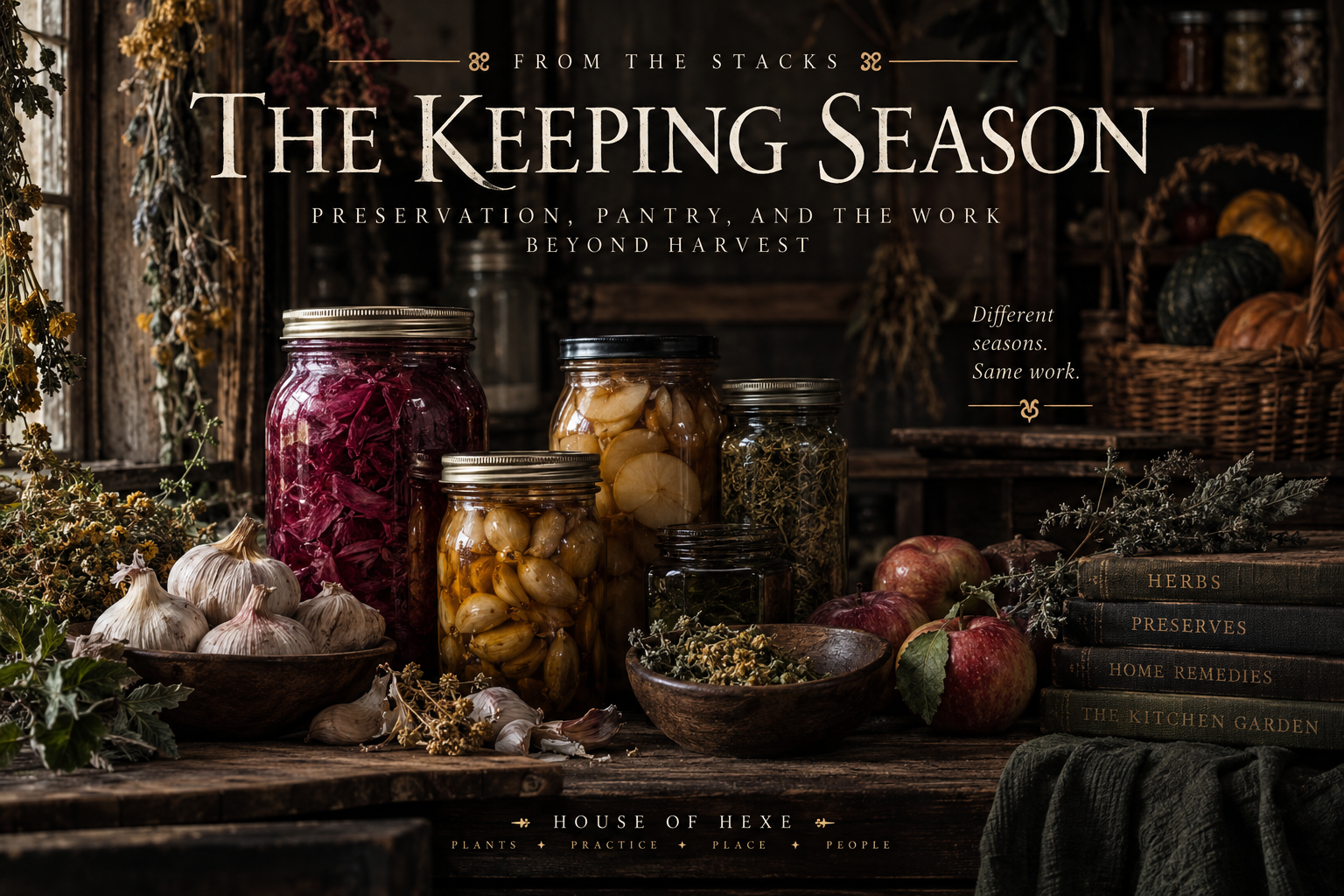
Harvest is easy to romanticize at the point of abundance. Baskets are full, fruit is heavy on the branch, herbs are hanging in bundles, grain has come out of the field, and the household appears to be surrounded by more than enough. Historically, however, gathering the harvest was only one stage in a much longer process. Food and medicine still had to be dried, cured, salted, smoked, fermented, pickled, stored, inspected, and protected well enough to remain useful after the growing season ended.
Even a successful harvest did not guarantee that a household would have enough food for the months ahead. Much of what was gathered remained highly perishable, and different foods presented different storage problems. Fruit bruised and deteriorated, grain had to be kept dry and protected from pests, root crops required suitable temperature and humidity, meat and dairy needed to be processed quickly, and medicinal plants could mold if they were stored before they were fully dry. Preserving the harvest therefore required knowledge beyond knowing when and how to gather it.
That second body of knowledge is what interests me here. Late summer and early autumn were not simply periods of gathering. They were periods of active preservation, when households had to understand how long something would keep in its fresh state, what method suited it best, and what conditions would carry it safely into winter.
Harvest Was Only the First Problem
Modern food systems make preservation feel optional in a way it was not for most households in the past. Refrigerators, freezers, commercial canning, grocery stores, and year-round access to produce allow many of us to preserve food because we enjoy the process, want to reduce waste, prefer a particular flavor, or simply have more of something than we can use immediately.
Before mechanical refrigeration became ordinary household equipment, preserving food was often far less elective. A household needed several methods because no single method suited every food. Some crops could be stored almost as they were harvested if they were kept under the right conditions, while others required moisture removal, salt, smoke, acidity, fermentation, or another form of processing before they could be stored safely.
Accounts of rural American foodways collected by the Smithsonian show this combination clearly. Cellars might contain potatoes and other storage crops alongside jars of preserved fruits and vegetables, crocks of fermenting food, dried apples and corn, and cured meat. Each method solved a different preservation problem, and several could be in use within the same household at the same time. (festival.si.edu)
The work also did not begin only when autumn arrived. Agricultural households preserved food throughout the growing season whenever enough of something became available. The Library of Congress documents drying, salting, smoking, pickling, and other methods as part of the recurring work of putting food by for later use. (blogs.loc.gov)
Autumn intensified that work because the growing season was ending. What remained in the field, garden, orchard, dairy, or herb bed had to be dealt with while it was still usable, and the household had to decide which things could be stored fresh and which needed to be transformed first.
Preservation was never a single technique. Different materials required different answers to the same problem: how to carry something useful beyond its season.
Reduce available moisture so herbs, fruits, seeds, meats, and other materials can remain usable after their fresh season has passed.
Draw out moisture, alter surface conditions, and extend the keeping life of foods that would otherwise spoil quickly.
Preserve through controlled transformation, encouraging one kind of microbial activity while making the material less hospitable to others.
Slow deterioration by managing temperature, humidity, airflow, light, and the condition of crops suited to long-term storage.
Drying
Drying is one of the oldest preservation methods because reducing available moisture makes the material less hospitable to many forms of spoilage. The basic principle is straightforward, but the actual work requires more judgment than simply leaving something out until it feels dry.
Fruit, meat, fish, seeds, culinary plants, and medicinal herbs all behave differently. Thick roots hold moisture differently from leaves. Dense flower heads can retain dampness at the center even when the outside appears dry. Humidity slows the process. Poor airflow allows moisture to linger. Strong sun can help with some materials and damage the color, volatile compounds, or quality of others.
For the household herbalist, drying is part of preparation rather than merely a waiting period between harvest and storage. Leaves need enough room for air to move around them. Roots often need to be cleaned and cut into smaller pieces so they can dry evenly. Bundles that look lovely hanging from a ceiling may be tied too thickly for the material at the center to dry properly. Flowers and aromatic herbs can lose quality when exposed to excessive heat or light.
The important point is that storage begins only after the plant material is genuinely dry enough to be stored.
Salt and Smoke
Salt became valuable in food preservation because it changes the environment available to microorganisms and helps draw moisture from food. Before refrigeration and modern canning became common, salting, drying, and smoking were among the principal methods used to extend the life of highly perishable foods.
Historic England's work on pre-industrial salt production traces organized salt manufacture in Britain back thousands of years. Salt mattered not only as a seasoning but as a preservation material for fish, meat, dairy products, and other foods that otherwise had relatively short usable lives. (historicengland.org.uk)
Smoking often worked alongside salting and drying rather than functioning as a completely separate method. Meat or fish could be salted first and then exposed to smoke while additional moisture left the food. The process altered flavor, texture, surface conditions, and keeping quality at the same time.
Preservation needs also shaped household architecture. Smokehouses, drying sheds, springhouses, granaries, cellars, storage lofts, and similar structures existed because certain kinds of preservation work benefited from specific conditions. When we look at these buildings now, they can seem picturesque, but their original purpose was practical. The household needed controlled places to dry, cool, cure, store, or protect food over time.
Fermentation
Fermentation approaches preservation differently because the material is allowed to change under conditions that favor a particular microbial process. Rather than preventing all biological activity, the method encourages one kind of transformation while making the environment less suitable for many others.
This is why fermented food should not be confused with food that has simply been left to spoil. Sauerkraut, fermented vegetables, sour dairy products, breads, beers, wines, vinegars, and many regional preparations depend upon controlled microbial activity. The methods vary according to ingredients, climate, vessels, salt levels, temperature, and local food traditions, but the underlying principle is deliberate transformation.
Historical home-preservation manuals describe vegetables packed into salt brine and allowed to ferment for later use, with lactic acid production forming part of the preserving process. (tile.loc.gov)
Fermentation is especially useful for understanding preservation because it shows that keeping something does not always mean trying to hold it in its original state. In some cases, a material becomes more stable or useful because it is allowed to become something else under controlled conditions.
Cool, Dark, and Underground
Not every food needs to be transformed before it can be kept. Roots, tubers, winter squash, onions, garlic, apples, and other storage crops can remain usable for extended periods when they are harvested carefully and kept under conditions that suit them.
Those conditions are specific rather than universal. Temperature, humidity, airflow, light, and the condition of the crop all matter. One damaged potato can rot beside healthy ones. Apples release ethylene and can affect nearby produce. Onions generally prefer drier conditions than many root vegetables. Winter squash needs proper curing before long storage, while garlic also benefits from curing before it is trimmed and put away.
Historically, households used cellars, pits, clamps, caves, springhouses, icehouses, and other naturally or artificially cool spaces to extend storage. The National Museum of American History documents the progression from underground ice pits and dedicated icehouses to household iceboxes and eventually electric refrigeration. (americanhistory.si.edu)
National Park Service material on food preservation also notes that certain vegetables could be stored in root cellars or even left in the ground under appropriate conditions through winter. (nps.gov)
These methods are a useful reminder that preservation is broader than recipes. Sometimes a material is preserved because it has been salted, fermented, or dried. In other cases, it is preserved because the household has created or chosen an environment in which deterioration happens more slowly.
The Knowledge Behind a Full Pantry
A full pantry can look like the finished stage of preservation, but stored foods still require inspection and maintenance throughout the months that follow. Jars need to be checked, roots sorted, grain protected from moisture and pests, ferments watched, and dried foods kept from reabsorbing moisture.
This work depended upon familiarity. Someone in the household had to know what normal looked like well enough to recognize the beginning of a problem. That knowledge might have come from family, neighbors, community practice, employers, household manuals, or years of observing which methods worked and which did not.
Failure was part of that education because preservation methods were never foolproof. Cellars became too damp. Grain attracted insects or rodents. Dried food took on moisture. Ferments failed. Stored produce developed rot. Containers cracked or leaked. A preservation system worked only as well as the household's ability to recognize and respond to those problems.
This is one reason I prefer to think of preservation as skilled domestic work rather than as a collection of picturesque old customs. The finished shelf is only the visible portion of a larger practice involving timing, judgment, observation, and repeated maintenance.
Medicine Had to Survive the Season Too
Medicinal plants presented the same seasonal problem as food. Most plants are not available fresh throughout the year, so a plant gathered in summer or autumn had to be processed in some way if the household expected to use it later.
Leaves and flowers could be dried. Roots could be cleaned, cut, and dried for storage. Some herbs were combined with honey or vinegar. Others were incorporated into fermented preparations or other forms that extended their usefulness beyond the fresh plant.
The household apothecary therefore shared much of the same logic as the pantry. Both were concerned with taking something available now and preparing it for a time when it would no longer be readily available.
For the modern herbalist, the urgency has changed but the skill remains relevant. Knowing how to harvest a plant responsibly is only part of knowing how to work with it. We also need to understand what happens after it comes inside: how it should be cleaned, whether it needs to be cut before drying, how much moisture can remain, what kind of container is appropriate, how it should be labeled, and what signs indicate that its quality has deteriorated.
A home apothecary depends on storage knowledge just as much as it depends on plant identification.
The Keeping Season
This is the side of autumn I want to spend more time with this year. Harvest imagery usually centers on abundance itself, but the practical work surrounding that abundance is just as important. Garlic cures before it is trimmed and stored. Roots are sorted before they go into a cellar. Herbs are tested before they are sealed in jars. Seeds are dried before they are packed away. Ferments are watched while they continue to change in their vessels.
Preservation is not a single practice but a group of skills developed around the same recurring problem: useful materials are often available for a shorter period than we need them. Different households answered that problem differently according to climate, culture, class, architecture, available materials, and the foods and medicines they were trying to preserve.
Drying suited one material. Fermentation suited another. Cool storage might be enough for a third. The method changed, but the underlying work remained the same: understanding what had been gathered well enough to know how to keep it usable after its season had passed.
That is the part of harvest that often gets left out when autumn is reduced to abundance alone. A full basket was valuable, but it was preservation knowledge that determined how much of that basket would still be useful months later.
The public article follows the practical work of preservation. September's Patron study goes further into the craft behind it: containment, transformation, fermentation, vessels, storage, and the magical possibilities of keeping. It looks at how technologies made for carrying food and medicine beyond their season can also be understood and worked with inside magical practice.
Enter the Patron Library →Historical foodways, preservation manuals, museum collections, and public-history resources consulted in the preparation of this article.