Divination
The ancient practice of perceiving meaning through symbol, omen, spirit, pattern, and the unseen currents moving beneath ordinary life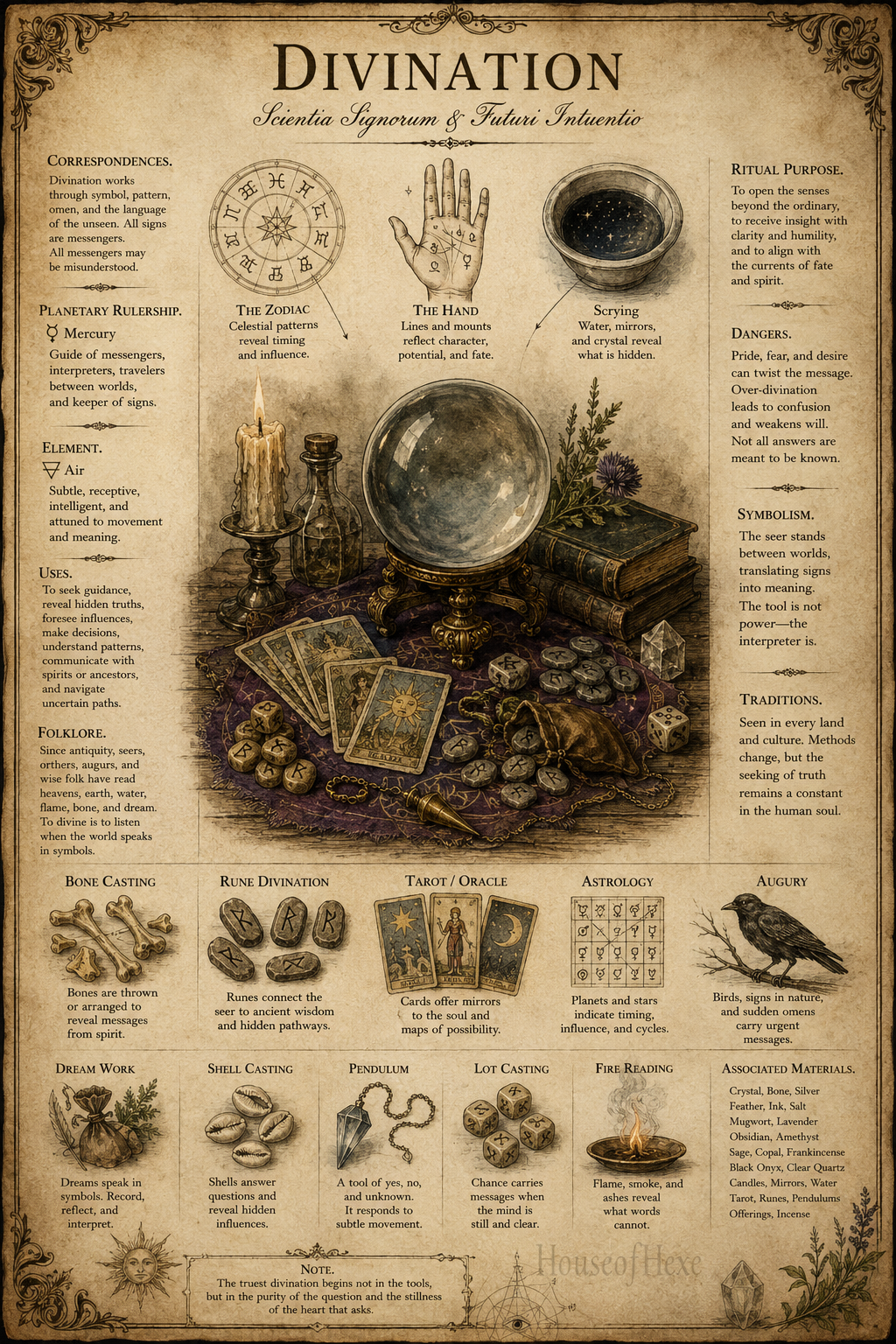
Divination is among humanity’s oldest spiritual technologies.
Long before clocks divided the day, before contracts governed exchange, before laboratories attempted to isolate mystery into measurable parts, human beings watched the world around them for signs. They studied birds in flight, cracks in bone, smoke rising from flame, dreams that lingered too long, and stars that moved with unnerving consistency. What modern people often dismiss as superstition once stood at the very center of survival.
To divine was not originally an act of entertainment, nor was it separate from medicine, agriculture, warfare, governance, or religion. A farmer watched the sky not only for rain, but for favor. A midwife noted unusual omens during labor. A ruler delayed battle because birds flew against expectation. A village healer cast lots before prescribing herbs. Across cultures, divination was woven directly into the mechanics of decision-making.
The word divination stems from the Latin divinare—to foresee, to be inspired by the divine, to predict. Yet the practice itself reaches far older than language alone can account for. Across continents and civilizations, systems emerged independently, each shaped by land, necessity, cosmology, ancestors, and lived observation.
Divination, then, is not a single system.
It is a language family.
At its core lies one enduring question:
How does the unseen speak?
✦ ✦ ✦
Origins
Archaeological evidence suggests that divinatory behavior stretches back thousands of years.
Marked bones discovered in ancient burial sites, cracked turtle shells from early East Asian oracle systems, ritual casting tools recovered across Europe and Africa, and trance practices preserved through oral lineages all point toward the same truth: humanity’s relationship with omen-reading is nearly as old as organized ritual itself.
In early Chinese systems, heated bones and shells were cracked and interpreted for matters of war, harvest, weather, and succession. Questions and interpretations were often recorded, creating some of the earliest surviving divinatory archives.
In the ancient Mediterranean, priests and state officials studied thunder, animal behavior, celestial movements, and the flight patterns of birds before political or military action. These interpretations were not symbolic hobbies. They shaped policy.
Among northern European peoples, carved lots, symbolic markings, and rune systems carried both practical and mystical meaning. In many cultures, the same symbols used for writing also served in spellcraft, oath-making, and omen work.
Across West Africa, the Americas, Central Asia, and the Middle East, equally sophisticated systems emerged through shells, chains, stars, trance, ancestral contact, and land-based observation.
The methods changed.
The hunger for understanding did not.
✦ ✦ ✦
Core Principles
Though systems vary widely, most forms of divination rest upon several shared principles:
Correspondence
Symbols carry layered meaning. Animals, numbers, colors, weather, celestial bodies, directions, and objects often develop significance through repeated cultural observation.
Pattern
One event means little on its own.
Repetition creates significance.
A single crow may mean nothing. Three appearing before major conflict begins to invite attention.
Relationship
The practitioner is never separate from the reading. Mood, bias, preparation, emotional state, ritual cleanliness, and spiritual condition all influence interpretation.
Interpretation
Signs rarely speak in plain language.
Meaning emerges through study, intuition, comparison, folklore, and lived experience.
This is why two skilled practitioners may witness the same omen and arrive at different—yet internally coherent—conclusions.
Divination is not always prediction.
Often, it is diagnosis.
Sometimes, it is warning.
Occasionally, it is confrontation.
✦ ✦ ✦
Common Systems of Divination
Modern students often encounter cards first, particularly through tarot or oracle decks. While accessible, these represent only one branch of a far older tree.
Common systems include:
Runes - carved symbols drawn or cast for interpretation
Cleromancy - chance-based casting systems involving stones, lots, dice, or marked objects
Bibliomancy - seeking messages through sacred, poetic, or randomly opened texts
Scrying - visionary interpretation through mirrors, water, smoke, crystal, or flame
Osteomancy - reading bone patterns, spirit movement, or ancestral symbolism
Pyromancy - interpreting flame movement, ash behavior, smoke, and crackling sounds
Astrological Divination - interpreting celestial movement and planetary timing
Necromantic Divination - communication with the dead, ancestors, or spirit intelligences
Historically, many practitioners worked with multiple systems side by side.
Bones might reveal spirit influence.
Smoke might reveal timing.
Stars might reveal the longer road.
The tools changed.
The conversation remained.
✦ ✦ ✦
Folk, Baneful, and Scorned Practices
Not all forms of divination were welcomed equally, nor were all practitioners granted the same social safety in their work. Systems that touched death, blood, warfare, illness, curses, or spirits of uncertain reputation often carried a darker public reputation, not necessarily because they were considered ineffective, but because they forced people to confront parts of life most would rather keep hidden. Historical records describe diviners who studied sacrificial organs, interpreted blood patterns, worked with grave earth, observed battlefield remains, handled the belongings of enemies, or sought meaning through the dreams of the recently bereaved. To modern eyes these methods may appear severe, even unsettling, yet within their original cultural settings they were often approached with the same seriousness one might reserve for medicine, law, or spiritual counsel.
A village healer may have watched the way smoke moved above a fevered child before deciding which herbs to prepare. A soldier might have carried marked bones into battle, seeking not comfort, but clarity. A widow may have left offerings at a grave and waited for answers to arrive through dream. A curse worker may have turned to divination not to ask what the future held, but to determine whether justice had finally found its mark. Practices such as these were frequently condemned by outsiders, though rarely because they lacked meaning to those who used them. More often, they were feared because they operated beyond sanctioned institutions, outside temples, courts, or systems of approved authority. History is full of practices first labeled dangerous… and later quietly absorbed into the very traditions that once condemned them.
Timing, Harvesting & Preparation
Divination becomes dangerous when symbols are treated as unquestionable authority rather than sources of insight. A reading can illuminate hidden patterns, sharpen perception, and reveal blind spots that might otherwise go unnoticed. Yet without discipline, self-awareness, and honest interpretation, the same tools can easily become vehicles for projection, obsession, dependency, or manipulation. A practitioner may ask the same question repeatedly until a desired answer appears, avoid necessary action by waiting for signs, project fear into neutral symbols, or mistake emotional intensity for spiritual certainty. The tools themselves are not inherently deceptive.
The reader, however, can be.
✦ ✦ ✦
Misuse, Distortion, and False Certainty
Divination becomes dangerous when symbols are treated as unquestionable authority rather than sources of insight. A reading can illuminate hidden patterns, sharpen perception, and reveal blind spots that might otherwise go unnoticed. Yet without discipline, self-awareness, and honest interpretation, the same tools can easily become vehicles for projection, obsession, dependency, or manipulation. A practitioner may ask the same question repeatedly until a desired answer appears, avoid necessary action by waiting for signs, project fear into neutral symbols, or mistake emotional intensity for spiritual certainty. The tools themselves are not inherently deceptive.
The reader, however, can be.
House of Hexe Perspective
At House of Hexe, divination is approached as a craft of relationship rather than performance. A reading is not meant to exist as spectacle, aesthetic identity, or a shortcut to certainty. It is a long discipline built through pattern recognition, symbolic literacy, historical study, and the willingness to confront honestly what rises to meet you, whether that answer is comforting or not. Over time, a practitioner begins to understand that divination is rarely about receiving instant clarity. More often, it is about learning how meaning reveals itself through repetition, context, and lived experience.
I teach students to document their work. Record the moon phase. Note the symbols that appear. Track the questions being asked, the emotional state surrounding the reading, and what unfolds afterward in ordinary life. Study folklore beside personal experience. Compare what tradition says with what reality confirms. If a raven appears once, it may be coincidence. If it appears every time you prepare for conflict, negotiation, or difficult conversation, it becomes something worth studying. In my experience, the strongest diviners are rarely the loudest or the most theatrical. They are the ones who have learned to watch carefully, record honestly, and remain in relationship with the symbols long enough for meaning to reveal itself.
✦ ✦ ✦
Warnings & Misuse
Divination can sharpen perception.
It can also distort judgment when approached through fear, desperation, intoxication, obsession, or unresolved projection.
Do not confuse urgency with accuracy.
Do not assume every coincidence is a message.
Do not allow symbolic systems to replace medicine, law, practical safety, or honest communication where those are required.
And perhaps most importantly—
not every silence means no answer.
Sometimes the answer is simply:
Not yet.
✦ ✦ ✦
Related Entries
Divining Tools
Crossroads
Binding
Charm Bags
Offerings
Spirit Work
Ancestor Veneration
Astrological Herbalism
Oaths & Pacts
*If links are not active…it is a future post yet to be published. Thank you for understanding!