Crossroads
Where paths meet, bargains are spoken, spirits are fed, and choices carry consequence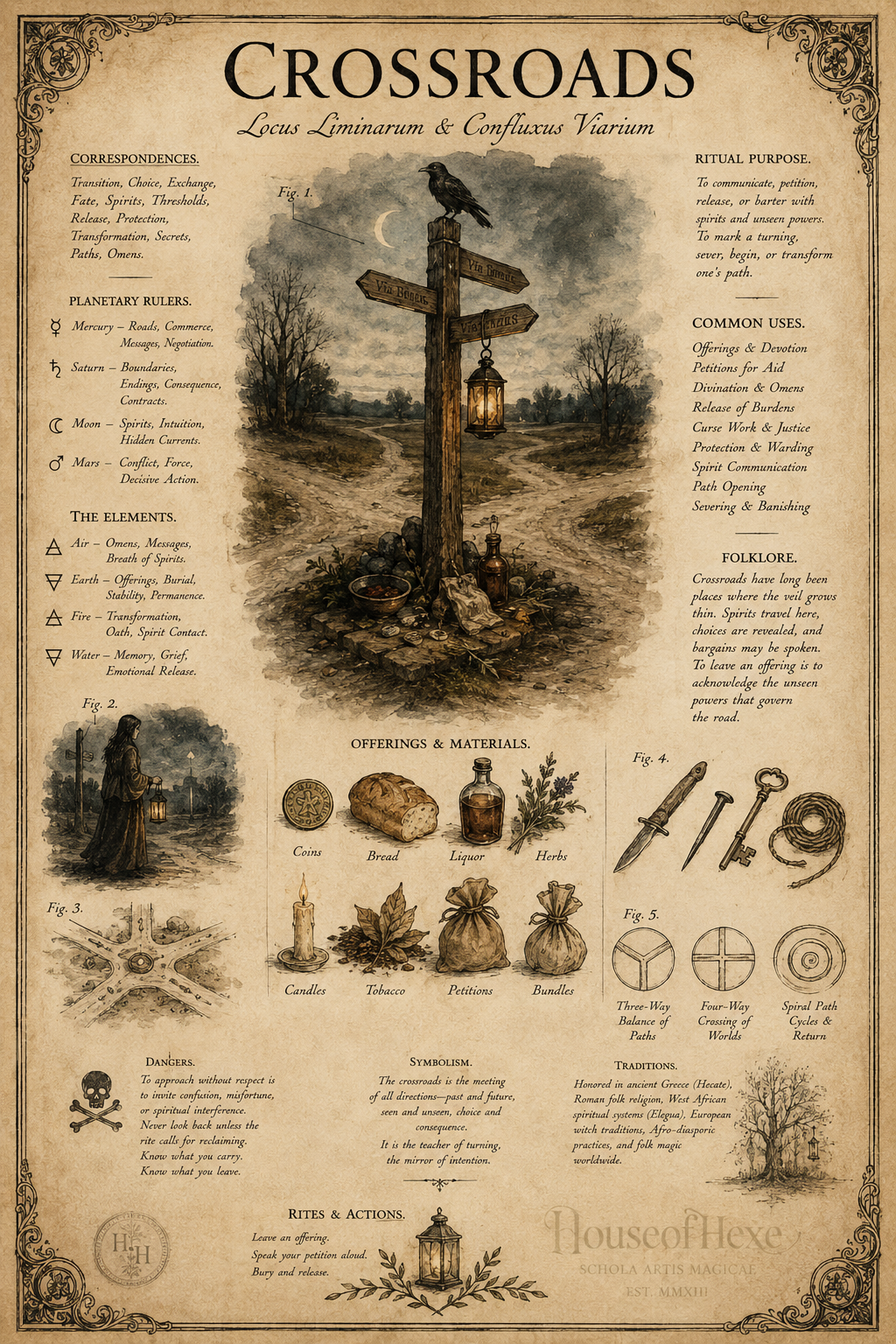
Among older systems of magical practice, few symbols appear as consistently…and as mysteriously…as the crossroads. Found in folk magic, spirit work, funerary customs, divination, sorcery, and rites of transformation, the crossroads has long been understood as a place where boundaries soften and ordinary rules grow thin. It is not merely a road intersection, but a liminal territory where choices become visible, bargains may be made, burdens may be discarded, and powers otherwise hidden are sometimes approached.
Across continents and centuries, practitioners, healers, witches, priests, and those working outside respectable religion have returned to crossroads for one simple reason: places where worlds overlap have always been considered useful.
Origins
Before crossroads became a symbol in books, films, or popular occult culture, they were practical realities. A road that split in multiple directions forced decision, and with decision came uncertainty. In agricultural societies, where roads were often rough trails through forest, marsh, or open field, an intersection represented more than geography. It represented risk, opportunity, trade, danger, and the unknown.
Because of this, crossroads gradually became associated with spirits who governed movement, fate, commerce, death, and transition. In the ancient Mediterranean world, offerings were left at crossroads to deities who oversaw boundaries and unseen traffic. One of the most well-known examples is Hecate, whose shrines often stood at three-way intersections, where food, flame, and prayer were offered to secure protection or favor.
In the Roman world, the household and the road were deeply linked, and spirits connected to boundaries and travel were routinely honored. Across West African spiritual systems and later African diasporic traditions, crossroads also became associated with spirits who governed communication, translation, pathways, and access between worlds. Figures such as Elegua, though often misunderstood in modern occult circles, hold profound connections to roads, doors, opportunity, and consequence.
In European folk practice, crossroads acquired additional associations with witches, criminals, suicides, oath breakers, and those considered spiritually dangerous or socially outside accepted norms. Some communities buried the condemned at crossroads, not always from cruelty, but from the belief that a divided road confused wandering spirits and prevented return.
Thus the crossroads became not only a place of beginning, but sometimes a place of ending.
Core Principles
At its heart, the crossroads represents liminality.
A liminal space is any place, state, or moment that exists between what was and what comes next. The crossroads is one of the oldest physical expressions of this concept.
Traditional virtues of crossroads work include:
Choice - the act of selecting a path with intention
Exchange - offerings, bargains, vows, and spiritual contracts
Release - discarding burdens, sickness, curses, grief, or old identities
Communication - speaking with spirits, ancestors, guides, or forces of fate
Transformation - stepping from one condition into another
Boundary Work - recognizing where one path ends and another begins
In many traditions, what is left at a crossroads is not always meant to be reclaimed. This is an important symbolic principle. To leave something at a crossroads often means one has surrendered ownership.
Whether that object is an offering, a burden, a petition, or a working depends entirely on tradition, intention, and context.
Spirits, Offerings, and Exchanges
Crossroads have historically been treated as places of negotiation.
Practitioners may leave:
Coins
Bread
Tobacco
Rum or whiskey
Oil lamps or candles
Flowers
Animal offerings in older traditions
Written petitions
Bundles of herbs
Ashes, dirt, bones, or symbolic objects
In some rites, the offering is not meant to "buy" power, but to establish relationship. Exchange has always been part of magical worldview. If one seeks assistance, guidance, protection, or knowledge, one may approach with respect rather than entitlement.
Other traditions use the crossroads for disposal. Illness bundles, cleansing baths, curse remains, broken ritual tools, and other spiritually charged materials were often carried away from the home and left where roads divide, symbolically handing them back to the land, the spirits, or fate itself.
Baneful and Otherwise Scorned Workings
Not all crossroads work is gentle, and historically, it was never meant to be.
In many systems of folk magic, the crossroads has been used for rites involving justice, punishment, confusion, domination, severing, and spiritual displacement. Powdered materials might be buried where a target would walk. Petition papers may be split, nailed, burned, or buried to fracture a bond or scatter influence.
Curses, bindings, foot track magic, spirit deployment, and enemy confusion rites have all historically appeared in crossroads traditions. Nails, thorn branches, black thread, graveyard dirt, sulfuric herbs, broken mirrors, ash, and iron are among the materials that appear in older records.
In some traditions, the practitioner walks away without looking back. In others, silence is required until sunrise. Some require offerings to spirits who govern the road so that what is released stays released.
These practices were rarely viewed as "evil" within their original cultural settings. More often, they were understood as tools of survival, justice, retaliation, or necessary correction.
Like all powerful rites, their meaning depended on circumstance, worldview, and the one carrying them out.
Planetary & Elemental Correspondences
Though not every tradition assigns planetary rulerships to crossroads, occult systems often observe the following:
| Force | Traditional Virtue |
|---|---|
| Mercury | Roads, messages, movement, negotiation |
| Saturn | Boundaries, endings, contracts, judgment |
| Moon | Spirits, dreams, unseen currents |
| Mars | Conflict, protection, aggressive workings |
Common Elemental Correspondences
How It Is Practiced
Traditional crossroads work varies widely, but certain patterns appear again and again.
A practitioner may approach at dawn, midnight, or during a specific lunar phase. Some arrive alone, carrying a lantern or candle. Others bring offerings wrapped in cloth, bundled herbs, or petition papers marked with symbols, names, prayers, or charms.
The rite may involve:
Standing in silence and listening
Speaking aloud a vow or petition
Burying or leaving an object
Turning in each direction before choosing one
Calling upon a spirit, ancestor, or deity
Walking away without looking back
What matters is not performance, but understanding the symbolic logic beneath the action.
To approach a crossroads is to admit that something is changing.
House of Hexe Perspective
At House of Hexe, the crossroads is approached as one of the oldest classrooms in magical tradition.
It teaches choice, consequence, timing, and the uncomfortable truth that not every path remains open forever. Some roads call for devotion. Some call for surrender. Some ask whether the practitioner is truly prepared for what they claim to seek.
Crossroads work is not approached here as aesthetic rebellion, spooky performance, or theatrical spirit summoning.
It is approached as relationship with land, with spirit, with history, and with the parts of ourselves that emerge only when no one else is standing beside us.
Warnings & Misuse
Modern occult culture often romanticizes crossroads work while stripping it of context.
Offerings are left without understanding local ecology. Spirits are invoked without cultural literacy. Baneful workings are either sensationalized for attention or censored so aggressively that students never learn why such practices existed at all.
Tradition suggests something far less dramatic and far more mature.
Know where you are. Know what you are leaving. Know what tradition you are borrowing from. And perhaps most importantly…know whether you are seeking transformation…or simply entertainment.
The crossroads tends to reveal the difference.
Related Entries
Crossings & Thresholds
Hecate
Graveyard Work
Banishing
Spirit Offerings
Divination
Materia Medica: Mugwort
*If links are not active…it is a future post yet to be published. Thank you for understanding!