Devotion
The disciplined act of giving attention, offering, reverence, and repeated care to a spirit, deity, ancestor, land, virtue, practice, or sacred relationship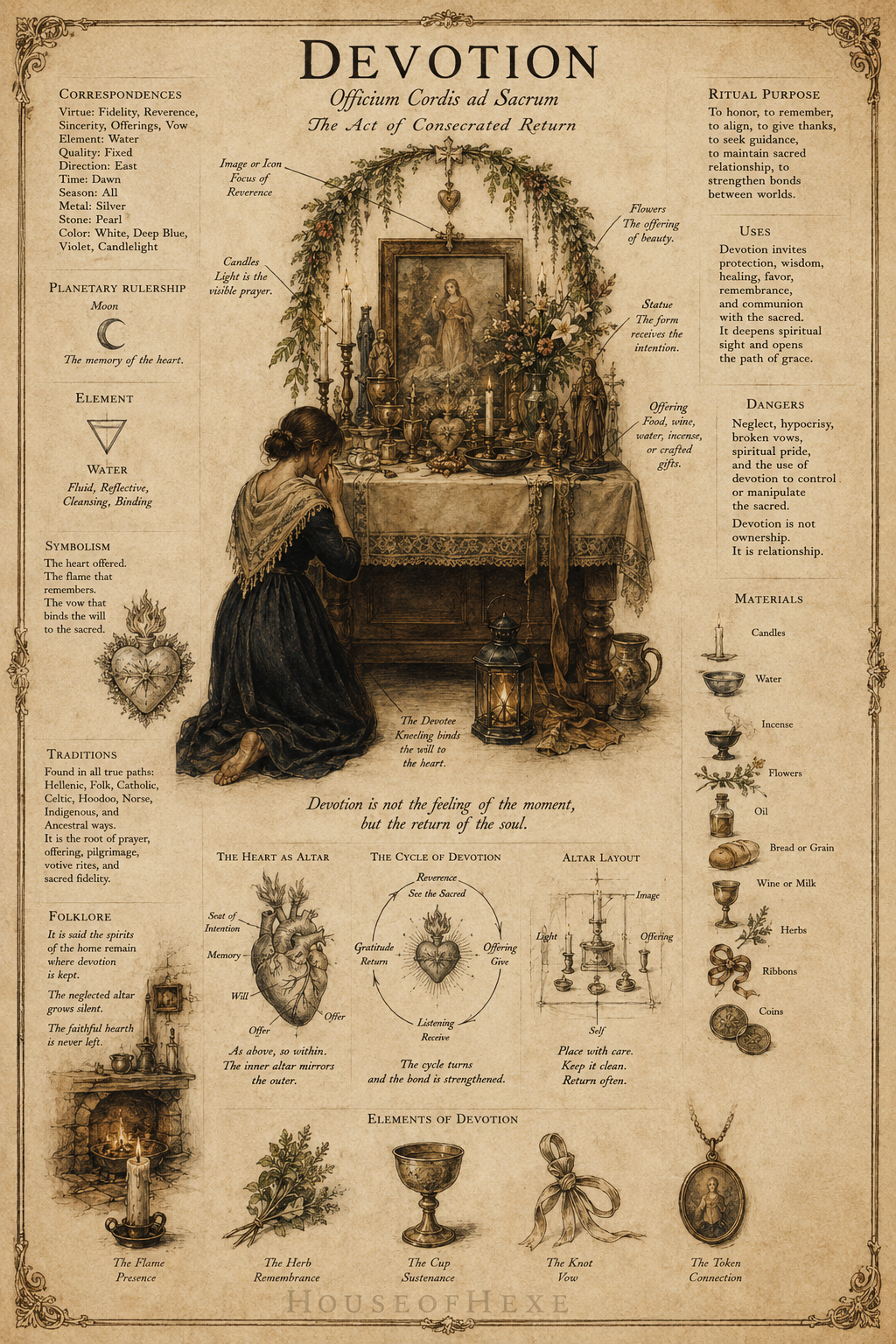
Devotion is one of the oldest currents beneath religious, magical, and folk practice. Before it became associated with formal worship, church language, or sentimental spirituality, devotion was an act of maintenance. It was the tending of fire, the laying of offerings, the speaking of names, the keeping of vows, and the daily return to what a person considered worthy of reverence.
In magical practice, devotion is not merely belief. It is relationship made visible through repeated action. A candle lit each morning, water poured for the dead, bread left for household spirits, prayers whispered before work, hands washed before touching sacred tools, the same path walked to the same tree at the same season year after year. These acts may appear small from the outside, but devotion has never depended on spectacle. It depends on return.
Historically, devotion mattered because humans understood that relationship required tending. Spirits were honored because they were part of the living order. Ancestors were remembered because memory was a form of continuity. Gods were approached with offerings because power was not treated casually. The land was fed, thanked, feared, and negotiated with because survival depended upon remaining in right relationship with it.
Modern spirituality often misunderstands devotion as emotional intensity. It assumes devotion must feel beautiful, inspired, dramatic, or certain. Traditional devotion is far older and more grounded than that. It is not proven by constant ecstasy. It is proven by consistency, humility, attention, and the willingness to keep showing up when the feeling has gone quiet.
✦ ✦ ✦
Origins
The word devotion comes from the Latin devotio, meaning a vow, dedication, consecration, or act of solemn commitment. In Roman religious life, devotion carried the weight of obligation and sacred duty. It was not only affection for the divine, but a binding of oneself toward a power, purpose, or rite.
Yet the practice itself is much older than the Latin word. Across the ancient world, devotion appeared wherever humans formed relationships with forces beyond ordinary control. Household gods received daily offerings. Ancestors were fed and remembered. Sacred fires were tended. Shrines stood at roadsides, wells, doorways, hearths, graveyards, groves, mountains, and springs.
Devotion arose from the understanding that the unseen world was not abstract. It was near. It lived in the house, beneath the threshold, in the bones of the dead, in the fertility of the field, in illness, weather, birth, luck, dreams, and protection. To live well required attention to these relationships.
✦ ✦ ✦
Core Principles
At its center, devotion is built on relationship. It is not the same as worship in every tradition, nor does it always require a deity. A person may be devoted to ancestors, spirits, land, saints, gods, virtues, the dead, the hearth, a craft, a lineage, or a sacred discipline.
Devotion also depends on repetition. One grand ritual does not build what steady tending builds. The old arts understand this well. Power gathers through repeated contact. Meaning deepens through return. A shrine becomes alive because it is visited. A prayer becomes worn smooth because it is spoken. A relationship becomes real because it is maintained.
The third principle is reciprocity. Traditional devotion is rarely one-sided. Offerings are given. Protection is requested. Guidance is sought. Gratitude is shown. Boundaries are honored. The practitioner does not approach the unseen as a vending machine, nor as a servant class of spirits waiting to fulfill desire. Devotion teaches proportion, patience, and respect.
✦ ✦ ✦
Devotion in Religious, Magical, and Folk Practice
In formal religion, devotion often appears as prayer, pilgrimage, fasting, feast days, liturgy, hymn, icon, vigil, and sacred observance. These practices train the body and mind to return to the holy through rhythm. The calendar itself becomes a devotional instrument.
In folk magic, devotion is often quieter and more domestic. It may look like feeding the ancestors, keeping a candle at the hearth, leaving milk or bread for household spirits, washing the threshold, tending a grave, or speaking to a saint before beginning a working. These acts belong to the lived religion of ordinary people as much as to ceremonial systems.
In witchcraft, devotion can become the root system beneath magical power. A practitioner devoted to the land learns its omens. A practitioner devoted to the dead learns the weight of memory. A practitioner devoted to a spirit learns the difference between contact and fantasy. Devotion disciplines the ego because it requires listening as much as asking.
✦ ✦ ✦
Devotion Without Dogma
Devotion does not require blind obedience. It does not require surrendering discernment, abandoning reason, or accepting another person’s authority over your spiritual life. Traditional devotion can be deeply reverent without becoming dogmatic.
This matters because many modern practitioners carry wounds from religious control. They hear the word devotion and imagine submission, guilt, punishment, or hierarchy. Those histories should not be dismissed. But devotion itself is older and wider than institutional fear.
A witch may practice devotion as relationship rather than obedience. A folk practitioner may honor a saint without belonging to a church. An herbalist may be devoted to plant spirits through study, cultivation, harvest ethics, and careful medicine-making. A person may be devoted to truth, justice, beauty, protection, healing, or the dead without turning that devotion into a cage.
✦ ✦ ✦
Misuse, Distortion, and False Certainty
Modern spirituality often distorts devotion in two opposing directions. One reduces it to aesthetics: a pretty altar, a candle photo, a dramatic caption, a spiritual identity performed for public recognition. The other turns devotion into dependency, where every decision must be confirmed by a deity, spirit, card pull, sign, or omen.
Neither is mature devotion.
Devotion can also become spiritual ego. A practitioner may begin to believe that their relationship with a deity, spirit, ancestor, or tradition makes them inherently superior, specially chosen, or beyond correction. This is one of the oldest traps in spiritual work. Contact does not equal mastery. Feeling called does not equal being trained. Reverence does not remove the need for humility.
False certainty is another danger. Devotion should deepen discernment, not replace it. A sincere practitioner must be willing to ask whether they are receiving guidance, projecting desire, repeating fear, or dressing impulse in sacred language.
✦ ✦ ✦
House of Hexe Perspective
At House of Hexe, devotion is treated as a discipline of return.
I do not view devotion as performance, and I do not teach it as emotional display. Devotion is not proven by how loudly someone claims a deity, how elaborate their altar looks, or how often they announce their spiritual relationships. It is proven in the quiet things: the kept promise, the clean shrine, the studied history, the respectful offering, the willingness to listen before asking.
For students, devotion is often where the work becomes real. It asks them to move beyond collecting tools, names, correspondences, and rituals. It asks them to form relationship with what they claim to honor. That may be an ancestor, a plant, a spirit, a god, a place, or the craft itself.
The House approach is simple: do not rush devotion. Observe first. Learn the history. Build slowly. Offer cleanly. Keep your word. Do not make vows because you are emotional. Do not promise what you cannot maintain. Devotion is not a costume placed over longing. It is a root system, and root systems take time.
✦ ✦ ✦
Warnings & Misuse
Devotion should not replace common sense, medical care, legal action, therapy, boundaries, or material responsibility. Sacred relationship may support life, but it should not become an excuse to abandon the ordinary duties that keep a person stable and whole.
Be cautious with vows. A vow made in grief, desperation, fear, intoxication, obsession, or spiritual excitement can become a burden once the mood has passed. Traditional cultures treated vows seriously for a reason. Words spoken before powers are not decoration.
Be equally cautious of anyone who claims authority over your devotion. Teachers may guide. Traditions may instruct. Elders may correct. But no one should use devotion to control your money, body, relationships, fear, or access to the sacred.
✦ ✦ ✦
Related Entries
Altar
Ancestor Work
Offerings
Prayer
Ritual
Spirit Work
Household Spirits
Vows
Consecration
Saints
The Hearth
*If links are not active…it is a future post yet to be published. Thank you for understanding!