Charm Bags
Portable vessels of intention, protection, and old-world sympathetic craft.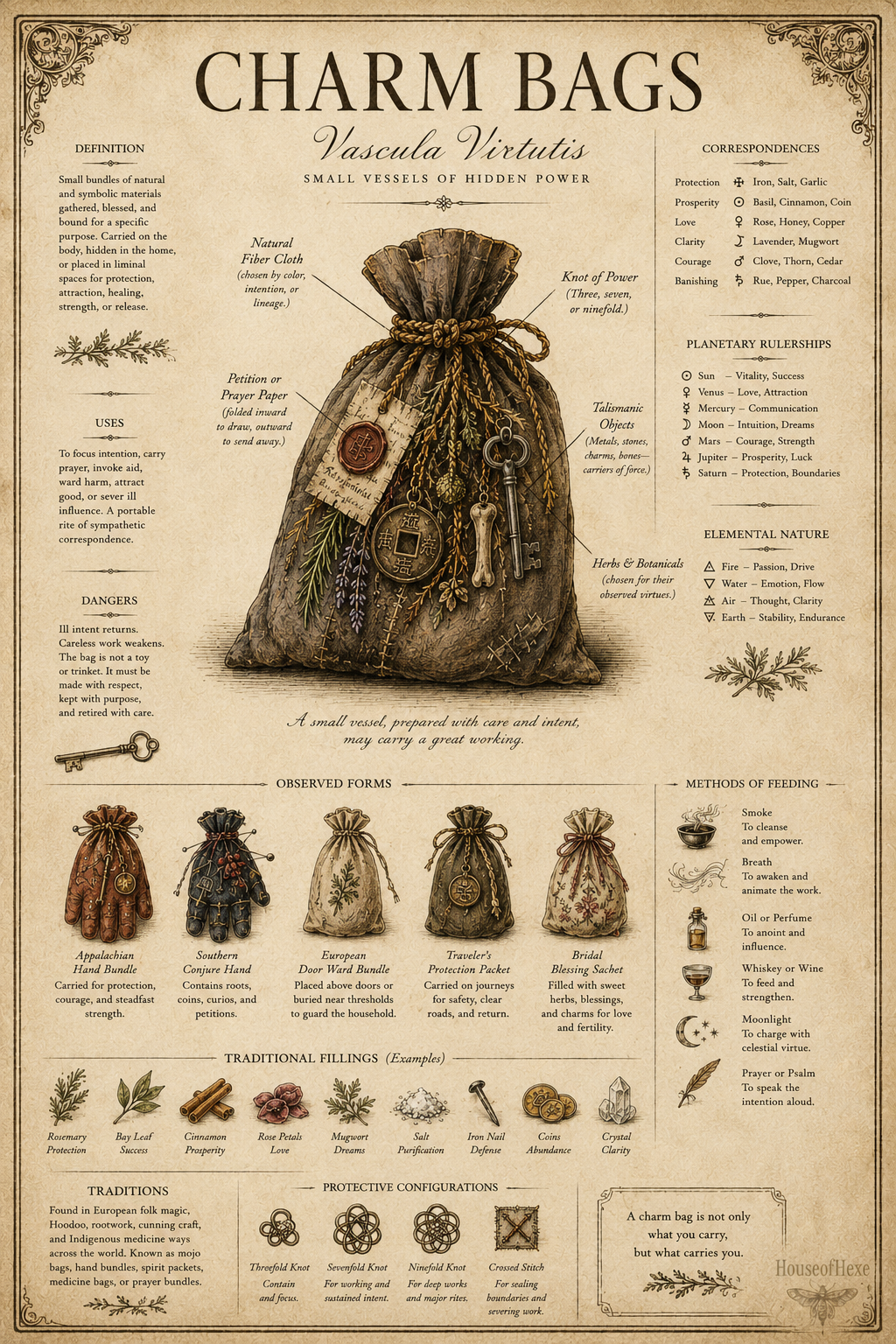
Among the oldest ritual tools still carried into modern practice, few are as quietly enduring as the charm bag. Small enough to disappear into a pocket, hang from a doorway, rest beneath a pillow, or remain hidden inside the folds of clothing, these modest bundles have traveled through centuries of folk practice carrying prayers, protections, petitions, blessings, and sometimes warnings.
Charm bags have appeared under many names depending on land, lineage, and language. Some traditions call them spirit bundles. Others know them as medicine bags, hand bundles, root bags, prayer packets, or conjure hands. The names may change, the ingredients may differ, and the rites surrounding them may shift with culture, but the heart of the practice remains remarkably consistent. Human beings have always sought ways to carry their intentions with them.
What makes charm bags endure is not complexity. It is intimacy. A charm bag asks a practitioner to gather physical materials that reflect an unseen goal, to bind them together with purpose, and then to live in relationship with that working. In this way, the bag becomes more than cloth and contents. It becomes a compact act of will, memory, and correspondence.
✦ ✦ ✦
Table of Contents
✦ ✦ ✦
origins
Before specialized ritual tools were sold in curated boxes or displayed on altar shelves, people worked with what was close at hand. A square of cloth cut from an old garment. A piece of cord. A few seeds from the kitchen. A protective root pulled from the garden. A nail from a doorway. A whispered prayer folded into paper and tied shut before dawn.
These were not aesthetic objects. They were practical acts of spiritual labor.
Across Europe, small protective bundles were tucked into cradles, stitched into hems, hidden in roof beams, or buried near thresholds to guard the household from illness, ill fortune, wandering spirits, or the envy of neighbors. In parts of the American South, practitioners of conjure and rootwork developed the mojo hand, often made of flannel and filled with roots, coins, lodestones, bones, herbs, and petitions prepared according to the needs of the client or worker. In many Indigenous traditions across the world, sacred bundles carried medicinal, ancestral, or ceremonial significance, though these are deeply cultural practices and not things to be copied without understanding their context, lineage, and responsibility.
Despite differences in form, the magical philosophy is surprisingly universal. What is gathered with purpose may hold purpose. What is bound together physically may also be bound together spiritually.
This is one of the oldest forms of sympathetic magic still practiced today.
✦ ✦ ✦
COre principles
Charm bags are based in systems of correspondence, sympathy, and relationship. While modern books may reduce them to ingredient lists, traditional practice suggests something much deeper is taking place.
At their foundation, charm bags often operate through several core ideas:
Like attracts like
Materials are selected because their observed nature mirrors the desired outcome. Thorns defend. Coins draw wealth. Sweet herbs attract affection. Salt preserves and protects.Containment strengthens focus
When ingredients are gathered into a defined vessel, their symbolic virtues are directed toward a singular purpose rather than scattered intention.Matter carries memory
Roots, stones, bones, metals, herbs, and cloth are often chosen not only for correspondence, but for history. Where was it gathered? Who carried it before you? What season birthed it? What labor brought it here?The worker animates the tool
A charm bag is rarely considered complete once tied shut. Breath, spoken petition, prayer, smoke, oiling, song, knotting, or ritual feeding may all be used to awaken the working.
This is where many beginners misunderstand the craft.
The power is not only in what goes into the bag.
The power lives in the relationship built around it.
✦ ✦ ✦
Traditional Correspondences
Though systems vary widely between traditions, certain correspondences appear repeatedly throughout folk magic, ceremonial work, and domestic witchcraft.
Common Intentions and Materials
| Purpose | Common Materials | Traditional Virtue |
|---|---|---|
| Protection | Salt, iron, rosemary, garlic, black thread | Boundary, defense, stability |
| Prosperity | Cinnamon, basil, coins, bay leaf, lodestone | Drawing, expansion, increase |
| Love | Rose, damiana, honey, copper, red cloth | Attraction, affection, magnetism |
| Clarity | Lavender, mugwort, clear quartz | Insight, dreams, perception |
| Courage | Cedar, thorn, clove, iron nail | Strength, endurance, action |
| Banishing | Rue, black pepper, charcoal, sulfuric herbs | Restriction, severing, removal |
Color may also influence the working:
White for blessing, purification, spirit work, and peace
Red for vitality, passion, courage, and blood memory
Green for growth, prosperity, fertility, and abundance
Black for protection, boundaries, concealment, and banishing
Blue for truth, sleep, dream work, and emotional calm
Planetary timing may also shape the construction of a bag. A Friday working may be chosen for attraction, beauty, or love. A Saturday working may favor boundaries, banishing, protection, or ancestral rites. A Wednesday may support communication, commerce, and road opening.
Timing does not replace skill, but it can strengthen alignment.
✦ ✦ ✦
Baneful and Defensive Applications
Much of modern magical publishing presents charm bags as soft tools. Protection, love, prosperity, peace, sleep, beauty. While these are certainly common applications, historical practice reveals a much broader range of use. Across folk traditions, cunning craft, conjure, and household sorcery, small bundles were also created for defensive pressure, boundary enforcement, justice, and forms of magical aggression.
In some traditions, a charm bag was carried not to attract something, but to keep something away. Ill intention. Envy. Gossip. Malicious spirits. Harmful neighbors. Dangerous lovers. Predatory employers. In these cases, the bag functioned less as a blessing and more as a ward with teeth.
Certain workings were constructed to create confusion in an aggressor, to expose lies, to sour unwanted influence, or to return persistent hostility back toward its source. Others were built for binding. Not necessarily punishment, but restriction. To slow harmful action. To tangle the plans of someone acting with malice. To create spiritual friction where unchecked harm was taking root.
Materials used in these workings often reflected harsher temperaments:
Thorn and briar for defensive entanglement
Iron nails for boundary and force
Charcoal for absorption and banishing
Black pepper for irritation, heat, and removal
Sulfuric herbs for severing or disruption
Rue for protection, reversal, and uncrossing
Animal remains, graveyard dirt, or rusted metals in traditions where such materials are culturally appropriate
What matters here is understanding purpose.
A baneful charm bag was rarely made casually in traditional practice. These were often built when diplomacy had failed, when harm had become repetitive, or when a practitioner believed spiritual force was necessary to restore order.
As with any working involving coercion, domination, or consequence, the tool itself is neutral.
The intention, discipline, and responsibility of the practitioner determine what it becomes.
✦ ✦ ✦
How Charm Bags Are Built and Worked
A traditional charm bag does not begin with ingredients.
It begins with clarity.
Before a single herb is gathered or a square of cloth is cut, the practitioner must know what the working is meant to accomplish. Protection is not the same as banishing. Attraction is not the same as obsession. Prosperity is not the same as greed. Precision matters.
Once purpose is defined, materials are chosen according to correspondence, relationship, and lived observation. Some practitioners choose cloth based on color. Others choose cloth from an object that already carries memory, such as an old shirt, family linen, altar cloth, or worn work garment.
Ingredients are often added slowly, one at a time, with each object named aloud or prayed over. Some traditions include written petitions folded toward the body to draw, or folded away to banish. Others include knot magic, smoke cleansing, planetary oils, spoken psalms, sigils, or whispered invocations.
After the bag is tied shut, its placement matters.
A charm bag may be:
Carried on the body for influence or protection
Hidden in a vehicle for safe travel
Tucked beneath a pillow for dreams or healing
Buried near a doorway for household defense
Placed on an altar for active spellwork
Sewn into clothing for secrecy and personal empowerment
Some charm bags are completed in a single rite and left untouched.
Others become long-term spiritual companions and are regularly fed with breath, smoke, prayer, oil, whiskey, perfume, moonlight, or offerings depending on tradition.
A neglected bag may simply become dormant.
A tended bag often becomes personal.
✦ ✦ ✦
House of Hexe Perspective
At House of Hexe, charm bags are not approached as decorative accessories or quick manifestations. They are viewed as portable acts of disciplined magic.
A charm bag asks more from the practitioner than choosing ingredients that look beautiful together. It asks for observation. It asks for memory. It asks for relationship.
Why this herb?
Why this stone?
Why this cloth?
Why now?
What virtue does this material actually carry, and how do you know?
These questions matter because magical practice deepens when it becomes personal. A bag built from trend-based ingredients may still be beautiful, but beauty alone has never guaranteed power.
A charm bag built with understanding becomes something else entirely.
It becomes a companion.
It becomes a witness.
Sometimes it becomes a teacher.
✦ ✦ ✦
Warnings & Misuse
Modern charm bags are often reduced into aesthetic recipes, color palettes, and one-size-fits-all ingredient lists. While correspondences can be useful places to begin, tradition reminds us that magical objects gain strength through repetition, observation, and lived relationship.
Another common mistake is excess.
Many beginners assume that adding more ingredients creates a stronger working. In practice, too many materials can muddy the purpose of the bag. Older folk systems often favored fewer ingredients chosen with precision over bags stuffed with every herb on the shelf.
Material ethics also matter.
Some plants are toxic. Some roots are endangered. Some animal curios are protected by law. Some spiritual technologies belong to cultures that deserve respect, context, and permission.
And perhaps most importantly, a charm bag should never become a substitute for necessary mundane action.
Protection magic does not replace locks….Prosperity magic does not replace labor….Healing magic does not replace care.
Magic and action have always walked together.
Related Entries
Spell Jars
Knot Magic
Petition Papers
Threshold Magic
Rosemary in Protection Work
Mugwort in Dream Work
Salt in Folk Magic
*If links are not active…it is a future post yet to be published. Thank you for understanding!