Altar
The consecrated meeting place between the seen and the unseen.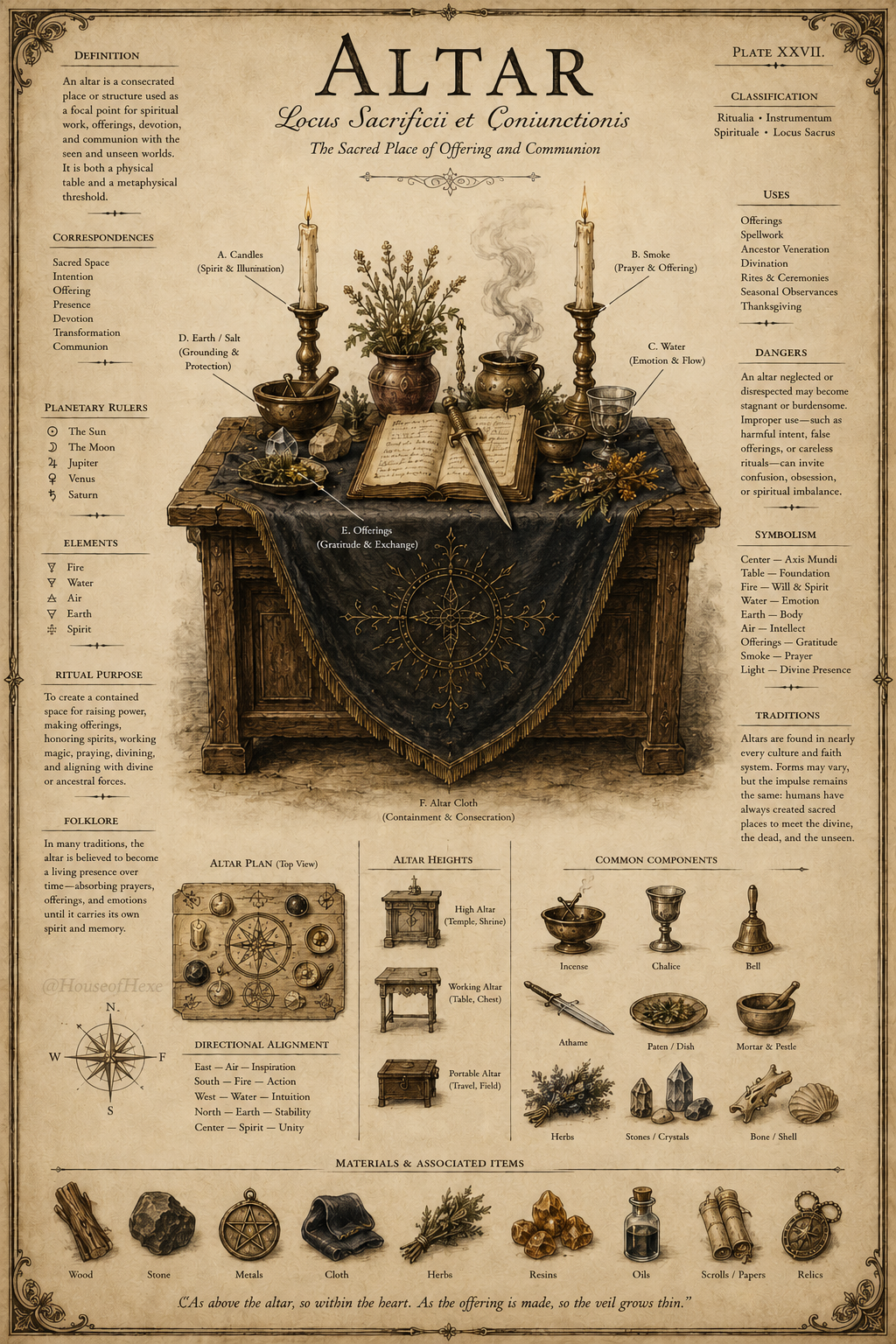
Among the oldest ritual structures in human history, the altar remains one of the most enduring. Whether carved from stone, built from wood, assembled from earth, or improvised from a windowsill, an altar serves as a deliberate place of contact. It is where devotion, magic, memory, prayer, and will are given form through matter.
Across cultures, traditions, and centuries, people have built sacred spaces to house offerings, honor spirits, commune with gods, remember ancestors, or focus intention. Though modern aesthetics often reduce the altar to decoration, its deeper virtue lies in relationship, repetition, and presence.
Origins
Before books of magic were bound in leather, sacred surfaces existed in temples, caves, hearths, and forest shrines. Archaeological evidence from ancient Egypt, Greece, Rome, and across countless Indigenous traditions reveals one repeating truth: human beings have always created places to make offerings.
In some traditions, altars stood before gods. In others, they were built for the dead. Hearth altars were once central to domestic life, acting as both spiritual anchor and physical center of the home.
Among cunning folk, witches, herbalists, and folk practitioners, the altar evolved into something more personal. It became both a workspace and a threshold, a place where practical craft and spiritual rite met.
An altar was never required to be ornate. A stump in the woods, a stone ledge, or a kitchen table could serve just as powerfully as a carved temple.
Purpose of an Altar
At its core, an altar creates containment.
It separates ordinary space from intentional space.
Traditional purposes include:
Offering food, drink, herbs, smoke, or flame
Honoring ancestors, spirits, saints, or deities
Conducting spells, rites, and devotional workings
Creating focus during divination or prayer
Marking seasonal observances and sacred timings
Holding ritual tools between workings
An altar is less about belief and more about relationship. Through repeated use, it gathers memory, symbolism, and personal virtue.
Traditional Observations
Practitioners often notice that a working space develops a distinct temperament over time:
Some altars feel warm and inviting
Some feel sharp and protective
Some become deeply ancestral
Some carry heavy Saturnian or lunar influence
Like a garden, an altar reflects what is fed into it.
Traditional Components
Though every tradition differs, certain tools appear again and again.
Common altar objects include:
Candles — illumination, spirit, will
Water — emotion, cleansing, receptivity
Salt or earth — grounding, boundaries, preservation
Incense or smoke — prayer, offering, purification
Blade or iron — protection, severing, direction
Herbs — healing, virtue, correspondence
Bones, stones, shells, feathers — ancestral or elemental links
Written petitions — focused intent
Personal relics — lineage, memory, devotion
Not every altar needs all of these. Traditional craft values function over clutter.
Directional & Planetary Correspondences
Many practitioners orient their altar according to elemental or planetary systems.
Common Directional Correspondences
| Direction | Virtue | Element |
|---|---|---|
| East | Inspiration, breath, clarity | Air |
| South | Action, courage, transformation | Fire |
| West | Emotion, dreams, healing | Water |
| North | Stability, bones, wealth | Earth |
Common Planetary Influences
The Moon — divination, dreams, ancestors, intuition
Venus — beauty, harmony, pleasure, love
Mars — protection, conflict, courage
Saturn — boundaries, death, discipline, preservation
Jupiter — expansion, wisdom, blessing
These correspondences are symbolic frameworks, not rigid laws.
How Altars Are Built and Worked
Traditionally, an altar is built through use, not purchase.
A practitioner may begin with a cloth, a candle, a bowl of water, and a single object of meaning. Over time, tools are added through experience, necessity, and relationship.
Some altars remain permanent. Others are assembled only during specific rites such as moon workings, ancestral feasts, protection magic, or seasonal festivals.
Many practitioners cleanse their altar before major workings through smoke, salt water, prayer, or silence. Others intentionally allow the space to accumulate the residue of repeated work, believing that power deepens through continuity.
There is no universal rule, only the discipline of observation.
House of Hexe Perspective
At House of Hexe, the altar is not viewed as décor, performance, or aesthetic identity.
It is a working surface.
It is where herbs are blessed, petitions are written, offerings are made, and difficult truths are often confronted. A proper altar does not need crystals worth hundreds of dollars or shelves curated for photographs. It needs presence, repetition, and honesty.
Some of the strongest altars are quiet. Weathered wood. Wax drippings. A handwritten prayer. A sprig of yarrow. A glass of water left for the dead.
That is where real craft often begins.
Warnings & Misuse
Modern spiritual spaces often confuse collecting with practicing.
An altar covered in beautiful objects but never worked can become little more than display. Likewise, constantly dismantling and rebuilding a sacred space for trends can interrupt the relationship many traditions value.
Another common misunderstanding is assuming every altar must be public. Historically, many working altars were hidden…inside cupboards, behind books, beneath beds, or in the woods.
Privacy has always been part of the craft.
Related Entries
Ancestor Work
Ritual Tools
Sacred Smoke
Protection Magic
Divination
Materia Medica: Yarrow
*If links are not active…it is a future post yet to be published. Thank you for understanding!