Astrological Herbalism
A celestial art of reading plant virtue through the language of stars, seasons, and sacred timing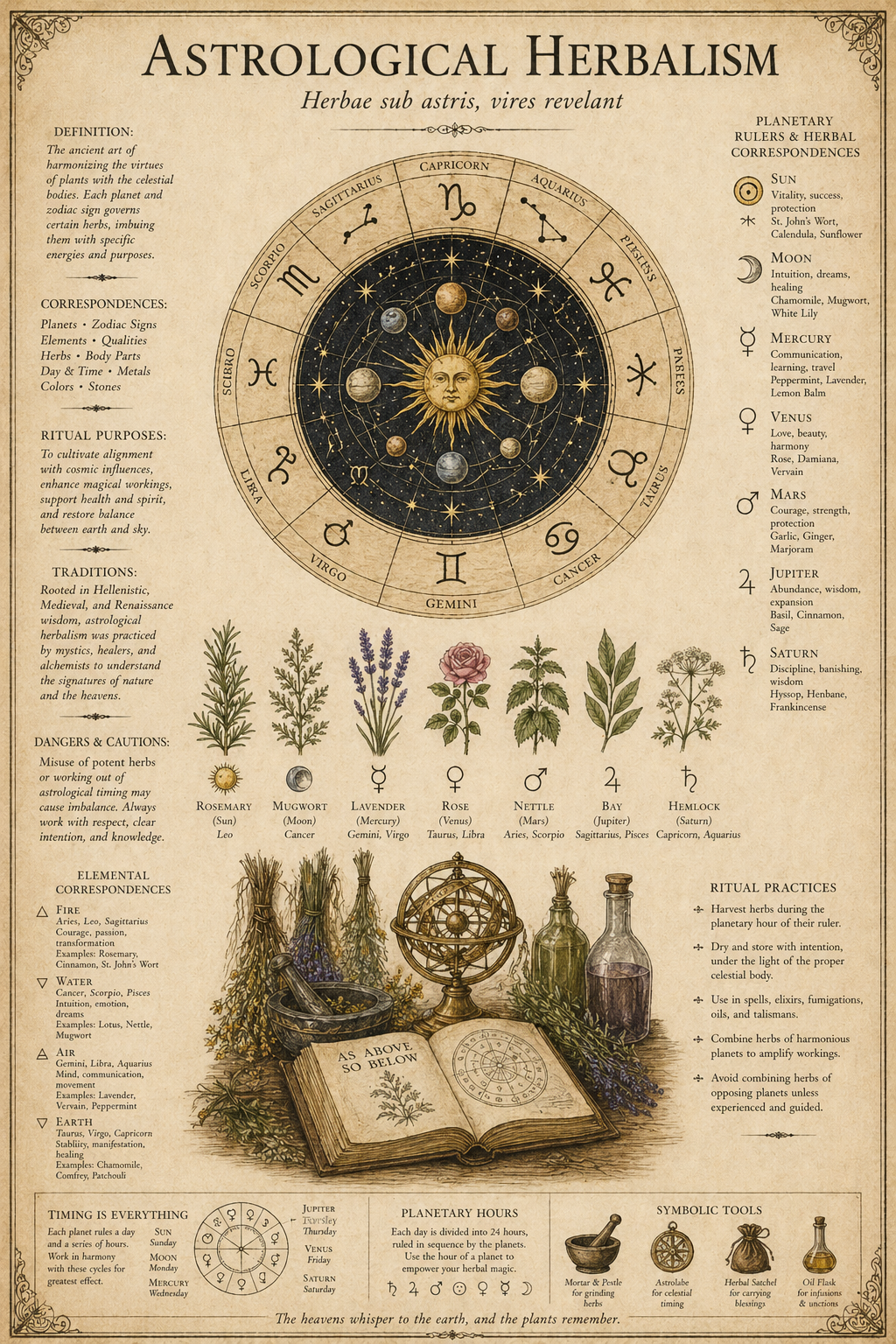
Astrological Herbalism is the traditional practice of linking herbs with planets, zodiac signs, elemental qualities, and favorable times of gathering or use. It stands at the meeting place of medicine, magic, agriculture, and cosmology. A system in which plants were not viewed as isolated substances, but as living expressions of a patterned universe.
For much of human history, the sky was not background scenery. It was calendar, clock, omen, scripture, and guide. The same heavens that governed tides, seasons, and migration were believed to influence the growth of crops, the moods of people, and the humors of the body. Within that worldview, herbs naturally became part of celestial order.
Whether one regards these ideas as symbolic, spiritual, historical, or practical, astrological herbalism remains compelling because it teaches relationship. It asks the practitioner to observe not only what a plant does, but when it thrives, how it behaves, what it resembles, and what rhythm it keeps. In an age of fragmentation, it offers a way of seeing wholes again.
Origins
The roots of astrological herbalism run deeper than any single culture. Long before modern divisions between science, religion, and medicine, many civilizations understood the cosmos as an interconnected whole. The stars were not separate from earthly life…they were woven into it.
In ancient Mesopotamia, priest-astronomers carefully tracked celestial movements and linked them with weather, kingship, agriculture, and illness. In Egypt, temple healing systems associated divine powers, cycles of inundation, and sacred botanicals with cosmic order. Greek thinkers later formalized these inherited ideas into philosophical systems of correspondence and balance.
Hippocrates is often quoted as saying that one who knows medicine but not astrology has no right to call themselves a physician, though the attribution is debated. Whether authentic or not, the quote reflects a real historical truth: for centuries, medicine and astrology were often studied side by side.
The physician Galen expanded the doctrine of humors and temperaments (hot, cold, moist, and dry) creating a framework that harmonized easily with planetary symbolism. Medieval Islamic scholars preserved and advanced Greek medical texts, transmitting astro-medical traditions back into Europe.
By the Renaissance, astrological medicine flourished. Physicians consulted ephemerides, chose auspicious hours, and avoided certain treatments when the Moon occupied sensitive signs. Herbalists gathered roots, flowers, and seeds according to lunar phases. Even universities taught elements of celestial medicine.
Among the most beloved popularizers was Nicholas Culpeper, whose herbal texts assigned common plants to planetary rulers and brought knowledge once guarded by elites into the hands of ordinary people.
The Worldview Behind the Practice
Astrological herbalism cannot be understood merely as “this herb belongs to this planet.” It rests upon an older philosophy of reality.
As Above, So Below
The phrase often associated with Hermetic thought expresses the belief that heavenly patterns echo in earthly forms. The body mirrors nature; nature mirrors cosmos. The pulse of moonlight, tide, menstruation, sap rise, sleep cycles, and emotion all suggested rhythm rather than randomness.
Temperament and Virtue
Plants were traditionally understood through qualities:
Hot
Cold
Moist
Dry
Stimulating
Relaxing
Opening
Binding
Nourishing
Purging
A warming pungent root might be martial or solar in nature. A moistening cooling leaf might be lunar. Astringent preservative bark might fall under Saturn.
Observation Over Superstition
Older practitioners watched patterns closely:
Which plants opened at dawn?
Which thrived in marshes?
Which bled colored sap?
Which soothed nerves?
Which pierced congestion?
Which hardened tissue or preserved flesh?
These observations shaped correspondence more than modern aesthetics ever could.
Planetary Rulerships
Planetary assignments vary by lineage, region, and teacher. What follows is a traditional overview rather than rigid law.
☉ Sun
The Sun governs vitality, confidence, warmth, circulation, visibility, and central force. Solar herbs are often aromatic, radiant, golden, strengthening, or uplifting.
Examples:
Rosemary
Calendula
Sunflower
Bay Laurel
Used traditionally for courage, vigor, brightness, and clearing stagnation.
☽ Moon
The Moon rules fluids, tides, fertility, sleep, dreams, intuition, memory, and cyclical change. Lunar herbs are often cooling, moistening, silvery, nocturnal, or soothing.
Examples:
Mugwort
White Willow
Cucumber
Lettuce
Used for dream work, rest, emotional tides, and softening excess heat.
♂ Mars
Mars governs heat, blood movement, defense, urgency, sharpness, severing, and courage. Martial herbs are pungent, thorned, stimulating, or forcefully active.
Examples:
Ginger
Garlic
Nettle
Mustard
Used for movement, protection, breaking stagnation, and strengthening will.
♀ Venus
Venus rules pleasure, beauty, sweetness, affection, fertility, softness, and harmony. Venusian herbs are fragrant, floral, sensual, moistening, or graceful.
Examples:
Rose
Violet
Damiana
Hibiscus
Used for love rites, adornment, self-regard, receptivity, and pleasure.
☿ Mercury
Mercury governs language, trade, nerves, wit, adaptability, and movement between worlds. Mercurial herbs are clever, aromatic, quick, and often linked to digestion or the mind.
Examples:
Lavender
Dill
Fennel
Peppermint
Used for clarity, communication, mental sharpness, and travel workings.
♃ Jupiter
Jupiter governs growth, prosperity, generosity, wisdom, law, and abundance. Jovial herbs are expansive, protective, noble, or richly nourishing.
Examples:
Sage
Oak
Nutmeg
Dandelion
Used for blessing, success, confidence, and broadening one’s path.
♄ Saturn
Saturn governs bones, time, limits, endings, structure, preservation, solitude, and discipline. Saturnine herbs may be bitter, slow, drying, dark, or strengthening through hardship.
Examples:
Comfrey
Horsetail
Cypress
Myrrh
Used for boundaries, endurance, ancestral work, and matters requiring seriousness.
The Zodiac and the Body
Traditional astrology also mapped signs onto body regions, a system sometimes called the Zodiac Man.
Aries — Head
Taurus — Throat and neck
Gemini — Arms and lungs
Cancer — Breasts and stomach
Leo — Heart and spine
Virgo — Intestines and digestion
Libra — Kidneys and balance
Scorpio — Reproductive organs
Sagittarius — Hips and thighs
Capricorn — Knees and bones
Aquarius — Ankles and circulation
Pisces — Feet and lymphatic tides
This map was historically used to guide timing. For example, some practitioners avoided treating a body part when the Moon transited its corresponding sign.
Timing, Harvesting & Preparation
One of the most practical surviving forms of astrological herbalism is sacred timing.
Lunar Phases
Waxing Moon: growth, attraction, nourishment, increase
Full Moon: culmination, potency, blessing, revelation
Waning Moon: banishing, reduction, cleansing, release
Dark Moon: rest, ancestor work, hidden rites, stillness
Planetary Days
Sunday — Solar works
Monday — Lunar works
Tuesday — Mars works
Wednesday — Mercury works
Thursday — Jupiter works
Friday — Venus works
Saturday — Saturn works
Harvest Traditions
Common examples include:
Gather flowers in waxing or full light
Harvest roots in autumn or waning phases
Prepare love oils on Friday
Make protective washes on Tuesday
Conduct boundary rites on Saturday
Even when symbolic, timing creates intention, rhythm, and discipline.
How It Is Practiced Today
Modern practitioners approach astrological herbalism in several ways.
Some use it devotionally…choosing herbs for altars, incense, baths, and oils based on planetary symbolism. Others use it agriculturally, planting by moon phase or seasonal currents. Some herbalists consult natal charts as reflective tools, selecting plants that symbolically balance temperament.
For example:
Excess haste and irritation may call for cooling lunar or Venus herbs.
Lethargy and dullness may benefit from solar or martial stimulation.
Lack of boundaries may invite Saturnian support.
Creative stagnation may call for Jovial expansion.
Many contemporary practitioners also simply use the system to pay attention more deeply. To notice that rosemary reaches upward like flame, that mugwort belongs to thresholds and dreams, that nettle stings before it nourishes.
This kind of seeing has value of its own.
House of Hexe Perspective
At House of Hexe, astrological herbalism is not treated as superstition nor as mechanical law. It is approached as a symbolic language through which plants may be known more intimately.
The sky does not command the plant. It reveals a pattern in which the plant participates.
A chart cannot replace lived experience, dosage knowledge, contraindications, cultivation skill, or direct relationship with the herb itself. Yet correspondences can sharpen instinct, refine ritual timing, and deepen reverence.
When the practitioner studies both heavens and hedgerow, a richer medicine emerges.
Warnings & Misuse
Modern media often flattens complex traditions into decorative charts: “You are a Leo, therefore use sunflower.” Such simplifications strip away nuance, context, and historical method.
Not every planetary herb is safe for every person. Toxicity, allergies, interactions, dosage, preparation method, and medical context matter deeply.
Likewise, astrology should not replace necessary healthcare. Traditional systems can enrich modern life without pretending to be infallible.
Another common error is rigidity. If rosemary is solar, it does not cease having other dimensions. Plants are living beings, not one-word labels.
Related Entries
Planetary Magic
Moon Gardening
Doctrine of Signatures
Ritual Timing
Temperaments
*If links are not active…it is a future post yet to be published. Thank you for understanding!