Skullcap | Scutellaria lateriflora
Herb of nervous system restoration, quieting the mind, sleep support, overstimulation, emotional steadiness, threshold rest, and the return of inner composureSkullcap is one of the great nervines of the Western herbal tradition: quiet, blue-flowered, unassuming, and deeply suited to the person whose mind will not stop circling the same worn path. It is not a dramatic herb. It does not arrive with heat, thunder, perfume, or spectacle. Skullcap works more like a hand placed gently over a trembling wire until the vibration begins to lessen.
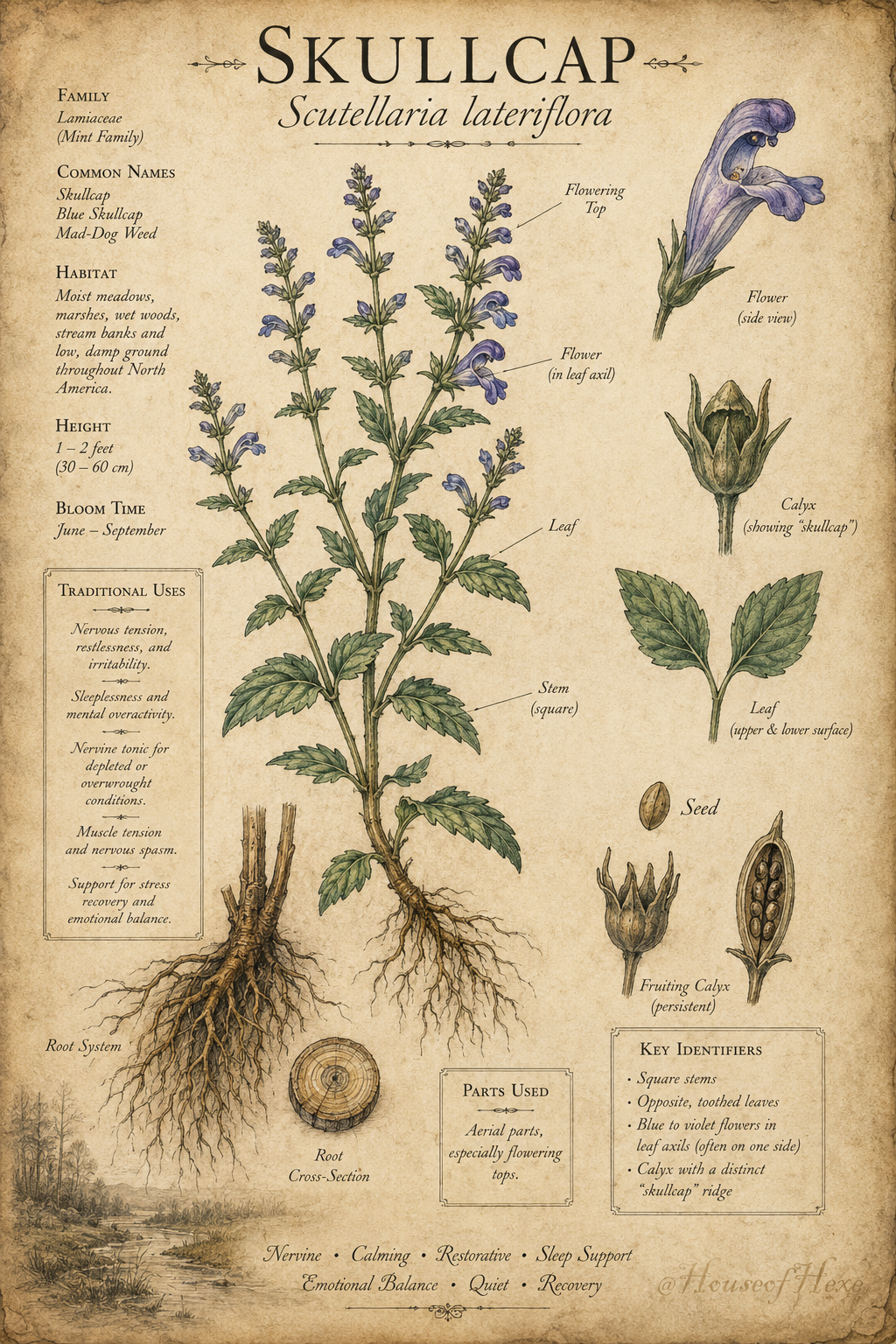
Quick Correspondence Block
Planet: Moon, Mercury, Saturn
Element: Water, Air
Zodiac: Cancer, Virgo, Gemini, Capricorn
Primary Actions: Nervine, mild sedative, anxiolytic-adjacent, antispasmodic, trophorestorative nervine, sleep-supportive, relaxing, cooling
Parts Used: Aerial parts, especially flowering tops
Preparation Style: Tea, infusion, tincture, glycerite, sleep tea, nervous system blend, bath, ritual wash, dream sachet
Magical Uses: Peace, rest, nervous system protection, dream work, emotional regulation, sleep rites, recovery after conflict, quieting obsessive thought
Spirit of the Herb: The keeper of the quiet room: blue-flowered, soft-spoken, steady-handed, and unwilling to let the mind devour itself.
Overview
Skullcap is often spoken of as a calming herb, but that description is too thin for what the plant actually offers. In the older language of herbalism, Skullcap belongs among the nervines: plants used to tend the nervous system when it becomes strained, frayed, restless, reactive, or unable to settle. Its traditional reputation centers on nervous tension, sleeplessness, agitation, and conditions where the body seems to remain on guard even after danger has passed.
Botanically, American Skullcap is Scutellaria lateriflora, a perennial member of the mint family, Lamiaceae. It is native to North America and is commonly associated with moist meadows, marshes, wet woods, stream edges, and other damp habitats. The Lady Bird Johnson Wildflower Center describes its native habitat as moist bottomlands, meadows, and marshes. (Lady Bird Johnson Wildflower Center)
The name Skullcap comes from the shape of the calyx, which resembles a small cap or helmet. This is one of those botanical details that becomes magical almost without effort. Here is a plant long used for the head, the nerves, the mind, and the storm of thought, bearing in its very form a tiny helmet.
In modern herbalism, Skullcap is most often used for stress, anxiety-like tension, restlessness, and sleep support. A randomized, double-blind, placebo-controlled crossover study examined Scutellaria lateriflora in healthy volunteers and found mood-related effects, though the evidence base remains modest and should not be exaggerated. (PubMed)
Botanical Identification
Scutellaria lateriflora belongs to the mint family, though it does not carry the strong aromatic fragrance many people expect from mints. It is more subtle in both scent and appearance, which is part of why careful identification matters.
Growth Habit - Skullcap grows as an herbaceous perennial, usually upright and branching, often reaching around one to two feet tall depending on site conditions. It favors damp places and will often look more at home near water, ditches, wet meadows, woodland edges, or low ground than in hot, dry, exposed beds.
Leaves - The leaves are opposite, narrow to lance-shaped, and toothed along the margins. They are not thick or leathery. They have a soft, green, nervous-system quality in appearance: fine, light, and responsive.
Flowers - The flowers are small, tubular, and usually blue to violet, though pale forms occur. One of the identifying features of Scutellaria lateriflora is that the flowers often appear along one side of the stem or from the leaf axils rather than forming one dramatic terminal flower spike. This side-flowering habit is reflected in the species name lateriflora, meaning “side-flowering.”
Stem - Like many members of the mint family, Skullcap has square stems. This is helpful, but not enough for identification on its own. Many mints share this trait.
Calyx - The calyx is especially important. Skullcaps have a distinctive little ridge or cap-like structure, giving the genus its common name. This “cap” remains one of the most useful features when learning the plant.
Habitat - Skullcap prefers moist soil and partial to full sun depending on climate. It is commonly associated with wetlands, marsh edges, stream banks, and damp meadows. USDA lists Scutellaria lateriflora as blue skullcap and identifies it within the Lamiaceae family. (plants.sc.egov.usda.gov)
Lookalikes / Confusion Species - There are many Scutellaria species, and not all are used in the same way. American Skullcap, Scutellaria lateriflora, should not be casually confused with Chinese Skullcap, Scutellaria baicalensis, which is a different species with different traditional uses and a different plant part commonly used. Chinese Skullcap is often associated with the root in Traditional Chinese Medicine, while American Skullcap is primarily used as aerial flowering herb.
Traditional Uses
Skullcap has a long-standing reputation as an herb for the nerves. In older Western herbal language, it was used where nervous agitation, trembling, hysteria, sleeplessness, convulsive tendencies, and exhaustion of the nerves were part of the picture. Some of those older terms are medically outdated now, but they show us how practitioners understood the plant: Skullcap belonged to states of disturbance, irritability, tension, and neurological unease.
Nervous Tension - Skullcap is traditionally suited to the person who cannot unclench. The jaw tightens, the shoulders rise, the thoughts circle, and sleep becomes a threshold that cannot be crossed. Skullcap does not force the gate open. It helps the system remember that the gate exists.
Sleep Support - Skullcap has often been used in evening formulas where sleeplessness is connected to mental activity, overstimulation, worry, or nervous depletion. It is especially appropriate when the issue is not simply “tiredness,” but the inability to come down from the day.
Restlessness and Agitation - Health Canada’s natural health product monograph recognizes Skullcap herb top as traditionally used in herbal medicine to help relieve restlessness and nervousness, which helps promote sleep. (Health Canada)
Nerve Restoration - Many herbalists consider Skullcap not merely a sedative, but a trophorestorative nervine: a plant used over time to nourish and restore function to a depleted system. This is why it often appears in longer-term nervous system blends rather than only as a one-night sleep herb.
Muscle Tension and Spasm - Because emotional and nervous tension often enter the body through muscle tightness, Skullcap is traditionally paired with herbs that relax tension patterns. It is not a heavy muscle relaxant in the modern pharmaceutical sense, but it belongs in the old category of plants that help the body soften where stress has become physical.
Modern Herbal Actions
Skullcap’s modern herbal reputation remains centered on the nervous system. It is usually described as calming, relaxing, mildly sedative, and supportive where stress and restlessness are present.
Nervine - A nervine is an herb that acts on or supports the nervous system. Skullcap is one of the classic examples, especially when the nervous system feels overworked, irritated, or unable to settle.
Mild Sedative - Skullcap may help encourage rest and sleep, especially when sleeplessness is tied to nervous tension. Higher doses may feel more sedating for some people.
Anxiolytic-Adjacent - Modern studies have explored Skullcap for anxiety and mood effects. A clinical trial on healthy volunteers with mood disturbance found results suggesting benefits for mood, but this should be understood as early supportive research rather than proof of a guaranteed effect. (PubMed)
Antispasmodic - Traditionally, Skullcap has been used where tension has a twitching, spasmodic, or tightly held quality. This can include nervous muscle tension, stress patterns, or the body’s inability to fully release.
Cooling and Settling - Energetically, Skullcap is often understood as cooling, calming, and diffusive. It suits heat of the nerves: irritability, agitation, sharp reactivity, mental overfire, and the kind of exhaustion that still cannot sleep.
Trophorestorative Nervine - This is one of Skullcap’s most important categories. It is not only for the immediate moment of distress. Used appropriately over time, herbalists have traditionally viewed it as helping rebuild resilience in a worn nervous system.
Preparations
Skullcap is gentle in character but should still be prepared with respect. Its effect depends on dose, freshness, constitution, and whether it is used alone or in formula.
Tea
Skullcap tea is a classic preparation. It is often taken in the evening or during periods of nervous agitation. The flavor is green, bitter, and somewhat earthy. It blends well with lemon balm, chamomile, passionflower, oatstraw, lavender, rose, and holy basil.
Infusion
A stronger infusion may be used when a deeper nervine effect is desired. Skullcap is not usually prepared as a long decoction because the aerial parts are more delicate than roots or barks.
Tincture
Fresh Skullcap tincture is highly valued by many herbalists. Dried tincture is also used, but freshness matters greatly with this herb. Skullcap that has been sitting too long and smells like old hay may have lost much of its virtue.
Glycerite
A Skullcap glycerite can be useful for those avoiding alcohol, though glycerites are generally milder and may require different dosing approaches.
Sleep Tea Blend
Skullcap combines beautifully with passionflower, chamomile, lemon balm, lavender, hops, or valerian depending on the person. For a sensitive constitution, begin with gentler companions before reaching for heavier sedatives.
Bath
Skullcap may be added to baths for nervous exhaustion, emotional overstimulation, grief tension, and post-conflict recovery. In this form, it becomes less about “taking an herb” and more about letting the body receive the instruction to soften.
Ritual Wash
A Skullcap wash may be used for peace after arguments, rest after spiritual labor, or clearing the static left behind by fear. It belongs well in rites of quieting, not domination.
Dream Sachet
Dried Skullcap may be placed in dream sachets with mugwort, lavender, rose, or chamomile when the intention is restful dreaming rather than intense psychic stimulation.
Magical Uses
Skullcap’s magic is not loud. It does not command the room like frankincense, throw sparks like cinnamon, or guard the gate like rosemary. Skullcap belongs to the inner chamber, the bed, the cup of tea after tears, the quiet hour after a difficult conversation, and the spell worked not to conquer the world, but to stop shaking inside it.
Peace and Quieting
Skullcap is well suited to workings for peace, stillness, and emotional cooling. It does not erase conflict. It helps the practitioner return to themselves after conflict has scattered them.
Nervous System Protection
In magical practice, Skullcap may be used to protect the mind from obsessive thought, emotional overwhelm, and energetic overstimulation. This is not the sharp protection of thorns or iron. It is the protection of a closed door, a dim room, and a nervous system allowed to rest.
Sleep Rites
Skullcap belongs in sleep charms, dream pillows, bedtime teas, and rituals for crossing into rest. It is especially useful when the threshold of sleep feels guarded by worry.
Recovery After Spiritual Work
After divination, spirit work, baneful workings, grief rites, or emotionally heavy rituals, Skullcap can help return the practitioner to ordinary embodiment. Not every magical act should leave a person cracked open. Some work requires closing properly.
Emotional Regulation
Skullcap may be used in workings for temper, panic, reactivity, and the habit of spiraling. It is not a spell for pretending nothing hurts. It is a spell for remaining housed within oneself while the hurt is tended.
Dream Work
Skullcap can support dream work when the goal is gentle access rather than forceful vision. It pairs well with herbs that soften the gate without violently throwing it open.
Household Calm
A Skullcap infusion may be added to floor washes or room sprays in spaces where arguments, anxiety, insomnia, or grief have lingered. It is not a banishing herb in the aggressive sense. It is a settling herb. It teaches the house to lower its shoulders.
Astrological Correspondences
Primary Rulership: Moon
Skullcap belongs strongly to the Moon through sleep, emotional tides, the nervous system, dreams, the inner life, and the need for safety. Its work is lunar not because it is passive, but because it governs the hidden waters beneath behavior.
Secondary Rulership: Mercury
Mercury appears through the mind, the nerves, thought patterns, speech loops, worry, and mental overstimulation. Skullcap is especially useful when Mercury has become too fast for the body to follow.
Saturnian Undertone
There is also a Saturnian quality in Skullcap’s boundary-setting around rest. Saturn says: enough. Close the book. End the conversation. Return to structure. Sleep is not laziness; it is law.
Elemental Nature
Water and Air. Water governs emotional cooling, sleep, dreams, and the softening of inner turbulence. Air governs thought, nerves, breath, and the mental currents Skullcap helps settle.
Zodiac Ties
Cancer appears through emotional safety, sleep, home, and the need for shelter. Virgo appears through nervous sensitivity, bodily regulation, and careful herbal tending. Gemini appears through thought, speech, worry, and mental movement. Capricorn appears through the discipline of rest, boundaries, and recovery after long strain.
Seasonal Timing
Skullcap belongs beautifully to evening rites, waning Moon work, Moon days, Mercury work for calming the mind, and Saturn work when rest must be protected as a boundary rather than treated as an afterthought.
Growing & Harvesting
Skullcap prefers moisture. This is important. Unlike many Mediterranean herbs that thrive on dry heat and poor soil, Skullcap wants a different kind of tending. It likes dampness, steadiness, and places where water remains close.
Soil
Skullcap prefers moist, fertile soil with decent drainage. It does not want to be baked dry for long periods. In a dry climate, it may need a more sheltered position, mulch, and consistent watering.
Sun
It can grow in full sun where moisture is reliable, but in hotter climates it may prefer partial shade. Morning sun and afternoon protection can be useful.
Water
Water is central to Skullcap’s temperament. Keep the soil evenly moist, especially while establishing. Do not treat it like rosemary, sage, or thyme.
Harvesting
Harvest the aerial parts when the plant is in flower. The flowering tops are commonly used medicinally. Cut cleanly and leave enough growth for the plant to recover.
Drying
Dry Skullcap quickly and carefully in a well-ventilated place away from direct sunlight. It should retain good color and a living scent. If it turns dull, brown, and lifeless, its medicine may be diminished.
Storage
Store dried Skullcap in airtight jars away from heat, light, and moisture. This is an herb worth refreshing regularly rather than keeping for years as a forgotten jar.
Warnings & Contraindications
Skullcap is generally regarded by herbalists as a gentle nervine, but gentle does not mean careless.
Avoid use during pregnancy and lactation unless guided by a qualified practitioner. Drugs.com notes documented adverse effects in pregnancy and recommends avoiding use during pregnancy and lactation. (Drugs.com)
Use caution with sedative medications, sleep medications, alcohol, benzodiazepines, barbiturates, and other central nervous system depressants, as Skullcap may increase drowsiness. WebMD lists sedative medications as a moderate interaction concern. (WebMD)
Use caution with liver disease or a history of liver injury. LiverTox notes that Skullcap has been implicated in rare cases of liver injury, though some historical cases may have involved adulteration or multi-herb formulas rather than clearly identified Scutellaria lateriflora alone. (NCBI)
Quality matters. Skullcap has a history of adulteration with germander, a plant associated with liver toxicity. This is one reason proper sourcing and identification are not optional. (sbrmc.adam.com)
Do not combine Skullcap casually with strong sedative herbs or medications if you need to drive, work, care for children, or remain alert.
Allergic reactions are possible, especially for those sensitive to mint family plants.
Final Thoughts
Skullcap is not an herb of escape. It is an herb of return.
It returns the mind to the body, the breath to its rhythm, the spirit to its room, and the exhausted practitioner to the simple truth that rest is part of the work. In a culture that praises intensity until the nerves become threadbare, Skullcap offers an older instruction: soften, restore, and stop mistaking constant vigilance for wisdom.
In the old herbal library, Skullcap belongs in the drawer marked Nerves, Sleep, Moon, Quiet, Recovery, Dream, and the Mind Brought Back Beneath Its Own Roof.
SOURCES / FURTHER READING
USDA Plants Database. “Scutellaria lateriflora L.”
Lady Bird Johnson Wildflower Center. “Scutellaria lateriflora var. lateriflora.”
Health Canada. “Natural Health Product Monograph: Skullcap.”
Brock, C., Whitehouse, J., Tewfik, I., and Towell, T. “American Skullcap (Scutellaria lateriflora): A Randomised, Double
Blind Placebo-Controlled Crossover Study of Its Effects on Mood in Healthy Volunteers.”
NIH LiverTox. “Skullcap.”
Drugs.com. “Scullcap Uses, Benefits & Dosage.”
Hoffmann, David. Medical Herbalism.
Grieve, Maud. A Modern Herbal.