Sage | Salvia officinalis
Herb of purification, wisdom, protection, longevity, clear speech, household blessing, throat medicine, and old-world spiritual cleansingSage is one of the great herbs of the threshold: kitchen herb, medicine herb, cleansing herb, funeral herb, teacher’s herb, and guardian of the spoken word. It is familiar enough to be underestimated, yet old enough to stand among the oldest green allies of household magic and traditional healing.
Quick Correspondence Block
Planet: Jupiter, Mercury
Element: Air, Earth
Zodiac: Sagittarius, Gemini, Virgo
Primary Actions: Aromatic, carminative, astringent, antimicrobial, anti-inflammatory, antioxidant, nervine-adjacent, drying, digestive-supportive
Parts Used: Leaf, flowering tops, essential oil
Preparation Style: Tea, infusion, gargle, vinegar, honey, culinary use, steam, bath, smoke, floor wash, ritual wash, infused oil
Magical Uses: Purification, wisdom, protection, blessing, spirit clearing, truth, longevity, grief work, threshold rites
Spirit of the Herb: The old teacher at the door: sharp-eyed, dry-handed, watchful, cleansing, and unwilling to let falsehood linger.
Overview
Sage is one of those herbs that seems simple until one begins following it through history. It sits in the kitchen beside salt and pepper, but it also belongs to the sickroom, the temple, the funeral table, the threshold, and the ritual bath. Its scent is strong, resinous, bitter-green, and unmistakably cleansing.
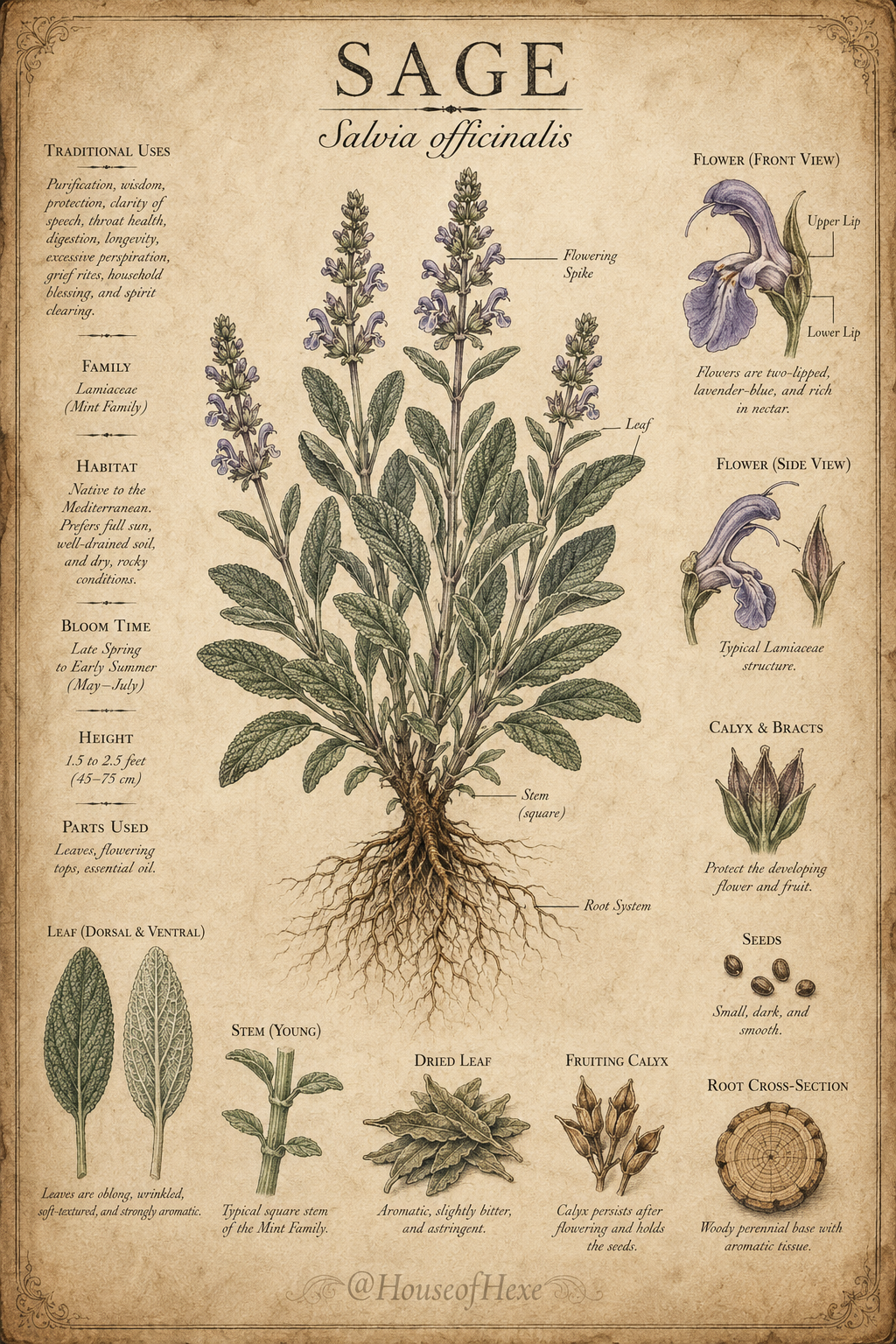
Botanically, common garden Sage is Salvia officinalis, a woody-stemmed perennial in the mint family. Missouri Botanical Garden describes it as a semi-shrubby perennial with aromatic gray-green leaves and two-lipped lavender-blue flowers appearing in late spring. (Missouri Botanical Garden)
In traditional herbal medicine, Sage has been used for digestion, sweating, sore throats, mouth inflammation, minor skin irritation, and excessive moisture. The European Medicines Agency recognizes sage leaf as a traditional herbal medicinal product for mild dyspeptic complaints, excessive sweating, inflammation of the mouth or throat, and minor skin inflammations. (European Medicines Agency (EMA))
Magically, Sage is not merely “for cleansing,” though modern use often reduces it to that. Sage purifies, yes, but it also teaches discernment. It dries what is excessive, clears what is stagnant, strengthens the voice, protects the household, and asks the practitioner to speak truth with consequence.
Botanical Identification
Salvia officinalis belongs to the Lamiaceae family, the mint family. Like many of its relatives, it carries aromatic volatile oils, opposite leaves, square young stems, and a strong fragrance released when bruised.
Growth Habit
Sage grows as a low, woody perennial or semi-shrub. It commonly reaches about 1.5 to 2.5 feet tall, depending on climate, pruning, and variety. Older plants become woody at the base and may need replacing after several years if they grow leggy or weak.
Leaves
The leaves are oblong, wrinkled, soft-textured, and gray-green to silvery. They are strongly aromatic, with a savory, camphorous, slightly bitter scent. This gray-green color is part of Sage’s old-world virtue: dry, lunar-silver in appearance, but sharp and solar in action.
Flowers
Sage produces upright spikes of two-lipped flowers, usually lavender-blue, though cultivars may vary. Bees and pollinators favor the blossoms.
Stem
Young stems are square and green, becoming woody with age. This is a plant that visibly matures; it does not remain soft and tender forever.
Habitat
Sage prefers full sun, good air movement, and well-drained soil. It does not like wet feet. Its Mediterranean temperament shows in its preference for warmth, drainage, and restraint rather than rich, soggy ground.
Lookalikes / Confusion Species
Many plants are called “sage,” including white sage, clary sage, meadow sage, Russian sage, and various ornamental salvias. For culinary and medicinal garden Sage, use properly identified Salvia officinalis. Do not assume all “sage” species are interchangeable.
Traditional Uses
Sage has long been valued as a plant of medicine, preservation, wisdom, and purification. Its Latin name, Salvia, is often connected with healing and saving, and its old reputation reflects this. Sage was not treated as a decorative herb. It was a household necessity.
Throat and Mouth Herb
Sage has a strong tradition of use for the mouth and throat. Gargles and rinses made from Sage were used where the tissues felt inflamed, loose, damp, irritated, or sore. Its astringent and aromatic nature makes it especially suited to this kind of work.
Digestive Herb
As a culinary herb, Sage helps cut through rich, fatty, heavy foods. This is not accidental. Traditional kitchens often paired herbs with foods they helped the body understand. Sage with pork, butter, beans, stuffing, roasted roots, and winter dishes reflects its warming, drying, digestive quality.
Sweat and Moisture
Sage has traditionally been used where there is excess moisture: sweating, damp digestion, loose tissues, or overly wet conditions in the body. This drying temperament is one of the keys to understanding the plant.
Preservation and Food Use
Sage’s aromatic oils made it valuable in cooking, preserving, and seasoning. Before modern refrigeration, aromatic herbs were not merely flavor. They were part of how people managed heaviness, spoilage, digestion, and the atmosphere of food.
Household Cleansing
Sage has been burned, steeped, sprinkled, and carried in cleansing rites. In European folk practice, garden Sage was used in household protection and blessing alongside other strong herbs such as rosemary, rue, bay, lavender, and hyssop.
Wisdom and Longevity
Sage has an old association with wisdom, age, and long life. This is not soft wisdom. Sage is the wisdom that comes through correction, dryness, discipline, memory, and experience.
Modern Herbal Actions
Sage is common, but it is not weak. Its medicinal character is aromatic, drying, astringent, stimulating, and clarifying.
Aromatic - Sage’s volatile oils act through scent, digestion, and atmosphere. The aroma is clearing and sharp, making it useful in steams, teas, gargles, ritual washes, and culinary preparations.
Astringent - Sage tightens and tones tissues. This is why it appears traditionally in mouth rinses, throat gargles, and formulas for excessive moisture.
Carminative - Sage supports digestion, especially when food feels heavy, cold, greasy, or slow to move.
Antimicrobial - Research reviews have discussed Sage’s antimicrobial activity, which helps explain its historical use in mouth, throat, cleansing, and preservation contexts. (PMC)
Anti-inflammatory - Sage has been studied for anti-inflammatory potential, particularly in relation to its phenolic compounds and essential oil constituents. (PubMed)
Antioxidant - Modern research has examined Sage for antioxidant activity and other pharmacological properties, including effects connected to its bioactive constituents. (PMC)
Cognitive-Supportive - Sage has a long-standing relationship with memory and mental clarity. Modern reviews have explored its potential cognitive and neuroprotective effects, though this should be treated as an area of study rather than a promise or cure. (PMC)
Preparations
Sage changes greatly depending on preparation. A light culinary use is not the same as a strong medicinal tea, concentrated extract, or essential oil.
Tea
Sage tea is strong, drying, and aromatic. It is best used with intention rather than as an endless daily beverage.
Infusion
A stronger infusion may be used as a gargle, mouth rinse, foot bath, hair rinse, ritual wash, or cleansing water.
Gargle
Sage gargles are one of its classic preparations for the throat and mouth. Let the infusion cool to a comfortable temperature before use.
Culinary Use
Sage is excellent with poultry, pork, beans, butter, winter squash, potatoes, mushrooms, breads, gravies, and rich foods.
Sage Vinegar
Sage vinegar may be used in cooking, cleansing washes, hair rinses, and floor washes.
Sage Honey
Sage-infused honey can be used in winter teas and throat preparations.
Steam
A Sage steam is sharp and clearing. It may be used for atmosphere, ritual clearing, or breath-centered preparations.
Bath
Sage baths are traditionally suited for cleansing, uncrossing, grief heaviness, spiritual fatigue, and clearing the residue of conflict.
Smoke / Incense
Dried Sage may be burned in small amounts for purification and protection. It blends well with rosemary, cedar, bay, lavender, juniper, mugwort, frankincense, and pine.
Essential Oil
Sage essential oil is potent and should be used with care. It is not interchangeable with the leaf and should not be taken internally without professional guidance.
Magical Uses
Sage is one of the most misunderstood magical herbs because modern practice often flattens it into one word: cleansing. Cleansing is part of Sage’s virtue, but not the whole of it.
Purification
Sage clears through dryness, sharpness, and authority. It does not wash like water. It scours like a dry wind moving through an old house.
Protection
Sage protects by restoring order. It is useful at thresholds, doorways, windows, ritual spaces, sickrooms, and places where spiritual residue gathers.
Wisdom
Sage belongs to elders, teachers, discernment, and hard-earned knowledge. It may be used in study rites, initiatory work, teaching spaces, and rituals where truth must be spoken plainly.
Truth and Speech
Because of its relationship with the throat and mouth, Sage is well suited to workings involving truthful speech, testimony, confession, vows, teaching, and the removal of verbal poison.
Grief and the Dead
Sage may be used after death, illness, arguments, or heavy emotional periods to clear the atmosphere and help the living return to order. It does not replace mourning. It helps the house breathe again.
Household Blessing
Sage can be steeped into floor washes, tied into bundles, placed near thresholds, or added to protective jars and charm bags. It is especially useful when a home feels spiritually stale.
Banishing and Boundary Work
Sage is appropriate for banishing when the goal is purification, removal of residue, and restoration of spiritual cleanliness. It is not always the herb for aggressive work. It is the herb that says: enough. Leave. This place is being returned to order.
Astrological Correspondences
Planetary Rulership: Jupiter
Sage belongs strongly to Jupiter through wisdom, counsel, blessing, law, teaching, protection, and longevity. It carries the authority of the elder, the priest, the judge, and the keeper of tradition.
Secondary Rulership: Mercury
Mercury appears through Sage’s relationship with speech, memory, thought, study, and the mouth. Sage clears the tongue and sharpens the message.
Elemental Nature
Air and Earth. Air governs its scent, smoke, speech, thought, and clearing action. Earth governs its dryness, preservation, household use, medicine, and old-rooted wisdom.
Zodiac Ties
Sagittarius for teaching, spiritual law, wisdom, and Jupiterian blessing.
Gemini for speech, study, memory, and communication.
Virgo for medicine, discernment, purification, and practical household order.
Seasonal Timing
Sage is especially suited to late summer, autumn, and winter household work. It belongs well in rites of clearing before seasonal transitions, Thursday Jupiter workings, Wednesday Mercury rites, waning moon purification, and threshold blessings after illness, conflict, or grief.
Growing & Harvesting
Sage prefers discipline. It does not want rich wet soil, crowding, or constant fussing. Give it sun, drainage, pruning, and room to breathe.
Soil - Sage prefers well-drained soil and may struggle in heavy, wet ground. Raised beds, containers, rocky soil, and sandy loam are often better than damp clay.
Sun - Full sun is best. Shade weakens the plant and reduces its aromatic strength.
Water - Water young plants until established, then avoid overwatering. Sage is more tolerant of dryness than soggy roots.
Climate - Common Sage is grown as a perennial in many temperate regions, though hardiness depends on variety and winter conditions. Missouri Botanical Garden lists common Sage as a perennial commonly grown in zones 4 to 8 depending on cultivar. (Missouri Botanical Garden)
Harvesting - Harvest leaves once the plant is established. Cut sprigs rather than stripping the plant bare. Avoid cutting deep into old woody stems unless pruning intentionally.
Drying - Dry Sage in small bundles or on screens away from direct sunlight. The leaves should remain fragrant after drying.
Storage - Store dried Sage in airtight jars away from heat, light, and moisture. If the scent has faded to dust, much of the virtue has gone with it.
Warnings & Contraindications
Culinary amounts of Sage are generally well tolerated for most people.
Medicinal doses, strong extracts, and essential oil require more caution.
Sage contains thujone, and excessive amounts may be unsafe. NCCIH notes that Sage may be unsafe during pregnancy because of thujone, and safety during breastfeeding is not well established. (NCCIH)
Avoid high-dose Sage preparations during pregnancy and lactation unless guided by a qualified practitioner.
Use caution with seizure disorders, high blood pressure, diabetes, and complex medication use.
Sage essential oil should be diluted before topical use and should not be taken internally without professional guidance.
Because Sage is drying, it may aggravate dryness in some constitutions when used heavily or for long periods.
Allergic reactions are possible.
Final Thoughts
Sage is not merely a cleansing herb. It is an herb of wisdom, speech, preservation, medicine, and threshold authority.
It teaches the old virtue of discernment: what is useful may remain, what is false must be named, what is stagnant must be cleared, and what is sacred must be protected.
In the old herbal library, Sage belongs in the drawer marked Wisdom, Smoke, Throat, Threshold, Purification, Longevity, and the House Returned to Order.
SOURCES / FURTHER READING
European Medicines Agency. “European Union Herbal Monograph on Salvia officinalis L., folium.”
Missouri Botanical Garden. “Salvia officinalis Plant Finder.”
Ghorbani, Ahmad, and Mahdi Esmaeilizadeh. “Pharmacological Properties of Salvia officinalis and Its Components.”
Hamidpour, Mohsen, et al. “Chemistry, Pharmacology, and Medicinal Property of Sage (Salvia) to Prevent and Cure Illnesses Such as Obesity, Diabetes, Depression, Dementia, Lupus, Autism, Heart Disease, and Cancer.”
National Center for Complementary and Integrative Health. “Sage: Usefulness and Safety.”
Grieve, Maud. A Modern Herbal.
Hoffmann, David. Medical Herbalism.