Rosemary | Salvia rosmarinus
Herb of remembrance, protection, clarity, ancestral memory, hearth blessing, sharp mind, strong blood, and old-world purificationRosemary is one of the great threshold herbs: kitchen herb, funeral herb, wedding herb, cleansing herb, memory herb, and protective green ally of the household. It is familiar enough to be overlooked, yet old enough to deserve reverence. In the apothecary and the magical cabinet alike, Rosemary belongs wherever fog must be cleared, memory must be preserved, and the spirit must be strengthened.
Quick Correspondence Block
Planet: Sun, Mercury
Element: Fire, Air
Zodiac: Leo, Aries, Gemini
Primary Actions: Aromatic, carminative, circulatory stimulant, antioxidant, antimicrobial, warming, cognitive-supportive, digestive bitter-adjacent
Parts Used: Leaf, flowering tops, essential oil
Preparation Style: Tea, infusion, vinegar, oil, honey, bath, steam, smoke, culinary use, ritual wash, floor wash, incense
Magical Uses: Protection, remembrance, cleansing, blessing, courage, clarity, ancestral work, fidelity, purification, warding
Spirit of the Herb: The evergreen flame: sharp, faithful, protective, and unwilling to forget.
Overview
Rosemary is often treated as a simple culinary herb, but its older reputation is far larger than seasoning. It has been carried in bridal wreaths, placed with the dead, burned in sickrooms, tucked into charm bags, planted near doorways, and used to strengthen memory, digestion, circulation, and courage. Its scent is unmistakable: resinous, camphorous, pine-like, clean, and awakening.
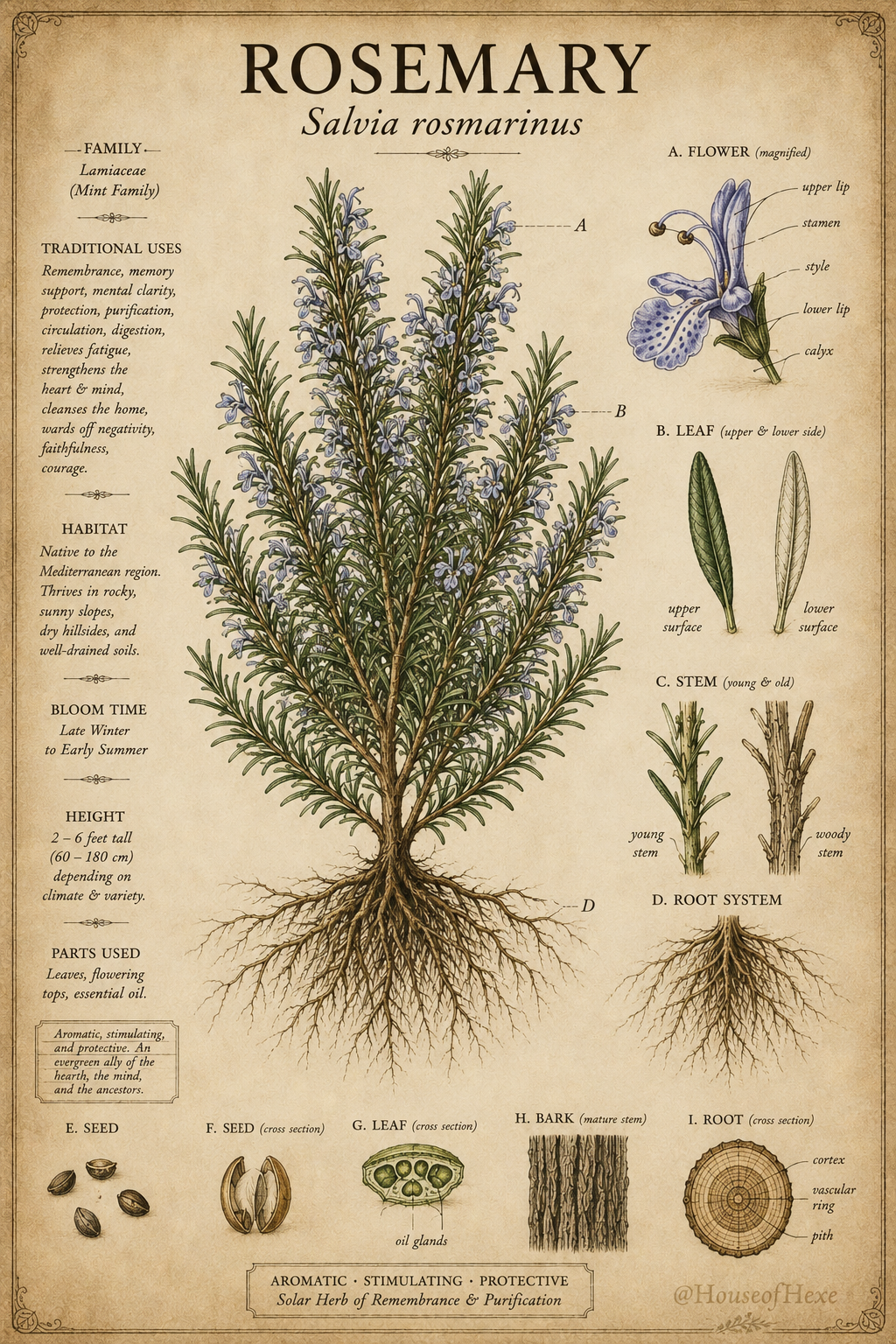
Botanically, Rosemary is now classified as Salvia rosmarinus, though many herbal texts still use the older name Rosmarinus officinalis. It is a woody evergreen shrub native to the Mediterranean region, with narrow needle-like leaves and small two-lipped flowers that may be blue, violet, white, or pale pink. Missouri Botanical Garden notes its aromatic gray-green foliage and typical growth as an upright evergreen shrub in warm climates. (Missouri Botanical Garden)
In traditional herbal practice, Rosemary has been associated with digestion, circulation, muscular discomfort, mental clarity, and nervous exhaustion. The European Medicines Agency recognizes rosemary leaf and rosemary essential oil in traditional herbal medicinal use for minor muscular and joint pain and minor peripheral circulatory complaints. (European Medicines Agency (EMA))
Magically, Rosemary is one of the old household guardians. It cleanses without becoming watery, protects without becoming heavy, and remembers without becoming sentimental. It is the herb of the hearth that says: what belongs here may remain, and what does not may leave.
Botanical Identification
Salvia rosmarinus is a perennial evergreen shrub in the Lamiaceae family, the mint family. Like many mints, it carries aromatic oils, square-ish stems when young, opposite leaves, and strong fragrance.
Growth Habit
Rosemary grows as a woody, branching shrub. Depending on variety and climate, it may remain compact or grow several feet tall and wide. In warm regions, it can become a substantial hedge plant. In colder climates, it is often grown in pots and overwintered indoors.
Leaves
The leaves are narrow, linear, leathery, and needle-like, with a deep green upper surface and a paler underside. They are intensely aromatic when crushed.
Flowers
Rosemary flowers are small, two-lipped, and usually blue to violet, though white and pink forms exist. Bees love them. In mild climates, Rosemary may bloom for a long season.
Stem
Young stems are green and flexible, becoming woody with age. Older Rosemary carries a shrub-like, almost miniature-tree character.
Habitat
Rosemary prefers full sun, excellent drainage, and lean to moderately fertile soil. It does not like wet feet. Its Mediterranean origin is reflected in its love of sun, warmth, air movement, and drier conditions.
Lookalikes / Confusion Species
Rosemary is generally easy to identify by scent, leaf shape, and growth habit. Still, culinary or medicinal Rosemary should come from clean, unsprayed plants. Avoid ornamental nursery stock treated with systemic pesticides unless you know it was grown for edible use.
Traditional Uses
Rosemary has long belonged to the home, the temple, the grave, and the feast table. It is one of those plants whose usefulness made it sacred by repetition.
Memory and Remembrance Herb - Rosemary’s association with memory is ancient and persistent. It appears in funeral customs, wedding rites, student traditions, and folk charms for remembrance. To carry Rosemary was to remember the dead, remember one’s vows, remember one’s purpose, or strengthen the mind.
Household Protection - Rosemary was commonly used to guard the home, especially when planted near doors, hung in bundles, burned as smoke, or added to washing water. It has the temperament of a watchful threshold plant: aromatic, upright, evergreen, and alert.
Digestive Herb - As a culinary herb, Rosemary helps make rich, fatty, and heavy foods feel more digestible. Its aromatic bitterness and volatile oils place it naturally in cooking traditions involving meat, oil, beans, potatoes, bread, and preserved foods.
Circulation and Warmth - Rosemary has a warming, moving quality. Traditional use often places it in formulas for coldness, stagnation, sluggish circulation, and muscular discomfort. This is especially clear in external preparations such as infused oils, liniments, baths, and rubs.
Cleansing and Fumigation - Rosemary has been burned, steeped, and sprinkled in rites of cleansing and blessing. It is not soft like Rose or dreamy like Mugwort. Rosemary clears with brightness. It cuts through heaviness.
Food Preservation and Antioxidant Use - Modern research has also examined rosemary extracts for antioxidant and food-preservative potential, especially because of compounds such as rosmarinic acid, carnosic acid, and carnosol. (Europe PMC)
Modern Herbal Actions
Rosemary is a strong herb, though it is often used casually because it lives in the kitchen. Its medicinal character is warming, aromatic, stimulating, drying, and clearing.
Aromatic - Rosemary’s volatile oils act quickly through scent. The aroma wakes the mind, sharpens the senses, and changes the atmosphere of a room.
Carminative - Rosemary supports digestion through its aromatic action. It is commonly used with heavy meals, gas, sluggish digestion, and cold digestive patterns.
Circulatory Stimulant - Rosemary has long been used where warmth and movement are desired. This may be internal through tea or food, or external through oil, bath, steam, or liniment.
Antioxidant - Rosemary contains several well-studied antioxidant compounds. Reviews have discussed its phenolic constituents and their potential roles in inflammation, oxidative stress, and broader therapeutic activity. (PMC)
Cognitive-Supportive - Rosemary has a strong historical link to memory, and modern research has explored its possible cognitive effects. Reviews have examined rosemary’s potential influence on memory, attention, and neuroprotective pathways, though this should not be exaggerated into a cure-all claim. (PMC)
Antimicrobial - Rosemary essential oil and extracts have been studied for antimicrobial activity. This supports, in a modern way, some of its older uses in cleansing, preservation, and fumigation.
Warming and Moving - Rosemary does not sit quietly in a formula. It moves. It warms the blood, wakes the senses, stirs digestion, and pushes stagnant atmospheres out of corners.
Preparations
Rosemary changes depending on whether it is used fresh, dried, culinary, medicinal, external, or magical. The essential oil is not interchangeable with the leaf.
Tea
Rosemary tea is strong, warming, and aromatic. Use a light hand at first, as too much can become overpowering and drying.
Infusion
A stronger infusion may be used as a hair rinse, ritual wash, foot bath, compress, or cleansing water for thresholds and tools.
Culinary Use
Rosemary is excellent with potatoes, bread, lamb, chicken, mushrooms, beans, roasted vegetables, oils, vinegars, and salt blends. This is one of its oldest and most practical forms of medicine.
Rosemary Vinegar
Rosemary vinegar may be used in cooking, hair rinses, cleansing washes, and protective floor washes.
Rosemary Honey
Rosemary-infused honey can be used for winter teas, sore throats, digestive support, and solar-style strengthening formulas.
Infused Oil
Rosemary-infused oil is useful for massage, scalp care, anointing, muscle rubs, warming body oils, and protective ritual work.
Steam
A rosemary steam can be used for the face, breath, atmosphere, or ritual clearing. It is bright, sharp, and opening.
Bath
Rosemary baths are traditionally suited for cleansing, courage, vitality, protection, and shaking off spiritual heaviness.
Smoke / Incense
Dried Rosemary may be burned in small amounts for cleansing and protection. It can be blended with bay, juniper, frankincense, cedar, mugwort, lavender, or pine.
Essential Oil
Rosemary essential oil is potent and should be diluted before topical use. It is not appropriate for casual internal use.
Magical Uses
Rosemary is one of the most useful magical herbs because it does not belong to only one kind of working. It is protective, purifying, solar, ancestral, intellectual, and domestic.
Protection
Rosemary protects through sharpness and order. It may be placed at doors, added to charm bags, burned as smoke, used in floor washes, or tied into household bundles.
Cleansing
Rosemary clears stagnant energy, especially when the issue feels dull, heavy, confused, or spiritually stale. It is excellent after illness, conflict, grief fog, nightmares, or unwanted visitors.
Remembrance
Rosemary belongs to the dead, to vows, to ancestors, and to memory. It may be used on ancestral altars, in funeral rites, in grief baths, or in workings where something must not be forgotten.
Clarity and Study
Rosemary is a fine herb for study, divination preparation, writing, exams, planning, and focused ritual work. It sharpens the mind without making the spirit cold.
Courage
Rosemary carries a solar backbone. It is useful when fear, confusion, or exhaustion has made a person feel spiritually wilted.
Fidelity and Vows
Because of its old connection to remembrance, Rosemary appears in love and marriage customs as an herb of fidelity. This is not the intoxicated sweetness of Rose. It is the steady remembering of what one has promised.
Ancestral Work
Rosemary is especially useful when ancestral work requires clarity, respect, and protection. It can be used to wash the hands before tending the dead, cleanse the altar, or mark the boundary between reverence and obsession.
Banishing and Threshold Work
Rosemary may be used in banishing when the goal is not destruction, but removal, purification, and the restoration of household order. It is excellent for doorways, windows, brooms, and boundary lines.
Astrological Correspondences
Planetary Rulership: Sun
Rosemary belongs strongly to the Sun through vitality, courage, purification, protection, health, clarity, and sovereign presence. It strengthens the center. It reminds the practitioner to stand upright.
Secondary Rulership: Mercury
Mercury appears in Rosemary through memory, study, speech, thought, nervous quickening, and the movement of information. Rosemary helps the mind gather itself.
Elemental Nature
Fire and Air. Fire governs its warmth, protection, courage, purification, and vitality. Air governs its scent, mental clarity, movement, breath, and cleansing smoke.
Zodiac Ties
Leo for solar courage, visibility, heart-strength, and vitality.
Aries for protection, action, heat, and spiritual defense.
Gemini for memory, learning, language, and mental sharpness.
Seasonal Timing
Rosemary can be worked with year-round because it is evergreen. It is especially suited to solar rites, Sunday work, Mercury day study rites, waning moon cleansing, and household protection during seasonal transitions.
Growing & Harvesting
Rosemary is hardy in temperament, but not careless in its needs. It likes discipline: sun, drainage, pruning, and restraint.
Soil
Rosemary prefers well-drained soil. Heavy wet soil can cause root rot. In clay-heavy regions, grow it in raised beds, rocky soil, or pots with excellent drainage.
Sun
Full sun is best. Rosemary grown in shade becomes weak, leggy, and less aromatic.
Water
Water deeply, then allow the soil to dry somewhat. Rosemary dislikes constant dampness.
Climate
In warm climates, Rosemary may become a perennial shrub. In cold climates, it may need winter protection or indoor overwintering. Penn State Extension notes Rosemary’s preference for full sun and well-drained soil, with caution against overly wet conditions. (Penn State Extension)
Harvesting
Harvest sprigs as needed once the plant is established. Cut above woody growth and avoid stripping the plant bare.
Drying
Hang small bundles or dry sprigs on screens away from direct sun. Once dry, strip leaves from stems and store in airtight jars.
Storage
Store dried Rosemary away from heat, light, and moisture. Good Rosemary should still smell sharp and resinous. If it smells like dust, it has lost much of its virtue.
Warnings & Contraindications
Culinary amounts of Rosemary are generally well tolerated for most people.
Medicinal doses, concentrated extracts, and essential oil require more caution.
Avoid high-dose Rosemary preparations during pregnancy unless guided by a qualified practitioner.
Those with seizure disorders, high blood pressure, bleeding disorders, or complex medication use should use caution with concentrated Rosemary preparations.
Rosemary essential oil should be diluted before topical use and should not be taken internally without professional guidance.
Rosemary may be too stimulating for some people, especially in strong tea, large doses, or evening use.
Allergic reactions are possible.
Final Thoughts
Rosemary is not merely a kitchen herb. It is a keeper of memory, a guardian at the door, a bright flame in the sickroom, and a green blade against spiritual fog.
It teaches the old virtue of remembrance: remember the dead, remember your vows, remember your strength, remember what belongs to you, and remember what must be cleared away.
In the old herbal library, Rosemary belongs in the drawer marked Memory, Fire, Threshold, Protection, Clarity, and the Faithful Dead.
SOURCES / FURTHER READING
European Medicines Agency. “European Union Herbal Monograph on Rosmarinus officinalis L., folium.”
European Medicines Agency. “European Union Herbal Monograph on Rosmarinus officinalis L., aetheroleum.”
Rahbardar, M. G., and H. Hosseinzadeh. “Therapeutic Effects of Rosemary (Rosmarinus officinalis L.) and Its Active Constituents.”
Habtemariam, S. “The Therapeutic Potential of Rosemary (Rosmarinus officinalis) Diterpenes.”
Andrade, J. M., et al. “Rosmarinus officinalis L.: An Update Review of Its Phytochemistry and Biological Activity.”
Missouri Botanical Garden. “Salvia rosmarinus Plant Finder.”
Plants for a Future. “Rosmarinus officinalis.”
Grieve, Maud. A Modern Herbal.
Hoffmann, David. Medical Herbalism