Peppermint | Mentha × piperita
Cool green fire, digestive ally, breath-clearer, temple herb, and sharp-scented keeper of clarityPeppermint is one of the most familiar herbs in the modern world, yet familiarity has made people underestimate it. Mentha × piperita is a hybrid mint, traditionally understood as a cross between watermint and spearmint, and it has moved through kitchen, apothecary, medicine chest, temple, bath, sickroom, and garden with remarkable ease. It is cooling, aromatic, stimulating, soothing, and unmistakably alive with volatile oils.
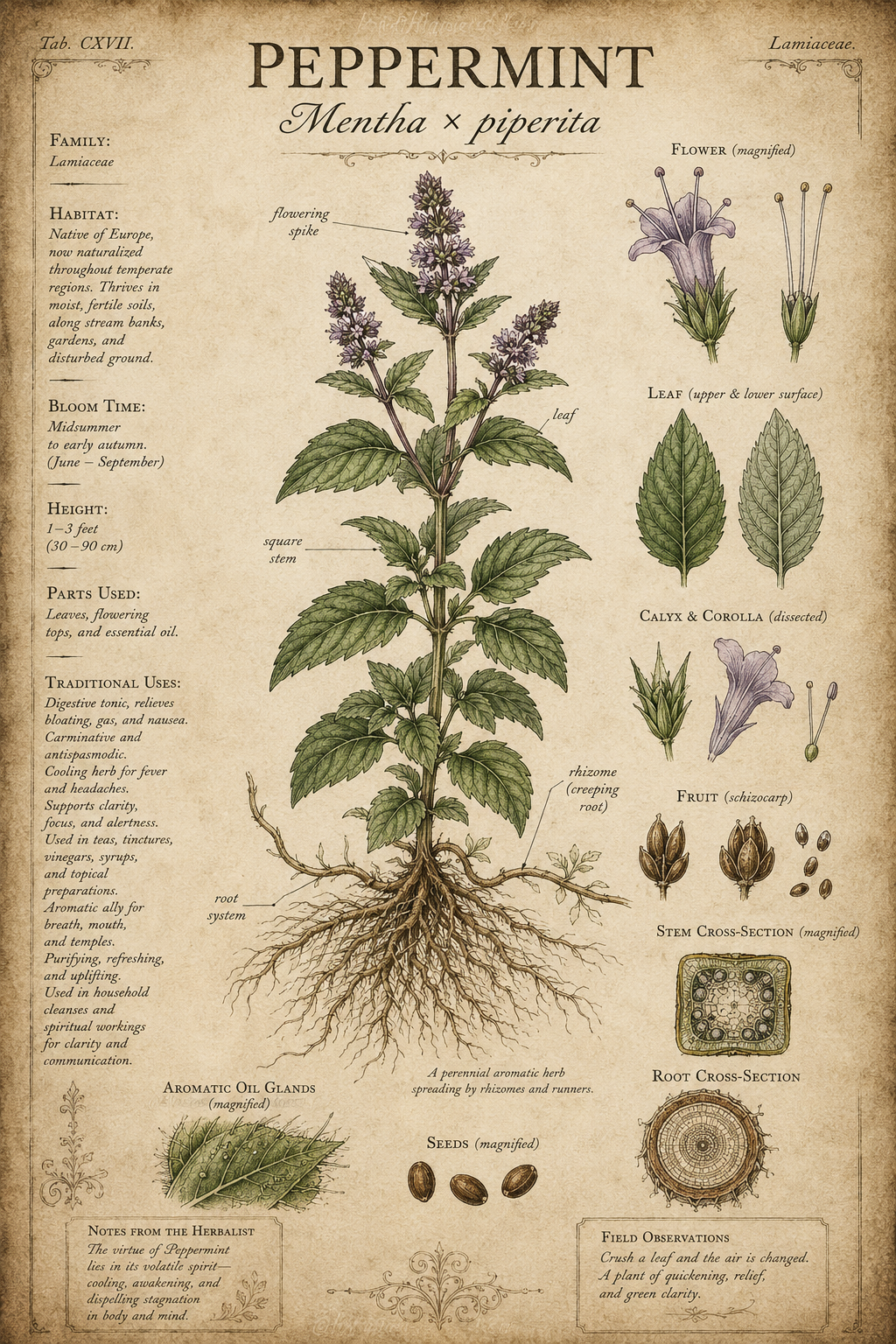
Quick Correspondence Block
Planet: Mercury, Venus
Element: Air, Water
Zodiac: Gemini, Virgo, Libra
Primary Actions: Carminative, antispasmodic, aromatic, cooling, digestive, mild analgesic, nervine-adjacent, antimicrobial folk use
Parts Used: Leaf, flowering tops, essential oil
Preparation Style: Tea, infusion, tincture, syrup, vinegar, steam, compress, oil, bath, floor wash, ritual rinse
Magical Uses: Purification, clarity, communication, healing, prosperity, attraction, cleansing, dream refreshment, house blessing
Spirit of the Herb: The cool green messenger who clears the air, sharpens the tongue, settles the stomach, and opens the windows.
Overview
Peppermint is a plant of immediate recognition. Crush one leaf between the fingers and the whole body responds: breath deepens, the mouth cools, the mind sharpens, and the stomach seems to remember order. It is one of those herbs that entered daily life so thoroughly that it became ordinary, appearing in tea tins, tooth powders, candies, balms, soaps, cordials, and household remedies. Yet beneath that commonness is a plant of old and precise virtue.
Botanically, Peppermint is Mentha × piperita, a hybrid commonly described as arising from watermint, Mentha aquatica, and spearmint, Mentha spicata. It belongs to the Lamiaceae family, the great mint family, with its square stems, opposite leaves, aromatic oils, and generous tendency to spread. Modern botanical references continue to describe it as a cultivated and widely naturalized hybrid mint. (Encyclopedia Britannica)
Traditionally, Peppermint has been used for the stomach, breath, nerves, head, temples, and household atmosphere. It is the herb poured after a heavy meal, tucked into sachets, steeped for nausea, added to baths, rubbed into the temples, and scattered where stale air or stale feeling has gathered. It does not move like a heavy root medicine. It moves like scent, vapor, breath, and quick green intelligence.
Modern herbalism still values Peppermint for digestive discomfort, gas, cramping, tension, nausea, and aromatic refreshment. Peppermint oil, especially in enteric-coated forms, has been studied for irritable bowel syndrome, with reviews and clinical summaries noting benefit for abdominal pain and global IBS symptoms in adults. (NCCIH)
Botanical Identification
Mentha × piperita is a perennial aromatic herb in the Lamiaceae family. Like other mints, it has square stems, opposite leaves, and a strong scent released when bruised.
Growth Habit
Peppermint grows as a spreading perennial, often forming dense patches through creeping rhizomes and runners. Where it is happy, it expands quickly and should be treated as a plant that prefers movement over containment.
Height / Spread
Usually grows around 1–3 feet tall, though conditions may influence size.
Leaves
Leaves are opposite, pointed, serrated, and dark green, often with a slightly purple cast to stems or veins. The scent is sharp, cool, sweet, and penetrating.
Flowers
Small purple to lilac flowers appear in dense terminal spikes, typically in summer.
Stem
The stem is square, a classic marker of the mint family.
Roots / Runners
Peppermint spreads by underground rhizomes and surface runners. Because the plant is a hybrid, it is often propagated vegetatively rather than reliably by seed.
Habitat
Peppermint prefers moist, rich soil and does well along damp edges, garden beds, stream margins, and cultivated herb patches.
Lookalikes / Confusion Species
Peppermint may be confused with other mints, including spearmint, apple mint, watermint, and field mint. Identification should rely on scent, leaf shape, growth habit, flower structure, and source. Many mints hybridize easily, so garden mints are not always perfectly tidy in their identities.
Traditional Uses
Peppermint’s traditional use is deeply domestic. It belongs to the meal table, the sickroom, the wash basin, the apothecary shelf, and the threshold of the house.
Digestive Herb
Peppermint has long been used after meals to ease heaviness, gas, bloating, nausea, and cramping. Its aromatic oils make it a classic carminative herb, helping move trapped wind and settle digestive discomfort.
Breath and Mouth Herb
The sharp cooling taste of Peppermint made it a natural addition to tooth powders, mouth rinses, candies, and breath preparations. It freshens, clears, and leaves behind the sensation of cleanliness.
Head and Temple Herb
Peppermint has been used in folk preparations for tension, heat, headache patterns, and mental fatigue. Diluted Peppermint oil or strong Peppermint preparations have been applied externally to the temples and neck, though the essential oil must be used carefully.
Nausea and Travel Discomfort
Peppermint tea and aromatic inhalation have long been used for queasiness, especially when the stomach feels unsettled, nervous, or stagnant.
Household Freshening
Peppermint has been placed in sachets, washes, and cupboards to refresh stale air and discourage pests. Its scent carries the feeling of windows opened after illness or winter confinement.
Bath and Body Use
Peppermint has been added to baths, foot soaks, rinses, and compresses for cooling, stimulation, and refreshment. In hot weather or after exhaustion, it has the old virtue of bringing a person back into themselves.
Modern Herbal Actions
Peppermint is often treated as a simple tea herb, but its actions are not minor. Its strength lies in volatile oil, especially menthol and related compounds.
Carminative
Peppermint helps ease gas, bloating, and digestive stagnation through its aromatic action.
Antispasmodic
Peppermint oil has been studied for its ability to relax smooth muscle in the digestive tract, which is one reason it appears so often in discussions of IBS and abdominal cramping. (PMC)
Cooling Aromatic
Peppermint creates a cooling sensation through menthol. This does not mean the plant is physically cold in the simplistic sense, but that it acts upon sensory pathways in a way the body perceives as cooling.
Mild Analgesic External Use
Diluted Peppermint oil is used externally in some preparations for tension, sore muscles, and head discomfort.
Digestive Nervine-Adjacent Use
Peppermint is not usually framed as a deep nervine like skullcap or motherwort, but it can be useful where nerves and digestion meet: nervous stomach, clenched belly, stress nausea, or tension that rises into the gut.
Aromatic Antimicrobial Folk Use
Peppermint has a long history in breath, mouth, and cleansing preparations. Modern studies explore antimicrobial qualities of mint oils, though household use should not be inflated into a cure-all claim.
Preparations
Peppermint is one of the easiest herbs to prepare, but preparation matters. A delicate cup of tea, a strong infusion, and a drop of essential oil are not the same medicine.
Tea
Peppermint tea is the classic preparation for digestion, nausea, breath, and general refreshment. Cover the cup while steeping to preserve the volatile oils.
Infusion
A stronger infusion may be used for ritual washes, baths, compresses, and more pronounced aromatic effect.
Tincture
Peppermint tincture may be used in small amounts for digestive discomfort or added to formulas where a cooling aromatic quality is desired.
Syrup
Peppermint syrup can be used in digestive preparations, throat formulas, or culinary remedies.
Vinegar
Peppermint vinegar may be used in cleaning preparations, hair rinses, foot soaks, and summer cooling formulas.
Steam
Peppermint steam can help open the senses and clear the feeling of heaviness in the head, but it should be used gently and kept away from the eyes.
Compress
A cooled Peppermint infusion can be used as a compress for heat, tension, or tired feet.
Essential Oil
Peppermint essential oil is potent and should be diluted. It is not interchangeable with the leaf. One cup of Peppermint tea and one drop of Peppermint essential oil are very different in concentration and risk.
Ritual Wash
A strong Peppermint infusion may be added to floor washes, door washes, altar cleansings, and baths for clarity, freshness, removal of stagnation, and opening communication.
Magical Uses
Peppermint is a herb of clarity, movement, cleansing, and quickening. It does not have the heavy authority of roots or the thorned warning of baneful plants. Its magic is sharper, brighter, and more immediate.
Purification
Peppermint is excellent in cleansing washes where the goal is not solemn exorcism, but refreshment. It clears stale rooms, heavy moods, old arguments, and the clinging feeling that lingers after illness or stress.
Clarity
Use Peppermint in workings for mental focus, study, divination preparation, writing, speaking, and decision-making. Its scent wakes up the mind.
Communication
Under Mercury, Peppermint fits workings involving speech, messages, writing, negotiation, and clear expression. It is useful before difficult conversations when the goal is clean words rather than emotional fog.
Healing
Peppermint belongs in healing charms, especially those concerned with digestion, breath, cooling, and restoration after overwhelm.
Prosperity and Attraction
Like many green, fragrant, fast-growing herbs, Peppermint appears in prosperity and drawing work. It may be added to money washes, business floor washes, charm bags, and cash box preparations to “freshen the road” and keep movement flowing.
House Blessing
Peppermint works well in house blessings after cleaning, illness, conflict, or stagnation. It does not merely banish. It refreshes the current of the home.
Dream and Temple Work
Peppermint may be used lightly in dream pillows or pre-divination washes when the practitioner wants clarity without heaviness. It sharpens the threshold rather than deepening trance.
Astrological Correspondences
Planetary Rulership: Mercury
Peppermint’s quick scent, mental clarity, digestive movement, and relationship to breath and speech place it strongly under Mercury. It is a messenger herb, a word herb, a study herb, a trade herb, and a plant of movement through channels.
Secondary Rulership: Venus
Venus appears in Peppermint’s sweetness, pleasure, refreshment, cleanliness, attraction, and use in body care. This is not the heavy rose-Venus of devotion and grief. It is the bright green Venus of freshness, charm, and pleasantness restored.
Elemental Nature
Air and Water. Air governs scent, breath, speech, mental clarity, and movement. Water governs cooling, soothing, digestion, and emotional refreshment.
Zodiac Ties
Gemini for Mercury, speech, breath, hands, and quick thought.
Virgo for digestion, herbal preparation, order, and bodily discernment.
Libra for sweetness, pleasantness, attraction, and restoring harmony in the atmosphere.
Seasonal Timing
Peppermint belongs to late spring and summer, when its cooling nature is most appreciated. Magically, it suits Mercury days and hours, waxing moon work for attraction and prosperity, and cleansing rites after heat, conflict, illness, or stagnation.
Growing & Harvesting
Peppermint is easy to grow, sometimes too easy. It is a plant that teaches abundance and boundary management at the same time.
Soil
Prefers rich, moist, well-drained soil.
Sun
Grows in full sun to partial shade. In hot climates, afternoon shade may help preserve tenderness.
Water
Likes consistent moisture. Dry conditions can make the plant tougher and less lush.
Containment
Grow Peppermint in pots or contained beds unless you want it to wander. It spreads aggressively by runners and rhizomes.
Harvest Timing
Harvest leaves before flowering for best flavor and aromatic strength. Flowering tops may also be gathered.
Best Time of Day
Harvest after dew has dried but before intense afternoon heat, when aromatic oils are still strong.
Drying Notes
Dry in thin layers or small bundles away from direct sunlight. Good dried Peppermint should remain green and strongly aromatic.
Storage Notes
Store dried Peppermint in airtight jars away from light, heat, and moisture. If it smells like dust instead of mint, it has lost much of its virtue.
Warnings & Contraindications
Peppermint leaf tea is widely used, but Peppermint is still active and should be treated with respect.
Peppermint may worsen reflux, GERD, or heartburn in some people because it can relax the lower esophageal sphincter. Peppermint oil capsules are especially likely to cause heartburn if not properly formulated.
Avoid using Peppermint essential oil on or near the face of infants and young children. Menthol-containing products can cause serious breathing concerns in young children. NCCIH also cautions that Peppermint oil should not be used on infants or small children. (NCCIH)
Use caution with gallbladder disease, bile duct obstruction, severe reflux, hiatal hernia, or complex digestive conditions unless guided by a qualified practitioner.
Peppermint essential oil should be diluted before topical use and should not be casually ingested. Essential oil is not tea.
Pregnancy and breastfeeding require caution, especially with concentrated Peppermint oil. LactMed notes that Peppermint contains menthol, menthone, and menthyl acetate, and that topical Peppermint preparations have been studied in nipple pain contexts, but this does not mean all Peppermint preparations are appropriate in all lactation situations. (NCBI)
Do not assume that because Peppermint is common, it is weak.
Final Thoughts
Peppermint is the herb of the opened window. It clears what has gone stale, cools what has become overheated, wakes what has gone dull, and reminds the body that relief can arrive through the simplest green things.
It is not rare. It is not exotic. It does not need mystery added to it. Its mystery is already present in the way one leaf can change the breath, the stomach, the room, and the mind.
In the old herbal library, Peppermint belongs in the drawer marked Breath, Digestion, Clarity, and Green Thresholds.
SOURCES / FURTHER READING
National Center for Complementary and Integrative Health. “Peppermint Oil: Usefulness and Safety.”
Alammar, N., et al. “The Impact of Peppermint Oil on the Irritable Bowel Syndrome.” BMC Complementary Medicine and Therapies, 2019.
Chumpitazi, B. P., et al. “The Physiologic Effects and Safety of Peppermint Oil and Its Efficacy in Irritable Bowel Syndrome and Other Functional Disorders.” Alimentary Pharmacology & Therapeutics, 2018.
American Botanical Council. “Peppermint.”
Britannica. “Peppermint.”
LactMed. “Peppermint.” National Library of Medicine.
Grieve, Maud. A Modern Herbal.
Hoffmann, David. Medical Herbalism.