Nettle | Urtica dioica
Green blood-builder, boundary herb, iron-rich guardian of the old hedgerowNettle is one of the great strengthening herbs of the traditional apothecary: mineral-rich, deeply green, bristling with protection, and long associated with blood, bones, resilience, nourishment, and the sharp medicine of boundaries. Urtica dioica has been used across food, folk medicine, textile history, spring tonics, urinary support, and magical protection. It is a plant that teaches through contact. Approach carelessly, and it stings. Approach properly, and it feeds.
Quick Correspondence Block
Planet: Mars, Saturn
Element: Fire, Earth
Zodiac: Aries, Scorpio, Capricorn
Primary Actions: Nutritive tonic, mineral-rich herb, alterative, diuretic, anti-inflammatory, astringent, antihistamine-adjacent folk use
Parts Used: Leaf, seed, root
Preparation Style: Infusion, tea, tincture, vinegar, cooked green, powder, hair rinse, ritual wash
Magical Uses: Protection, boundaries, uncrossing, strength, resilience, vitality, reversal, household warding
Spirit of the Herb: The old green guardian who says, “Come correctly, or be corrected.”
Overview
Nettle is not a delicate herb. It does not invite the hand with softness or perfume. It stands upright, serrated, bristling, and armed with tiny hollow hairs that deliver an immediate lesson in respect. Yet beneath that sting is one of the most nourishing green medicines in the old herbal world.
Traditionally, Nettle has been used as a spring tonic, blood-building food herb, mineral restorative, urinary herb, and strengthening ally after depletion. It belongs to soups, teas, iron pots, hedgerows, livestock feed, fiber work, and the hands of people who understood that medicine was not always rare or exotic. Sometimes the strongest medicine grew exactly where people tried to remove it.
Modern herbalism still values Nettle for its mineral content, nutritive quality, urinary support, and inflammatory modulation. Reviews note its nutritional richness and traditional use as both food and medicine, with studies exploring anti-inflammatory, antioxidant, hypotensive, and other pharmacological properties. (PMC)
In magical practice, Nettle is a boundary herb. It protects, strengthens, repels, reverses, and teaches the practitioner how to hold their line. It is not gentle comfort. It is the fence, the thorn, the iron nail, the hiss at the door.
Botanical Identification
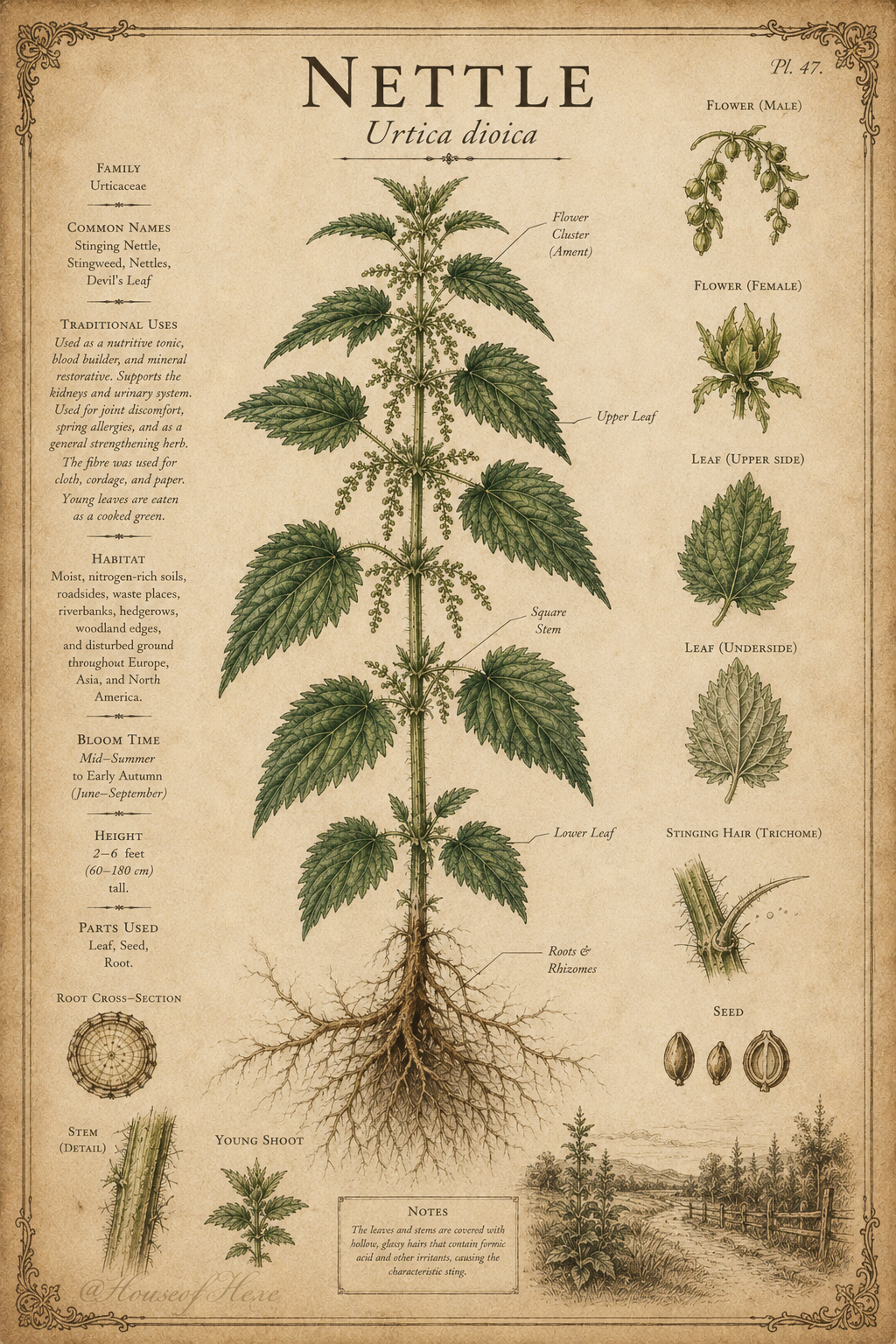
Urtica dioica is a perennial herbaceous plant in the Urticaceae family. It is native to much of Europe, Asia, North Africa, and parts of North America, and it has naturalized widely in disturbed soils, damp margins, woodland edges, riverbanks, and old homestead ground.
Growth Habit
Nettle grows in upright colonies, often spreading through rhizomes beneath the soil. Where it is happy, it does not usually appear as one plant, but as a stand.
Height / Spread
Often reaches 2–6 feet tall depending on soil, moisture, and climate.
Leaves
Leaves are opposite, serrated, pointed, and deeply green. The surface and stems are covered with fine stinging hairs.
Flowers
Small greenish flowers appear in drooping clusters from the leaf axils. Nettle is dioecious, meaning male and female flowers are usually borne on separate plants.
Sting
The stinging hairs contain irritating compounds that can cause burning, itching, redness, and tingling on contact.
Habitat
Moist, nitrogen-rich soils, barnyards, compost edges, streambanks, woodland margins, garden edges, old settlements, and disturbed ground.
Lookalikes / Confusion Species
Nettle may be confused with dead nettle, mint-family plants, or other serrated-leaf greens, though true stinging nettle announces itself quickly through touch. Always identify before harvesting.
Traditional Uses
Nettle’s history is practical, domestic, medicinal, and magical. It has been eaten as a spring green, brewed into teas, used in folk remedies for joint pain, worked into fiber, fed to animals, and gathered as a strengthening herb after winter.
Spring Tonic
Nettle has long been gathered in early spring when the young tops are tender and mineral-rich. After months of preserved food and winter heaviness, Nettle offered green strength, iron, chlorophyll, and movement.
Food Herb
Cooked Nettle has been eaten much like spinach. Cooking, drying, or blending disables the sting, making the leaves useful in soups, pestos, broths, vinegars, and cooked greens.
Blood and Mineral Support
Traditional herbalists often place Nettle among the nourishing herbs used for weakness, depletion, anemia-adjacent patterns, postpartum recovery traditions, and general rebuilding. This is not because it acts like an iron pill, but because it brings mineral density, food value, and long-term restoration.
Urinary Support
Nettle leaf has a long tradition as a urinary herb. It has been used to encourage urination and support the kidneys and urinary passages. Nettle root has a separate modern and traditional use history, especially in relation to lower urinary tract symptoms associated with benign prostatic hyperplasia. (herbalgram.org)
Joint and Inflammatory Folk Use
Nettle has been used both internally and externally in folk practice for rheumatic pain and stiffness. The old practice of urtication involved deliberately brushing or striking the skin with fresh Nettles to provoke circulation and heat.
Fiber and Domestic Use
Nettle stalks have historically been used for fiber, cordage, and textile work. This makes Nettle not only an herb of medicine, but of survival, clothing, labor, and household craft.
Modern Herbal Actions
Nettle is often treated as a foundational nutritive herb in modern Western herbalism. It is less dramatic than some plants, but its strength lies in steady rebuilding.
Nutritive Tonic - Nettle leaf is rich in minerals and is commonly used as a long infusion for nourishment, resilience, and mineral support.
Diuretic - Nettle leaf has traditional use as a diuretic, supporting fluid movement through the urinary system.
Anti-inflammatory - Modern reviews have explored Nettle’s anti-inflammatory and antioxidant potential, though traditional use should not be mistaken for a guaranteed clinical outcome. (PMC)
Alterative - In traditional herbal language, Nettle is often called an alterative, meaning an herb used over time to support the body’s natural channels of elimination and restoration.
Astringent - Nettle carries a mild astringency, useful in certain tissue states where tone and tightening are needed.
Seasonal Allergy Folk Use - Freeze-dried Nettle and Nettle preparations are commonly used in modern folk herbalism for seasonal allergies, especially where histamine-type irritation is present. Evidence is mixed, but the use remains common.
Preparations
Nettle is versatile and deeply practical. It belongs as much in the kitchen as in the apothecary.
Long Infusion
A mineral-rich infusion is one of the classic ways to prepare Nettle leaf. Dried Nettle is steeped for several hours to draw out its deep green nourishment.
Tea
A shorter tea may be used when a lighter preparation is desired, though it will not extract the same depth as a long infusion.
Tincture
Nettle tincture is used when convenience or a more concentrated preparation is needed.
Vinegar
Nettle vinegar is excellent for drawing minerals and can be used in food, hair rinses, and folk-style strengthening preparations.
Cooked Green
Young Nettle tops can be cooked into soups, sauces, stir-fries, and broths once properly handled.
Powder
Dried Nettle powder may be added to foods, capsules, smoothies, or green blends.
Hair Rinse
Nettle has a long association with scalp and hair preparations, especially where strength, shine, and stimulation are desired.
Ritual Wash
A strong Nettle infusion may be added to floor washes, threshold washes, or protective baths when the magical purpose is boundary, resilience, or reversal.
Magical Uses
Nettle is a herb of protection, consequence, and vitality. It does not merely “raise energy.” It teaches force with structure.
Protection
Hang dried Nettle near doors, add it to warding jars, place it in charm bags, or use it in floor washes for household protection.
Boundaries
Nettle is ideal for workings where the issue is intrusion, draining people, spiritual overreach, or weak personal boundaries.
Uncrossing and Reversal
In folk magic, sharp and stinging herbs are often used to return harm, cut through crossed conditions, and make hostile forces uncomfortable enough to leave.
Strength and Resilience
Use Nettle in workings for endurance, recovery, courage, and rebuilding after depletion.
Vitality and Blood Mysteries
Because of its deep green mineral richness and traditional connection to blood-building, Nettle fits workings involving life force, recovery, menstruation, vitality, and embodied strength.
Household Warding
Nettle may be combined with salt, rosemary, black pepper, garlic peel, iron, or thorned plants for strong household boundary work.
Astrological Correspondences
Planetary Rulership: Mars
Nettle’s sting, heat, defense, blood association, and protective virtue place it strongly under Mars. This is the Mars of boundaries, inflammation, courage, irritation, iron, and the body’s immediate response to threat.
Secondary Rulership: Saturn
Saturn appears in Nettle’s austerity, structure, endurance, and boundary-making. Nettle is not indulgent. It teaches discipline, containment, and respect for limits.
Elemental Nature
Fire and Earth. Fire for the sting, circulation, defense, and martial heat. Earth for the minerals, nourishment, roots, rebuilding, and bodily restoration.
Zodiac Ties
Aries for Mars, blood, sharpness, courage, and immediate defense.
Scorpio for protection, reversal, venomous medicine, and hidden strength.
Capricorn for Saturn, endurance, structure, and survival through harsh conditions.
Seasonal Timing
Nettle belongs strongly to spring, especially the first green surge after winter. Magically, it is useful during Mars hours, waning moon protection work, and rites of rebuilding after depletion.
Growing & Harvesting
Nettle is easy to grow if given moisture and nitrogen-rich soil, but it should be placed with care. Like many powerful plants, it does not always stay politely where it is planted.
Soil
Prefers rich, moist, nitrogen-heavy soil.
Sun
Full sun to partial shade.
Water
Likes consistent moisture but can adapt once established.
Containment
Because Nettle spreads by rhizomes, consider growing it in a contained bed or managed patch.
Harvest Timing
Harvest young tops in spring before flowering for food and leaf medicine. Once the plant flowers and sets seed, many herbalists shift away from using the older leaf for food.
Best Parts to Gather
Leaf in spring and early growth. Seed later in the season. Root is harvested separately, usually in autumn, and used differently than the leaf.
Drying Notes
Dry in thin layers or small bundles with good airflow. Wear gloves while handling fresh plant material.
Storage Notes
Store dried Nettle in airtight jars away from light, heat, and moisture. Good dried Nettle should remain deeply green, not brown and lifeless.
Warnings & Contraindications
Nettle is generally considered a nourishing herb, but it is still an active plant and should be treated with respect.
Fresh Nettle stings. Wear gloves when harvesting.
Use caution with blood pressure medications, diabetes medications, blood thinners, lithium, diuretics, kidney disease, or complex medication regimens unless guided by a qualified practitioner.
Pregnancy use is debated in herbal circles. Nettle leaf appears in many traditional pregnancy formulas, but some modern sources caution against use due to possible uterine stimulation concerns. Use professional guidance during pregnancy.
Use caution during breastfeeding. LactMed notes that Nettle has been used traditionally as a postpartum tonic and galactagogue, but scientific support for increasing milk supply is minimal. (NCBI)
Do not assume that “nutritive” means appropriate for everyone in unlimited amounts.
Final Thoughts
Nettle is a teacher of respect. It stands at the edge of the path with its leaves full of nourishment and its body covered in warning. That is part of its doctrine. Not everything nourishing is soft. Not every protector is gentle. Not every medicine asks to be approached casually.
It feeds the blood, strengthens the body, guards the threshold, and reminds the practitioner that boundaries are not cruelty. They are structure. They are survival. They are the fence that allows the garden to grow.
In the old herbal library, Nettle belongs in the drawer marked Blood, Iron, Boundaries, and Green Fire.
SOURCES / FURTHER READING
Bhusal, K. K., et al. “Nutritional and Pharmacological Importance of Stinging Nettle.” Heliyon, 2022.
Devkota, H. P., et al. “Stinging Nettle (Urtica dioica L.): Nutritional Composition, Bioactive Compounds, and Food Functional Properties.” Molecules, 2022.
American Botanical Council. “Stinging Nettle Herb and Leaf.”
LactMed. “Stinging Nettle.” National Library of Medicine.
Grieve, Maud. A Modern Herbal.
Hoffmann, David. Medical Herbalism.
Tilgner, Sharol. Herbal Medicine From the Heart of the Earth.