Mugwort | Artemisia vulgaris
Threshold herb, dream-opener, old green key of the hedgeMugwort is one of the great liminal herbs of the traditional apothecary: bitter, aromatic, moon-marked, protective, and deeply tied to dreams, digestion, menstruation, spirit-sight, and the old rites of crossing. Historically called the “mother of herbs” in parts of medieval European herbal tradition, Artemisia vulgaris has long stood at the meeting place between medicine and magic. It belongs to the roadside, the threshold, the traveler’s pouch, the dream pillow, the smoke bundle, and the hand of the practitioner who understands that some plants do not merely soothe the body. Some plants open doors. (PMC)
Quick Correspondence Block
Planet: Moon, Venus, Artemis/Diana current
Element: Earth, Air
Zodiac: Cancer, Virgo, Scorpio
Primary Actions: Bitter tonic, carminative, nervine, emmenagogue, antispasmodic, aromatic digestive
Parts Used: Leaf, flowering tops
Preparation Style: Tea, tincture, vinegar, smoke, bath, dream pillow, infused oil for ritual use
Magical Uses: Dreams, divination, protection, spirit work, thresholds, psychic sight, banishing confusion
Spirit of the Herb: The old hedge-walker who says, “Pay attention. The gate is already open.”
Overview
Mugwort is not a soft herb, though it is often used in soft places. It does not arrive with the sweetness of chamomile or the golden reassurance of calendula. Mugwort is bitter, silvery, sharp-scented, and ancient in its temperament. It belongs to the edge of paths, the margins of fields, the neglected fence line, and the places where cultivated land begins to give way to the wild.
In traditional herbalism, Mugwort has been used for digestion, sluggishness, menstrual complaints, tension, cramping, and states where the body seems to need movement, warmth, and direction. Its bitterness wakes the stomach. Its aromatics move wind and stagnation. Its old reputation as a uterine herb places it among the plants once approached with both respect and caution.
In magical practice, Mugwort is one of the classic herbs of dreaming, divination, protection, and spirit perception. It is placed beneath pillows, burned as smoke, carried during travel, added to baths before ritual, and used by practitioners who work with omens, thresholds, ancestral currents, and the unseen. It is not an herb of fantasy. It is an herb of attention.
If Calendula is sunlight made useful, Mugwort is moonlight made practical.
Botanical Identification
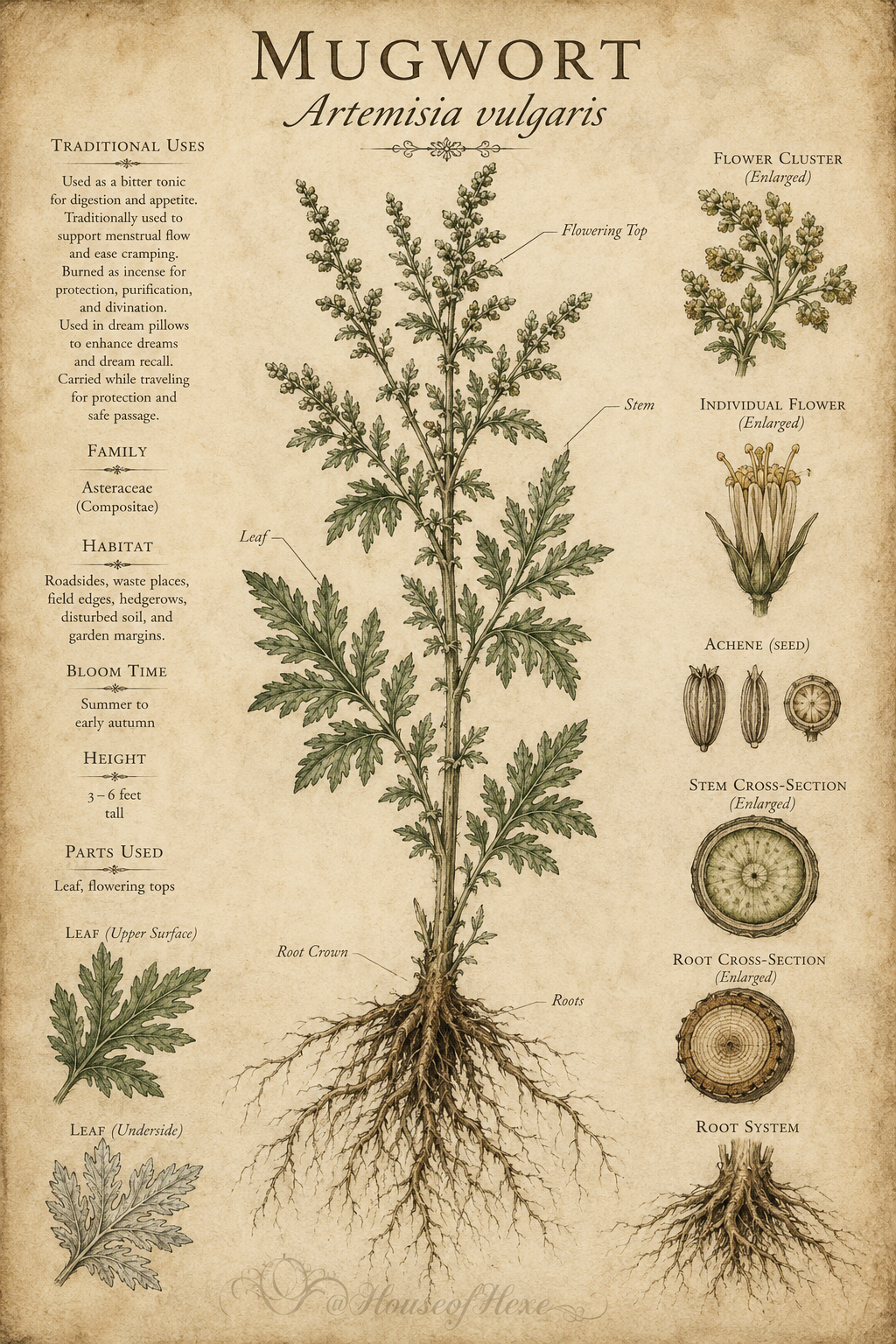
Artemisia vulgaris is a perennial member of the Asteraceae family. It grows vigorously and can become invasive in many regions due to its spreading rhizomes. The plant is native across much of Europe, Asia, and North Africa and has naturalized widely elsewhere. (PMC)
Growth Habit
Mugwort grows as a tall, upright perennial with branching stems and a strong rhizomatous root system. Once established, it can spread aggressively.
Height / Spread
Often reaches 3–6 feet tall depending on soil, moisture, and climate.
Leaves
Leaves are deeply lobed, dark green above, and pale silvery-white beneath. This contrast is one of Mugwort’s most useful identifying features.
Flowers
Small, clustered flower heads appear along branching upper stems. They are not showy and may appear greenish, yellowish, reddish, or brownish depending on maturity.
Scent
Aromatic, bitter, green, slightly camphorous, and resinous.
Habitat
Roadsides, disturbed soil, field edges, old homesteads, waste ground, hedgerows, and garden margins.
Bloom Season
Generally summer into early autumn.
Lookalikes / Confusion Species
Mugwort may be confused with other Artemisia species, ragweed, or young chrysanthemum-like foliage. Positive identification matters, especially because members of the Asteraceae family can trigger allergic reactions in sensitive individuals.
Traditional Uses
Mugwort’s history reaches across European, Asian, and folk medicinal traditions. It has been used as a bitter digestive herb, a menstrual herb, a protective plant, a ritual fumigant, a traveler’s charm, and a plant associated with dream, omen, and spirit-contact.
Digestive UsesTraditionally, Mugwort was used to stimulate sluggish digestion, ease gas, settle heaviness after rich food, and awaken appetite. Its bitter quality places it among the herbs that remind the body to begin the digestive process before food has even been fully received.
Menstrual UsesMugwort has a long-standing reputation as an emmenagogue, meaning an herb traditionally used to stimulate or regulate menstrual flow. This is one reason it must be avoided during pregnancy. (NCCIH)
Travel and ProtectionEuropean folklore often placed Mugwort in the shoes, belt, or travel bundle to guard against exhaustion, misfortune, wild animals, harmful spirits, and danger on the road. Its old association with St. John’s Eve also tied it to midsummer rites of protection and purification.
Beer, Food, and Domestic UseBefore hops became dominant in brewing, Mugwort was among the bitter herbs used in gruit ales. It has also been used in some culinary traditions as a seasoning, especially for rich meats and fatty foods. (Wikipedia)
Smoke and Ritual CleansingMugwort has been burned as incense or fumigation herb in various folk and spiritual contexts, especially where protection, dream work, cleansing, or spirit communication were desired.
Modern Herbal Actions
Mugwort remains a respected but more cautious herb in modern herbalism. It is not usually treated as a casual daily tea for everyone. Its strength lies in its bitterness, aromatics, warming movement, and affinity for threshold states in both body and spirit.
Bitter TonicMugwort stimulates digestion through bitterness. Bitter herbs are traditionally taken before meals to support appetite, digestive secretions, and the body’s readiness to receive food.
CarminativeIts aromatic nature helps move gas, bloating, and digestive discomfort related to stagnation or coldness.
NervineMugwort has a long folk association with the nervous system, especially in states of tension, dream disturbance, restlessness, or heightened sensitivity. This use is traditional, though modern clinical evidence remains limited. (NCCIH)
EmmenagogueMugwort has historically been used to stimulate menstruation and move pelvic stagnation. This is a traditional use, not a casual recommendation, and it is the root of many of its pregnancy warnings.
AntispasmodicTraditionally used where cramping, tension, or spasmodic discomfort is present, especially in digestive or menstrual contexts.
Aromatic Warming HerbMugwort is warming, moving, and dispersing. It is especially suited to cold, stagnant, heavy, damp, or dull presentations rather than hot, inflamed, irritated states.
Preparations
Mugwort is versatile, but it should be prepared with respect. It is not an herb to throw into everything simply because it has become popular in dream work.
Tea / Infusion
A light infusion may be used traditionally for digestion, menstrual sluggishness, or dream work. It is bitter, so small amounts are usually sufficient.
Tincture
Often used in small doses by herbalists when a stronger or more precise preparation is needed.
Vinegar
Mugwort vinegar may be used externally in ritual washes, hair rinses, or threshold cleansing blends.
Dream Pillow
Dried Mugwort is often placed in dream pillows, sometimes with lavender, hops, chamomile, rose, or blue lotus depending on the practitioner’s goal.
Smoke / Fumigation
Dried Mugwort may be burned as a ritual smoke for divination, protection, and clearing liminal space. Use ventilation and caution, especially around asthma, pets, children, or smoke-sensitive people.
Bath
A strong infusion can be added to bathwater before divination, ancestor work, shadow work, or rites of transition.
Infused Oil
Mugwort-infused oil is usually more ritual than medicinal. It may be used to dress candles, anoint tools, mark the brow before divination, or prepare the hands before spirit work.
Magical Uses
Mugwort is one of the great herbs of the hedge. It belongs to the practitioner who dreams, watches, listens, and learns to read the quiet pressure of the unseen.
Dream Work
Place dried Mugwort near the bed, under the pillow, or in a dream sachet to support vivid dreaming and dream recall. It does not guarantee prophecy. It sharpens the threshold where memory, symbol, spirit, and subconscious pattern meet.
Divination
Mugwort may be burned before tarot, scrying, bone casting, pendulum work, or omen reading. It helps shift the mind away from ordinary noise and toward symbolic perception.
Protection
Carry Mugwort while traveling, hang it near doors, or add it to boundary workings. Traditionally, it protects those who walk between places: roads, crossroads, thresholds, and spiritual crossings.
Spirit Work
Mugwort is suited to ancestor rites, cemetery work, liminal rituals, and communication practices where the practitioner needs both openness and protection.
Banishing Confusion
Use Mugwort when the issue is not simply “bad energy,” but fog, distortion, false perception, or dreamlike uncertainty. It clears by sharpening attention.
Threshold Rites
Add to baths, floor washes, or smoke blends before rites of initiation, seasonal crossing, grief work, endings, and beginnings.
Astrological Correspondences
Planetary Rulership: Moon
Mugwort’s relationship with dreaming, night vision, psychic perception, and the hidden places of the mind places it strongly under lunar influence.
Secondary Rulership: Venus
Its connection to the reproductive system, women’s mysteries, and embodied cycles gives it a secondary Venusian current, though this is not the soft Venus of rose petals. Mugwort carries the older Venus of blood, rhythm, fertility, and the body’s hidden tides.
Elemental Nature
Earth and Air. Earth for the bitter, bodily, digestive, root-spreading medicine. Air for dreams, omens, smoke, divination, and the messages moving between worlds.
Zodiac Ties
Cancer for lunar memory, dreams, ancestry, and the womb-current.
Virgo for bitter medicine, digestion, herbal skill, and practical healing.
Scorpio for thresholds, shadow, spirit work, blood mysteries, and transformation.
Seasonal Timing
Mugwort is especially suited to midsummer protection rites, waning moon divination, dark moon dream work, and autumn threshold practices.
Lunar Relevance
Best used in dream and divination rites during the waxing moon for vision-building, the full moon for heightened perception, and the dark moon for ancestor work, shadow work, and hidden knowledge.
Growing & Harvesting
Mugwort is easy to grow. Sometimes too easy.
Soil
Tolerates poor, disturbed, dry, or average soils. It does not require pampering.
Sun
Full sun to partial shade.
Water
Moderate to low once established.
Climate Notes
Hardy, persistent, and adaptable. In many regions, Mugwort spreads aggressively and should be grown with caution.
Containment
Because it spreads by rhizomes, consider growing it in a container or a contained bed rather than loose in a garden.
Harvest Timing
Harvest leaves before flowering for many herbal preparations. Flowering tops may be gathered when the plant begins to bloom.
Best Parts to Gather
Leaf and flowering tops.
Drying Notes
Dry in bundles or in thin layers with good airflow. Keep away from harsh direct sunlight to preserve aroma.
Storage Notes
Store in airtight jars away from light, heat, and moisture. Properly dried Mugwort should remain aromatic and green-gray.
Warnings & Contraindications
Mugwort is not for everyone.
Do not use Mugwort during pregnancy. It has traditional emmenagogue use and may stimulate uterine activity. NCCIH also advises that Mugwort should not be used during pregnancy, and notes that there is not enough evidence to determine its general safety orally or topically. (NCCIH)
Avoid during breastfeeding unless guided by a qualified practitioner.
Use caution with Asteraceae allergies, especially if sensitive to ragweed, chamomile, yarrow, daisies, or related plants.
Mugwort may cause contact dermatitis in some individuals. (Domestic Medicine)
Avoid excessive internal use. More is not better.
Use caution with seizure disorders, serious medical conditions, blood-thinning medications, sedatives, or complex medication regimens unless professionally guided.
Do not use dream herbs as a substitute for sleep hygiene, medical care, mental health support, or common sense.
Final Thoughts
Mugwort is an herb of crossings. It grows where people pass by without looking, yet it has followed human beings through medicine, magic, brewing, travel, women’s mysteries, dream practice, and household protection for centuries. It is not a decorative witch herb. It is older, rougher, and more demanding than that.
It teaches attention. It asks the practitioner to notice the underside of the leaf, the message inside the dream, the feeling at the threshold, the difference between true vision and projection. Mugwort does not hand over certainty. It sharpens perception.
In the old occult botanical library, Mugwort belongs in the drawer marked Dreams, Roads, Blood, and the Hedge Between Worlds.
SOURCES / FURTHER READING
National Center for Complementary and Integrative Health. “Mugwort: Usefulness and Safety.” (NCCIH)
Ekiert, Halina, et al. “Significance of Artemisia vulgaris L. in the History of Medicine and Its Possible Contemporary Applications.” Molecules, 2020. (PMC)
Grieve, Maud. A Modern Herbal.
Hoffmann, David. Medical Herbalism.
Tilgner, Sharol. Herbal Medicine From the Heart of the Earth.
Easley, Thomas, and Steven Horne. The Modern Herbal Dispensatory.