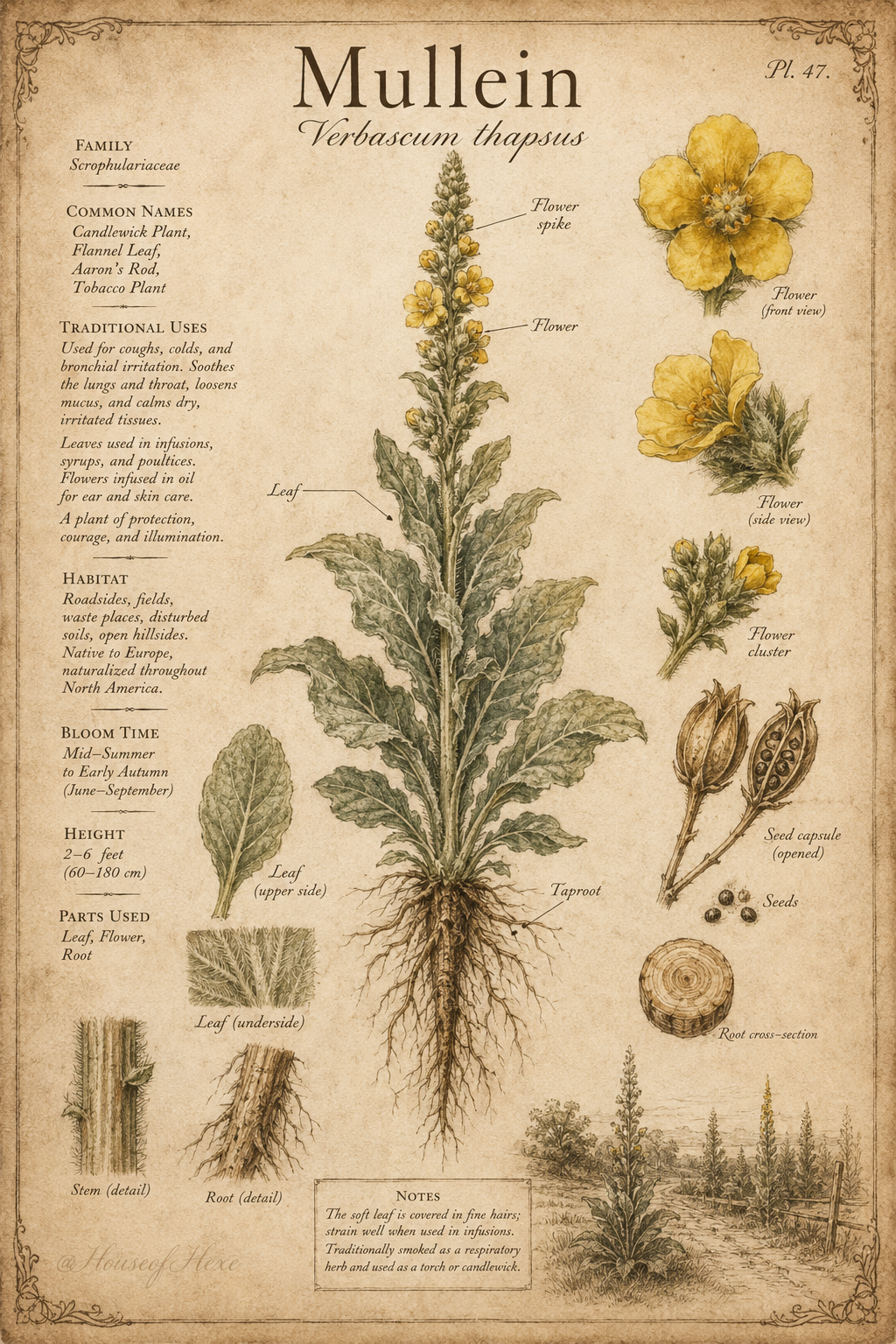
Lung leaf, candlewick plant, soft guardian of the breath and roadside thresholdMullein is a tall, biennial herb with woolly leaves, a deep taproot, and a towering yellow flower stalk that has made it instantly recognizable across roadsides, fields, disturbed soils, and old homesteads. Traditionally, it has been valued as a respiratory herb, especially for coughs, throat irritation, bronchial dryness, and stuck phlegm. Modern herbalists still reach for the leaf and flower as a soothing, demulcent, mildly expectorant plant ally for the lungs, while folk practitioners have long associated Mullein with protection, courage, spirit work, and illumination. Botanically, Verbascum thapsus belongs to the Scrophulariaceae family and is widely naturalized across North America. (plants.sc.egov.usda.gov)
Quick Correspondence Block
Planet: Saturn, Mercury, Sun
Element: Air with Earth and Fire
Zodiac: Gemini, Virgo, Capricorn, Leo
Primary Actions: Demulcent, expectorant, vulnerary, mild lymphatic, soothing respiratory tonic
Parts Used: Leaf, flower, root
Preparation Style: Infusion, oil, poultice, steam, syrup, tincture, smoke/incense, charm work
Magical Uses: Protection, courage, spirit communication, illumination, threshold work, warding, road-opening through hardship
Spirit of the Herb: The candle in the chest.
Overview
Mullein is one of those plants that looks as though it stepped out of an old field guide fully aware of its own symbolism. In its first year, it keeps low to the earth, forming a rosette of thick, soft, woolly leaves. In its second year, it rises into a tall flowering stalk, sometimes reaching several feet high, crowned with small yellow blossoms that open gradually along the spike.
Medicinally, Mullein belongs to the old respiratory cabinet. Its leaves are soft, mucilaginous, and soothing, making them especially suited to dry, irritated tissues of the throat, lungs, and bronchial passages. Traditional sources describe Mullein flower use for coughs, colds, and catarrh of the upper respiratory tract, and modern herbal references continue to place it among the classic herbs for easing respiratory irritation and helping loosen mucus. (European Medicines Agency (EMA))
Spiritually, Mullein carries the virtue of protection through endurance. It grows where the ground has been disturbed. It stands upright in poor soil, roadside dust, abandoned places, and neglected edges. This makes it a plant of resilience, breath, boundaries, and quiet authority. Mullein does not protect by hiding. It protects by standing tall.
Botanical Identification
Mullein is usually a biennial. In the first year, it forms a basal rosette of large, pale green to gray-green leaves covered in dense, soft hairs. These leaves can be long, broad, and velvety to the touch, with a texture that has inspired folk names like “flannel leaf” and “blanket leaf.”
In the second year, the plant sends up a tall, erect flowering stalk. This stalk is also woolly and may reach impressive height depending on soil and moisture. Small yellow flowers bloom along the spike, often opening a few at a time rather than all at once. The plant has a strong central presence, almost candle-like in form.
Mullein is taprooted and reproduces by seed. It favors disturbed ground, roadsides, dry fields, gravelly soils, open slopes, and places where competition is low. In North America, common Mullein is considered nonnative and widespread, occurring throughout most of the United States and southern Canada. (US Forest Service)
Lookalike caution:Mullein is fairly distinctive because of its dense woolly leaves and tall yellow flower spike, but proper identification still matters. Do not gather from roadsides sprayed with herbicides, polluted ditches, industrial lots, or heavy-traffic areas. Mullein loves disturbed places, and not all disturbed places are clean medicine.
Traditional Uses
Mullein has a long record of use in European and North American folk medicine. The flowers and leaves were traditionally prepared for coughs, colds, bronchial irritation, hoarseness, and phlegmy respiratory states. The European Medicines Agency assessment notes documented traditional use of Mullein flower for catarrh of the upper respiratory tract, cough, and colds. (European Medicines Agency (EMA))
The leaves were often infused as tea, sometimes combined with other respiratory herbs such as marshmallow, thyme, horehound, elecampane, or licorice. Because the leaves contain fine hairs that can irritate the throat, traditional preparation required careful straining through cloth.
Mullein flowers were also infused into oil, most famously for ear complaints in folk practice. This use is usually associated with the flowers rather than the leaf. The infused oil was applied externally around the ear or used according to traditional household practice, though modern use should be cautious and avoided if the eardrum may be ruptured or infection is severe.
Historically, dried Mullein stalks were sometimes used as torches or candlewicks after being dipped in fat or wax, which likely contributed to its associations with illumination, spirit work, and guiding light. This is where Mullein becomes more than lung medicine. It becomes a plant of the lamp, the road, and the threshold.
Modern Herbal Actions
Mullein leaf is best understood as a softening respiratory herb.
As a demulcent, it soothes dry, irritated tissues. Demulcents are herbs rich in mucilage or soothing constituents that help calm roughness, heat, and irritation along mucous membranes. This makes Mullein especially useful when the throat feels scraped, the cough feels dry, or the lungs feel irritated rather than deeply infected.
As an expectorant, Mullein helps the body move mucus more effectively. It is not a harsh forceful herb. Its virtue is gentler. It moistens, softens, and encourages the lungs to release what is stuck.
As a vulnerary, Mullein has been used externally for irritated skin, minor wounds, and inflamed tissues. Its soft leaf lends itself naturally to poultice work, though the leaf hairs may bother sensitive skin.
As a mild lymphatic, some herbalists use Mullein root or leaf where there is swelling, stagnation, or congestion, especially around the neck, throat, and upper respiratory tract. This is a more nuanced use and belongs in the hands of practitioners who understand tissue states rather than treating herbs like single-purpose pills.
Mullein is not a replacement for medical care in pneumonia, severe asthma, chest pain, whooping cough, high fever, difficulty breathing, or persistent respiratory symptoms. It is a household herb with old virtue, not a reason to ignore danger.
Preparations
Tea / Infusion:
This is the most common preparation for dried Mullein leaf. Pour hot water over the leaf, cover, steep well, and strain through fine cloth or a coffee filter to remove the irritating hairs.
Long Infusion:
Useful when working with Mullein as a deeper respiratory tonic. Again, strain extremely well.
Syrup:
Mullein combines beautifully with marshmallow, thyme, elderflower, licorice, or elecampane in respiratory syrups. It brings softness to stronger herbs.
Tincture:
Mullein tincture may be used in respiratory formulas, though many herbalists prefer infusion for the soothing mucilage of the leaf.
Flower Oil:
Mullein flower oil is a traditional preparation, especially for external ear and skin applications. Use only clean, fully dried or properly wilted flowers to reduce moisture in the oil.
Poultice:
Fresh leaf can be bruised and applied externally, though sensitive skin may react to the hairs. A cloth barrier can help.
Steam:
Mullein leaf may be added to respiratory steams, especially when the lungs feel dry, tight, or irritated.
Smoke / Incense:
Mullein has a history of being smoked or burned in some folk contexts, especially for respiratory or magical purposes. This should be approached carefully. Smoke is still smoke, and inhaling it may irritate the lungs, especially for people with asthma, COPD, or respiratory sensitivity.
Magical Uses
Mullein is a plant of the roadside, the abandoned field, the old path, and the upright spine. It has the temperament of a guardian who does not need to shout. It simply stands, watches, and keeps the lamp lit.
Use Mullein for:
Protection during spirit work
Courage when the breath feels trapped by fear
Road-opening after hardship
Guiding the dead or honoring ancestors
Warding the home and thresholds
Calling light into grief, confusion, or spiritual heaviness
Strengthening the voice before difficult speech
Softening sorrow held in the chest
Dream work and liminal rites
Breaking through stagnation without becoming violent
Mullein leaf may be added to charm bags, protection bundles, road-opening workings, ancestor lamps, dream pillows, and ritual baths. The dried stalk, because of its candle-like form and historical connection to torches, can be used symbolically as a ritual wand, staff, or guiding flame in devotional and threshold work.
In House of Hexe practice, Mullein is not treated as a trendy “lung detox” herb. It is approached as a plant of breath, endurance, and guarded softness. It teaches that protection does not always look like iron and thorn. Sometimes protection looks like velvet leaves around a tired chest.
Astrological Correspondences
Mullein carries Saturnian virtue through its upright structure, endurance, roadside survival, and ability to grow where the land has been disturbed. Saturn rules hardship, boundaries, bones, time, and the lessons that make a thing strong enough to remain.
It also carries Mercurial virtue through the lungs, breath, speech, pathways, and exchange. Mercury governs movement, communication, roads, and the passages between worlds. Mullein’s affinity for the respiratory tract and roadside places makes Mercury a fitting correspondence.
There is also a gentle Solar current in Mullein, especially in the yellow flowers and torch-like stalk. This is not the blazing Sun of domination. It is the guiding lamp, the candle in the dark, the small flame that helps the traveler keep walking.
Elementally, Mullein is primarily Air, through the lungs, breath, voice, and wind-shaped roadside habitat. Its Earth appears in the rosette, taproot, and grounding endurance. Its Fire appears in the flowering torch, protective illumination, and old association with candlewick and flame.
Zodiacally, Mullein may be worked through Gemini for breath, speech, and the lungs; Virgo for herbal medicine and practical tending; Capricorn for endurance and boundary; and Leo for courage, light, and the heart-fire needed to keep standing.
Growing & Harvesting
Mullein is easy to grow in the right conditions, though it often chooses its own place better than the gardener does. It prefers full sun, well-drained soil, and open ground with little competition. It is especially fond of disturbed soil and can appear after digging, clearing, fire, construction, or disruption.
Growing notes:
Soil: Dry to moderately fertile, well-drained, disturbed soilSun: Full sun preferredWater: Low to moderate once establishedClimate: Adaptable, drought-tolerant once rootedGrowth cycle: BiennialFirst year: Basal rosetteSecond year: Tall flowering stalk and seedHarvest leaf: First-year leaves or young second-year leaves before heavy floweringHarvest flower: Freshly opened yellow flowers, gathered carefully over timeHarvest root: First-year root, usually in autumnDrying: Dry leaves thoroughly with good airflowStorage: Airtight jar, cool dark place, label clearly
Mullein can produce a large number of seeds and may spread readily in open disturbed areas. In some regions it is treated as weedy or invasive, so grow and harvest with awareness of your local ecology. (Alaska Center for Conservation Science)
Warnings & Contraindications
Mullein leaf must be strained very well before drinking. The tiny hairs on the leaves can irritate the throat and mouth if left in the tea.
Avoid internal use or seek qualified guidance with:
Pregnancy or breastfeeding
Infants and very young children
Severe asthma, COPD, pneumonia, or serious respiratory illness
Persistent cough lasting more than a few weeks
Cough with blood, chest pain, high fever, or difficulty breathing
Known allergy or sensitivity to Mullein or related plants
Use of multiple medications where mucilage may interfere with absorption
Safety data is limited, and some references advise avoiding use during pregnancy and lactation due to lack of evidence. Clinical dosing data is also limited, so Mullein should be used respectfully rather than carelessly. (Drugs.com)
Do not put Mullein oil into the ear if there is any possibility of a ruptured eardrum, drainage, severe pain, or serious infection. Ear issues can become complicated quickly and should not be treated casually.
Final Thoughts
Mullein is medicine for the breath, but also for the person who has forgotten how to stand upright after being weathered. It grows from disturbed ground and turns hardship into architecture. It softens the lungs without weakening the spine. It teaches that gentleness and protection are not opposites.
In the old apothecary, Mullein belongs in the drawer marked cough, smoke, roadside spirits, lamp-light, and endurance. It is the herb for the chest that needs soothing, the threshold that needs guarding, and the traveler who needs one more candle to make it through the dark.
Sources / Further ReadinG
USDA PLANTS Database. Verbascum thapsus L. Common Mullein.
American Botanical Council. “Mullein Verbascum thapsus L. Family: Scrophulariaceae.”
European Medicines Agency. Assessment Report on Verbascum thapsus and related Mullein flowers.
USDA Forest Service Fire Effects Information System. Verbascum thapsus.
Drugs.com Natural Products. “Mullein Uses, Benefits & Dosage.”
Maud Grieve. A Modern Herbal.
David Hoffmann. Medical Herbalism.