Marshmallow | Althaea officinalis
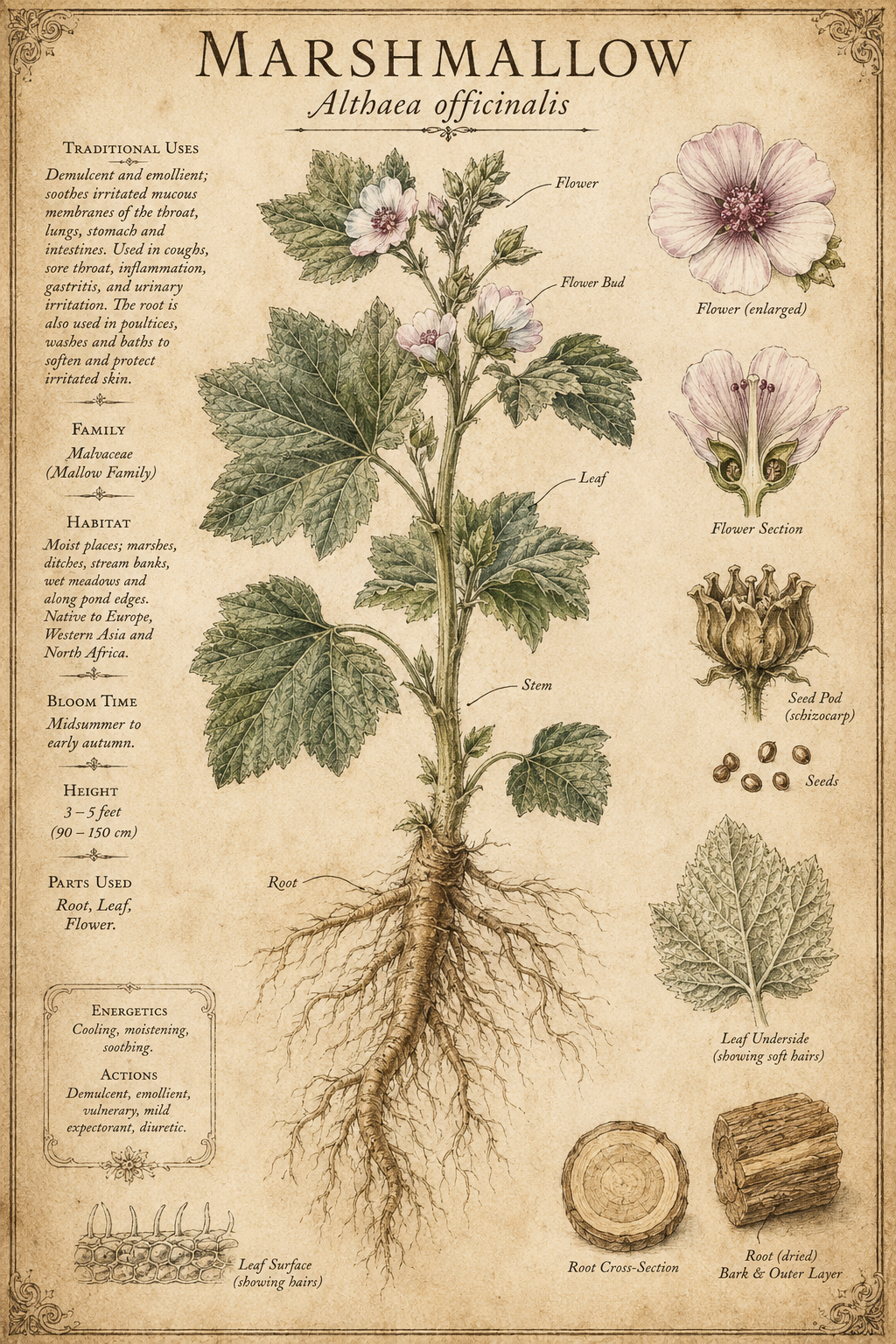
Softening root, mucilaginous healer, guardian of tender tissuesMarshmallow is a perennial mallow-family herb known for its velvety leaves, pale pink-white flowers, and thick, soothing root. Historically, it was valued in household medicine for irritated throats, dry coughs, inflamed digestion, and tender skin, while its root also gave early marshmallow confection its name. Modern herbalists still prize Marshmallow as a classic demulcent, meaning it moistens, coats, and soothes irritated mucous membranes. Magically, Marshmallow is a softening herb: used for peace, tenderness, reconciliation, emotional repair, and gentle protection around the home.
Quick Correspondence Block
Planet: Moon, Venus
Element: Water with Earth
Zodiac: Cancer, Taurus, Pisces
Primary Actions: Demulcent, emollient, vulnerary, soothing expectorant, mild diuretic
Parts Used: Root, leaf, flower
Preparation Style: Cold infusion, tea, syrup, poultice, wash, bath, lozenge
Magical Uses: Peace, reconciliation, emotional softening, love, household harmony, gentle protection
Spirit of the Herb: The hand that cools the burn.
Overview
Marshmallow is one of the great softeners of the apothecary. Where Angelica stands at the gate with a blade in one hand and a torch in the other, Marshmallow keeps the hearth dampened, the throat soothed, the belly lined, and the spirit from hardening into a wall.
This is not a weak herb. Soft does not mean powerless. Marshmallow works through coating, cooling, moistening, and protecting. Its medicine is found in its mucilage, a slippery plant substance that becomes especially noticeable when the root or leaf is soaked in water. That slick, silken quality is exactly why herbalists use it for dry coughs, irritated throats, inflamed digestion, hot urinary discomfort, and tender skin.
Historically, Marshmallow was part medicine, part food, part household comfort. The root was once used in sweet preparations long before modern marshmallows became a sugar-and-gelatin confection. In the older herbal tradition, it belonged to the world of poultices, syrups, soothing drinks, and softening remedies for tissues that had become hot, raw, dry, or inflamed.
Spiritually, Marshmallow is a plant of tenderness with boundaries. It does not banish by force. It quiets sharpness, cools anger, softens grief, and helps restore the kind of peace that can actually be lived inside.
Botanical Identification
Marshmallow is a hardy herbaceous perennial in the Malvaceae family, the same family as common mallow, hollyhock, okra, hibiscus, and cacao.
It usually grows upright, reaching around 3–5 feet tall, though in rich, moist conditions it may grow taller. The stems are sturdy, softly hairy, and often lightly branched. The whole plant has a muted grey-green softness to it, as though it has been dusted with velvet.
The leaves are alternate, broad, softly hairy, and often shallowly lobed, with toothed or scalloped edges. They feel downy to the touch, which is one of Marshmallow’s useful identifying features. The flowers are small compared to hollyhock or hibiscus, usually pale pink, white, or blush-toned, with five petals and a delicate mallow-family appearance. Blooms usually appear from midsummer into early autumn. (PFAF)
Marshmallow naturally favors damp ground: marshes, ditches, streambanks, brackish wetlands, moist meadows, and disturbed wet edges. It is native to parts of Europe, western Asia, and northern Africa, and has naturalized in some areas beyond its original range. (Missouri Botanical Garden)
Lookalikes and confusion species:
Marshmallow may be confused with common mallow, hollyhock, musk mallow, and other Malvaceae relatives. This is generally not as dangerous as confusion in families like Apiaceae, but correct identification still matters. Marshmallow is usually distinguished by its upright perennial habit, softly hairy grey-green leaves, pale flowers, and thick medicinal root.
Traditional Uses
Marshmallow has a long reputation as a soothing remedy for irritated tissue. Traditional herbalists used the root and leaf for dry cough, sore throat, inflamed mouth, irritated stomach, urinary discomfort, and skin inflammation. The European Medicines Agency recognizes Marshmallow root as a traditional herbal medicine used as a demulcent for oral or pharyngeal irritation with dry cough, and for mild gastrointestinal discomfort. (European Medicines Agency (EMA))
The leaf carries similar soothing virtues and is traditionally used for irritation of the mouth and throat, dry cough, and mild inflammation of the gastrointestinal mucosa. Health Canada’s monograph also recognizes Marshmallow leaf as a demulcent for these traditional uses. (webprod.hc-sc.gc.ca)
In domestic medicine, Marshmallow was often made into syrups, teas, lozenges, poultices, washes, and softening preparations. The root was especially prized because of its thick mucilage. When soaked in cool water, it releases a slippery texture that coats and calms irritated surfaces.
Culinarily, Marshmallow root was historically used in early sweet preparations, including the ancestor of the modern marshmallow confection. Modern commercial marshmallows usually no longer contain the plant, but the name remains as a ghost of the old root.
Modern Herbal Actions
Marshmallow is best understood as a cooling, moistening, mucilaginous herb.
As a demulcent, it soothes irritated mucous membranes. This makes it useful when the throat, mouth, stomach, intestines, or urinary tract feel dry, hot, raw, or inflamed.
As an emollient, it softens and soothes external tissues. This is why Marshmallow appears in poultices, washes, baths, and skin preparations.
As a soothing expectorant, it does not aggressively force mucus up like stronger stimulating herbs. Instead, it calms dry, irritated coughing and supports the respiratory passages when they feel scratched, hot, or overworked.
As a vulnerary, it supports the comfort and repair of irritated or tender tissue. In plain terms, it is the kind of herb used when something needs to be cooled, coated, and given a chance to stop screaming.
As a mild urinary soother, Marshmallow may be used in formulas for hot, irritated urinary patterns, especially when paired with other appropriate herbs.
Preparations
Tea / Infusion:
Marshmallow leaf may be prepared as a warm infusion. This is useful for mild throat, lung, digestive, or urinary irritation.
Cold Infusion:
This is the signature Marshmallow preparation. Cold water extracts mucilage beautifully. Add dried root to cool water and let it steep for several hours or overnight. The result should feel slippery and soft.
Decoction:
Root can be gently simmered, but high heat may reduce some of the mucilaginous quality. For Marshmallow root, cold infusion is often preferred when the goal is maximum soothing texture.
Tincture:
Less ideal as a primary preparation because mucilage extracts best in water, not alcohol. Tinctures may still be used in formulas, but they do not fully represent Marshmallow’s softening nature.
Syrup:
Excellent for dry coughs and irritated throats. Marshmallow root combines well with licorice, violet, plantain, elderflower, or rose depending on the formula.
Glycerite:
A good alcohol-free option, especially for children’s-style formulas when appropriate and professionally guided.
Lozenge:
Traditional and practical for throat irritation. Marshmallow root powder can be used in lozenge-style preparations.
Poultice:
Powdered root or leaf can be moistened and applied externally to irritated skin.
Wash:
A cooled infusion may be used as a gentle wash for tender skin or ritual cleansing where softness and peace are the goal.
Bath:
Beautiful for dry skin, grief work, emotional exhaustion, or magical softening after conflict.
Magical Uses
Marshmallow is the herb of softening without surrender.
Use Marshmallow for:
Peace after conflict
Sweetening harsh communication
Reconciliation work
Emotional healing after grief
Gentle love magic
Household harmony
Calming anger
Soothing a restless home
Tender protection around children, elders, and the weary
Dreamwork that requires safety rather than intensity
Softening spiritual hard edges after baneful or defensive work
Marshmallow belongs in workings where the goal is not domination, but repair. It is useful in charm bags for peace, floor washes after arguments, bath blends for emotional recovery, and spellwork meant to cool a situation before it becomes a wildfire.
In House of Hexe work, Marshmallow is not “love and light.” It is the wet cloth laid over a burn. It is the boundary that does not need to bare its teeth because it has already decided what it will and will not absorb.
Astrological Correspondences
Marshmallow carries strong Lunar virtue. It is moistening, cooling, protective, and deeply tied to fluids, tenderness, the stomach, the womb-like container, and the emotional body. The Moon rules the tides within and without, and Marshmallow speaks fluently in that language.
Venus also belongs here through softening, sweetness, reconciliation, beauty, affection, and the restoration of ease. This is Venus not as glamour, but as balm.
Elementally, Marshmallow is Water with Earth. The Water is obvious in its mucilage, cooling action, emotional soothing, and affinity for damp places. The Earth appears in the thick root, the body, the tissue, the protective coating, and the slow rebuilding of comfort.
Zodiacally, Marshmallow fits Cancer for emotional protection and nourishment, Taurus for Venusian softness and bodily comfort, and Pisces for spiritual tenderness, dreamwork, and the dissolving of harshness.
Seasonally, Marshmallow is especially useful in late summer dryness, winter throat irritation, and any season of grief where the body has forgotten how to unclench.
Growing & Harvesting
Marshmallow prefers moist, fertile soil and full sun to partial shade. It is especially well suited to rain gardens, damp borders, pond edges, and herb gardens where it can receive consistent moisture. It is hardy in many temperate climates and is often listed for zones 3–9. (Chicago Botanic Garden)
Growing notes:
Soil: fertile, moist, well-drained but moisture-retentive
Sun: full sun to partial shade
Water: consistent moisture preferred
Climate: hardy perennial in many temperate regions
Height: often 3–5 feet, sometimes taller
Bloom season: midsummer into early autumn
Harvest leaf: before or during flowering
Harvest flower: as blooms open
Harvest root: usually in autumn after the second year
Drying: dry roots thoroughly after washing and slicing
Storage: airtight jar, cool dark place, protected from moisture
For high desert growing, Marshmallow will likely need more water than Mediterranean herbs like lavender or rosemary. Give it a richer bed, afternoon shade if heat is brutal, mulch, and steady moisture. It would likely be happier near a greywater-safe ornamental zone, rain catchment area, greenhouse edge, or any place where the soil does not bake bone-dry by noon.
Warnings & Contraindications
Marshmallow is generally considered a gentle herb, but gentle does not mean careless.
Because of its mucilage, Marshmallow may slow or reduce absorption of medications taken at the same time. Separate Marshmallow from medications by at least 1–2 hours unless guided otherwise by a qualified practitioner. (RxList)
Use professional guidance with:
Pregnancy
Breastfeeding
Diabetes or blood sugar medication
Lithium
Multiple prescription medications
Chronic kidney conditions
Children
Known allergy to Malvaceae plants
Some sources advise caution with blood sugar because Marshmallow may theoretically affect glucose levels. Anyone using medication for diabetes should speak with a qualified clinician before internal use.
If symptoms such as persistent cough, fever, difficulty breathing, blood in sputum, severe throat pain, or ongoing digestive pain are present, seek medical care rather than relying on herbs alone.
Final Thoughts
Marshmallow is the apothecary’s quiet mercy. It teaches that protection does not always arrive as iron, thorn, salt, or flame. Sometimes protection is moisture. Sometimes the medicine is a softened throat, a cooled belly, a kinder room, a nervous system allowed to loosen its fists. Marshmallow is the plant you reach for when the world has been too sharp for too long.
Sources / Further ReadinG
European Medicines Agency. European Union Herbal Monograph on Althaea officinalis L., radix.
Health Canada. Marshmallow — Althaea officinalis — Leaf Monograph.
Hoffmann, David. Medical Herbalism.
Grieve, Maud. A Modern Herbal.
Plants for a Future. “Althaea officinalis — Marsh Mallow.”
Missouri Botanical Garden. “Althaea officinalis.”
Herbal Reality. “Marshmallow — Althaea officinalis.”
American Botanical Council / HerbalGram. “Marshmallow.”