Lavender | Lavandula angustifolia
Nervine flower of peace, protection, grief-softening, and clean thresholdsLavender is a fragrant, semi-woody perennial in the mint family, beloved for its violet flower spikes, silvery foliage, and unmistakable calming scent. Historically, it moved through Egyptian perfumery, Greek and Roman bathing traditions, medieval household medicine, strewing herbs, and protective folk practice. Modern herbalists value lavender as a gentle nervine, aromatic relaxant, digestive support, topical skin ally, and ritual herb for peace, cleansing, sleep, and spiritual order. It is soft, but it is not weak; Lavender clears the room without raising its voice. (Missouri Botanical Garden)
Quick Correspondence Block
Planet: Mercury, with Venusian influence
Element: Air, with soft Water undertones
Zodiac: Gemini, Virgo, Libra
Primary Actions: Nervine, aromatic, carminative, mild antispasmodic, vulnerary, anxiolytic, antimicrobial
Parts Used: Flower buds, flowering tops, leaves in smaller measure
Preparation Style: Infusion, tincture, infused oil, salve, bath, sachet, smoke, incense, linen spray
Magical Uses: Peace, sleep, cleansing, protection, love, grief work, dream magic, threshold blessing
Spirit of the Herb: The quiet housekeeper of the nervous system and the temple.
Overview
Lavender is one of those herbs that has been softened almost to the point of misunderstanding. Modern culture has turned it into a scent for laundry soap, sleepy-time sprays, and pastel gift baskets, but underneath all of that commercial sweetness is an old, capable plant with a long memory.
This is an herb of order. Lavender brings scattered energy back into form. It does not sedate the spirit into oblivion; it smooths the jagged edges so the body can remember how to unclench. Herbalists have long reached for it when the nerves are frayed, digestion is knotted from tension, the skin needs gentle attention, or a home needs to feel clean in more than one way.
Ecologically, Lavender belongs to dry, sunlit places. It thrives where drainage is sharp, heat is honest, and the air moves freely. That tells us much about its medicine. This is not a swamp herb, not a plant of heaviness or stagnation. Lavender belongs to breath, light, movement, and release.
Medicinally, it is calming without being dull. Magically, it is cleansing without being harsh. It is the herb you bring in after the storm, when the banishing is done, the windows are open, and the house needs to become livable again.
Botanical Identification
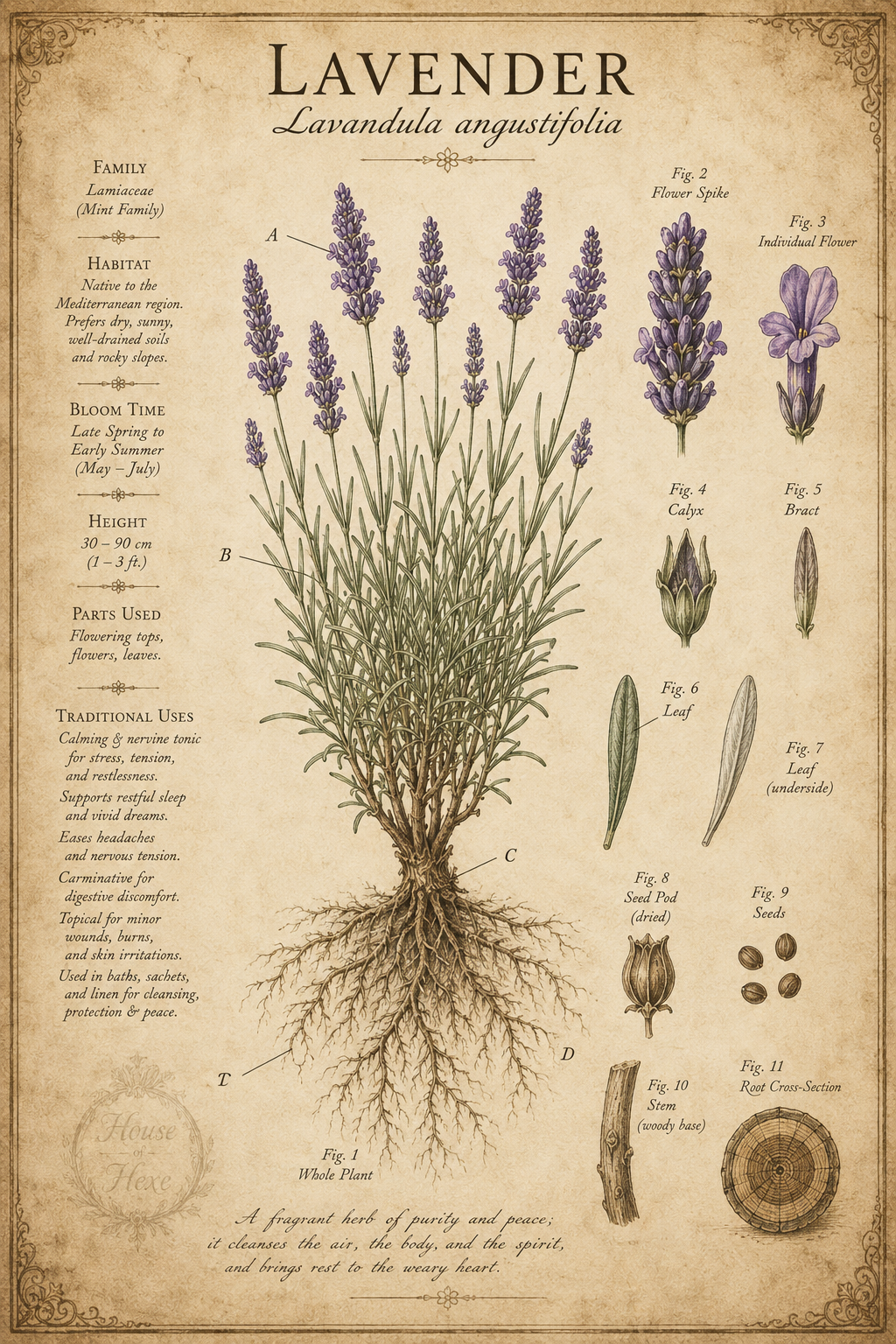
Lavender is a perennial, semi-woody shrub in the Lamiaceae family, the mint family. Like many mints, it carries aromatic oils, opposite leaves, and square stems. English lavender, Lavandula angustifolia, is one of the most commonly used species for culinary and medicinal preparations.
Growth habit:Lavender grows as a compact, branching, semi-woody perennial shrub. Older plants develop woody bases with soft new green growth emerging above.
Height / spread:English lavender commonly reaches about 1.5 to 3 feet tall, depending on cultivar and growing conditions. Compact cultivars may stay closer to 12–18 inches. (Missouri Botanical Garden)
Leaf shape:Leaves are narrow, linear to lance-shaped, gray-green to silvery, and highly aromatic when rubbed. They are arranged oppositely along square stems.
Flower appearance:The flowers appear in terminal spikes, usually purple to blue-violet, though some cultivars may be paler lavender, pink, or white. The flower spikes rise above the foliage on slender stems.
Scent:Lavender has a clean, floral, camphoraceous, slightly sweet aroma. The scent comes largely from volatile oils, especially compounds such as linalool and linalyl acetate. (PMC)
Habitat:Lavender prefers sunny, open, well-drained locations and is native to Mediterranean regions, though it is now cultivated widely in gardens and farms.
Bloom season:English lavender typically blooms from late spring into early summer, with some varieties reblooming later if trimmed properly. (Missouri Botanical Garden)
Lookalikes / confusion species:Several cultivated lavenders are commonly confused, including English lavender, lavandin, spike lavender, Spanish lavender, and French lavender. For medicinal and culinary use, Lavandula angustifolia is generally preferred because of its sweeter profile and lower camphor content compared with some other species.
Traditional Uses
Lavender has been moving through human hands for thousands of years. Ancient Egyptians used it in perfumery and incense. Greek and Roman traditions valued fragrant herbs in bathing, and lavender’s very name is often associated with washing, cleansing, and bathing practices. Dioscorides discussed lavender in the first century, placing it firmly within the old medicinal record. (New Crops & Organics)
In European domestic medicine, Lavender became a household herb: tucked into linens, added to baths, used in waters, vinegars, oils, and sachets. It was a strewing herb in medieval homes, scattered or hung to sweeten rooms, deter insects, and keep stagnant smells at bay. (The Herb Society of America Blog)
Folk use often placed Lavender at the crossroads of medicine and magic. It was used for love, chastity, sleep, protection, purification, and peace in the home. Crosses woven with Lavender were sometimes hung at doorways for protection, showing its role not only as a pleasant fragrance, but as a plant of spiritual boundary and domestic blessing. (The Herb Society of America Blog)
In older household herbalism, Lavender was used for headaches, nervous tension, melancholy, faintness, digestive discomfort, minor wounds, and troubled sleep. It was rarely the loudest herb in the formula, but it often served as the harmonizer, the one that made the rest of the medicine feel more inhabitable.
Modern Herbal Actions
Lavender is best understood as an aromatic nervine with digestive, topical, and antimicrobial virtues.
A nervine is an herb that supports the nervous system. Lavender is used when tension rises into the shoulders, jaw, stomach, head, and sleep cycle. It is especially suited to people who feel overstimulated, irritable, restless, or emotionally frayed.
An aromatic herb contains volatile oils that affect the senses, digestion, mood, and sometimes the respiratory system. Lavender’s scent is a major part of its medicine. Even before it reaches the stomach, it begins speaking through the nose and nervous system.
A carminative helps ease gas, bloating, and digestive tension. Lavender is not as strongly digestive as fennel, ginger, or peppermint, but it can be useful when digestion is upset by stress.
A mild antispasmodic helps relax muscular tension and spasms. This is part of why Lavender appears in formulas for tension headaches, menstrual discomfort, tight muscles, and nervous stomach patterns.
A vulnerary supports the healing of minor skin irritations and wounds. Lavender-infused oil or properly diluted lavender essential oil is often used in topical preparations, though essential oil should always be handled with respect.
Modern research has focused heavily on lavender for anxiety, relaxation, and sleep. NCCIH notes that oral lavender products may be safe short-term in studied amounts, and some evidence suggests lavender may be helpful for anxiety, though the quality of evidence varies. Aromatherapy is also considered possibly safe but may cause headache or coughing in some people. (NCCIH)
Preparations
Lavender is versatile, but it asks for a light hand. Too much Lavender can make a tea taste like soap, a bath feel overwhelming, or a formula become more perfumed than medicinal.
Tea / infusion:
Best for nervous tension, restlessness, mild headaches, digestive tension, and sleep support. Use a small amount of dried flowers. Lavender blends beautifully with chamomile, lemon balm, rose, oatstraw, skullcap, passionflower, and mint.
Tincture:
Useful when a more concentrated preparation is needed for nervous system support, tension patterns, or formula work. Lavender tincture is often best in blends rather than as a large standalone dose.
Glycerite:
A gentle option for those avoiding alcohol, especially in calming formulas. Lavender glycerite pairs well with lemon balm, rose, and chamomile.
Oxymel:
Less common, but lovely when Lavender is paired with honey and vinegar for a floral, aromatic preparation. This can be used in small amounts for tension, digestion, or ritual kitchen craft.
Syrup:
Lavender syrup may be used in culinary herbalism, especially in small amounts for evening drinks, lemonades, desserts, and ritual offerings. Keep it subtle.
Oil infusion:
Dried Lavender flowers infused into oil make a beautiful base for massage oils, body oils, salves, and anointing oils. It is excellent for nervous tension held in the body.
Salve:
Lavender salve is useful for minor skin irritation, dry patches, chafing, bug bites, and simple household skin care. It pairs well with calendula, plantain, rose, and chamomile.
Poultice:
Fresh or dried flowers may be used in a simple poultice for minor bites, stings, or irritated skin, though this is less common than oil or wash preparations.
Bath:
One of Lavender’s finest preparations. Use the dried flowers in a muslin bag, bath tea, salt blend, or infused oil. This is especially suited for grief, tension, overstimulation, and spiritual cleansing after emotional heaviness.
Smoke / incense:
Lavender may be burned alone or blended with other herbs for cleansing, peace, sleep, and threshold work. It is not a banishing hammer. It is the herb that restores order after the hammer has done its job.
Wash:
Lavender water or tea can be used as a floor wash, door wash, linen spray, altar wash, or ritual hand rinse when the goal is peace, purification, and soft protection.
Magical Uses
Lavender is a peacekeeper, but not in the weak way.
It does not pretend harm never happened. It does not spiritually bypass the mess. Lavender enters after the rupture and says: now we clean the room, wash the linens, calm the body, bless the threshold, and make this place fit for the living again.
Use Lavender in magic for:
Peace in the home
Sleep and dreamwork
Nervous system repair after conflict
Soft protection
Love that is calm, loyal, and kind
Grief rituals
Cleansing baths
Threshold blessing
Linen and bedroom magic
Reconciliation work where safety and accountability already exist
Spirit communication that requires a calm, clear mind
Lavender is especially useful in rituals where the body needs to feel safe enough to receive. Add it to dream pillows, sleep sachets, grief baths, protection jars, love workings, and floor washes after arguments or illness.
For house magic, Lavender belongs near beds, doorways, windows, laundry, and bathing spaces. It is a domestic guardian. Not a sword at the gate, but a clean lamp in the window.
For spirit work, Lavender can help settle the practitioner before divination, ancestor veneration, or dream practice. It clears the static without forcing the veil open.
Astrological Correspondences
Lavender carries strong Mercurial virtue through its aromatic nature, its relationship to the nerves, its ability to clear mental static, and its affinity for breath, thought, and communication. Mercury governs the nervous system, the hands, the tongue, the exchange of signals, and the quicksilver movement between body and mind. Lavender softens Mercury when Mercury becomes too sharp.
It also carries a clear Venusian thread. Lavender beautifies, harmonizes, sweetens, and restores emotional ease. Venus is not only romance; Venus is cohesion. She governs the forces that help things come back together after strain. Lavender does this in the home, the skin, the heart, and the atmosphere of a room.
Elementally, Lavender is primarily Air, with a gentle Water undertone. The Air is found in its fragrance, its lightness, its effect on thought and breath, and its ability to move through a room invisibly. The Water appears in its grief-softening, sleep-supporting, and emotionally soothing qualities.
Its zodiac ties include Gemini, Virgo, and Libra. Gemini reflects Lavender’s Mercurial relationship to the nerves, breath, and mental movement. Virgo speaks to its cleansing, ordering, household, and medicinal precision. Libra reflects the Venusian desire for harmony, peace, beauty, and relational repair.
Seasonally, Lavender belongs to late spring and summer, when heat rises, flowers open, bees gather, and the air becomes fragrant. Magically, it is well suited to evening rites, waning Moon cleansing, Friday Venus work, Wednesday Mercury work, and any ritual meant to calm, clarify, or restore peace.
Growing & Harvesting
Lavender is not difficult if you respect what it is. It does not want rich, wet, heavy soil. It does not want to be smothered. It wants sun, drainage, airflow, and restraint.
Soil:Plant Lavender in well-drained, sandy or gravelly soil. Avoid heavy clay unless amended for drainage or grown in raised beds or containers.
Sun needs:Full sun is best. Lavender needs strong light to produce healthy growth and aromatic oils.
Water needs:Water regularly while establishing, then reduce. Mature Lavender prefers drier conditions and dislikes wet feet.
Climate notes:English lavender is generally hardier than many other lavender species and is commonly listed for zones 5–8. In cold climates, winter drainage matters as much as winter temperature. Wet winter soil can kill Lavender faster than cold air. (Missouri Botanical Garden)
Harvest timing:Harvest flower spikes when buds have formed and some flowers are just beginning to open. This gives good color, scent, and medicine.
Best plant parts to gather:The flower buds and flowering tops are primary. Leaves may be used, but they are sharper and more resinous.
Drying notes:Bundle stems loosely and hang upside down in a warm, dry, shaded place with good airflow. You may also dry on screens. Keep out of direct sun to preserve color and volatile oils.
Storage notes:Store dried Lavender in airtight glass jars away from heat, light, and moisture. For best scent and potency, use within one year.
Warnings & Contraindications
Lavender is generally considered safe in normal culinary amounts, but concentrated preparations deserve more caution. NCCIH notes that oral lavender products may cause side effects such as nausea, headache, diarrhea, or burping in some people. Aromatherapy may cause headache or coughing in sensitive individuals. (NCCIH)
Avoid ingesting lavender essential oil unless under the guidance of a qualified practitioner using a product specifically prepared for internal use. Essential oils are highly concentrated and are not the same as tea, tincture, or infused oil.
Use caution with Lavender alongside sedatives, sleep medications, alcohol, or other substances that depress the nervous system, as it may contribute to drowsiness.
For pregnancy and breastfeeding, culinary amounts are generally different from medicinal doses or essential oil use. Medicinal preparations should be discussed with a qualified healthcare provider.
Topically, lavender essential oil should be diluted before use. Some people may experience irritation or allergic reaction. Patch testing is wise, especially for sensitive skin.
Keep essential oils away from children and pets. Do not apply essential oils directly to infants.
Final Thoughts
Lavender is not just the herb of sleep. It is the herb of the room after the crying is done, the bath after the hard conversation, the clean sheet after illness, the breath after panic, the doorway after smoke has cleared.
Its medicine is not dramatic, and that is exactly its power. Lavender restores order gently. It teaches that peace is not passive. Sometimes peace is a discipline, a washing, a boundary, a softened jaw, a locked door, and a bed that finally feels safe again.
Sources / Further ReadinG
National Center for Complementary and Integrative Health. “Lavender: Usefulness and Safety.” (NCCIH)
Missouri Botanical Garden Plant Finder. “Lavandula angustifolia.” (Missouri Botanical Garden)
North Carolina State Extension. “Lavender: History, Taxonomy, and Production.” (New Crops & Organics)
Herb Society of America. “Herb of the Month: Love of Lavender.” (The Herb Society of America Blog)
National Center for Complementary and Integrative Health. “Anxiety and Complementary Health Approaches.” (NCCIH)
Manzoor, S. et al. “A Comprehensive Review on Anxiolytic Effect of Lavandula.” 2025. (PMC)