Hibiscus | Hibiscus sabdariffa
Tart red heart-herb, cooling flower, blood-bright refresherHibiscus, often called roselle, is a tropical member of the mallow family best known for its deep ruby calyces, which are used in teas, syrups, drinks, and traditional remedies across Africa, the Caribbean, the Middle East, Asia, and the Americas. Historically, it has lived at the crossroads of food, medicine, color, cooling, and celebration. In modern herbalism, Hibiscus is most often valued as a cooling, antioxidant-rich, mildly diuretic, gently sour herb with strong affinity for the cardiovascular system. Magically, it is a flower of attraction, sensuality, beauty, cooling anger, sweetening the blood, and restoring color to the spirit.
Quick Correspondence Block
Planet: Venus, with Mars undertones
Element: Water and Fire
Zodiac: Libra, Taurus, Scorpio, Leo
Primary Actions: Refrigerant, antioxidant, diuretic, astringent, cardiovascular tonic, nutritive sour
Parts Used: Calyces, flowers, leaves, occasionally seeds
Preparation Style: Infusion, cold infusion, syrup, oxymel, cordial, tea blend, bath, wash
Magical Uses: Love, attraction, beauty, sensuality, cooling anger, heart-softening, offerings, pleasure work
Spirit of the Herb: Bright, sensual, cooling, blood-red, generous, and unapologetically alive
Overview
Hibiscus is one of those herbs that refuses to be quiet. It stains the water crimson, sharpens the tongue with sour brightness, cools the body, and makes even the simplest cup of tea feel ceremonial. The hibiscus most commonly used in herbal medicine and tea is Hibiscus sabdariffa, also known as roselle, sorrel, karkadé, bissap, flor de Jamaica, and many other names depending on region and tradition.
This is not the ornamental tropical hibiscus many people picture first, though it belongs to the same broad family. The medicinal and culinary part most often used is not technically the soft flower petal but the fleshy red calyx that remains after the bloom. That calyx holds the sour, wine-colored, mineral-rich character that makes Hibiscus beloved in cooling drinks, household remedies, feast beverages, and modern herbal tea blends.
Herbalists value Hibiscus for its sourness, color, cooling nature, and affinity for heat-pattern conditions. It is useful when the body feels overheated, stagnant, heavy, or inflamed in the everyday herbal sense. It is not a dramatic plant that storms the system. It refreshes, moves fluids, tones tissue, and brings the body back toward brightness.
Botanical Identification
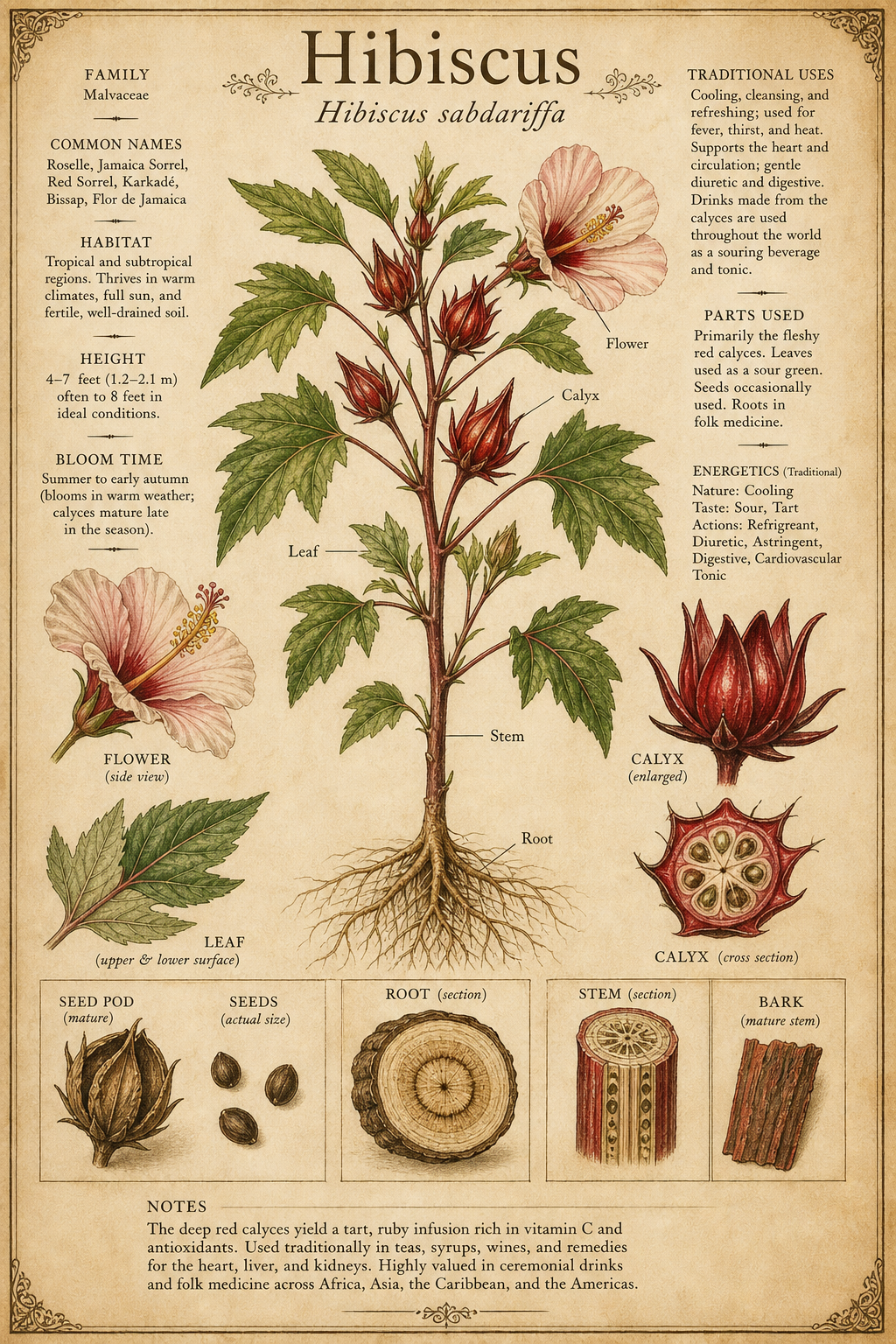
Hibiscus sabdariffa is an annual or short-lived perennial shrub in the Malvaceae family, the same plant family as marshmallow, okra, cotton, and cacao. It thrives in warm climates and is often grown as an annual in regions with frost.
It has an upright, branching growth habit and may reach several feet tall in a good season. Many cultivated plants grow between 4 and 7 feet, though size depends heavily on climate, growing season, and fertility. The stems may be green to reddish, often becoming more richly colored as the plant matures.
The leaves are alternate and variable. Younger leaves may be simpler, while mature leaves often become deeply lobed, somewhat resembling okra leaves. The leaf edges are usually toothed, and the plant carries that familiar mallow-family softness in its overall structure.
The flowers are typically pale yellow, cream, or light pink with a darker red to maroon center. They are hibiscus-like in form, with a prominent central column. After the flower fades, the red calyx enlarges and becomes fleshy, glossy, and deeply colored. This is the part most often harvested for tea.
The scent of fresh Hibiscus is mild, green, and tart rather than heavily floral. Dried calyces have a fruity, sour, cranberry-like aroma.
Hibiscus prefers warm, sunny habitats and is widely cultivated in tropical and subtropical regions. It blooms and forms calyces late in the growing season, often responding to shortening day length. In cooler climates, it must be started early and protected from frost.
Potential confusion can happen between Hibiscus sabdariffa and ornamental hibiscus species such as Hibiscus rosa-sinensis. While many hibiscus species have edible or useful parts, the classic red tea herb is Hibiscus sabdariffa. Proper identification matters, especially if harvesting from gardens or ornamental landscapes.
Traditional Uses
Hibiscus has an enormous traditional life. Across West Africa, the Caribbean, Mexico, Egypt, Sudan, India, Southeast Asia, and the Middle East, it has been used as food, drink, dye, medicine, and celebration herb. Drinks such as bissap, sorrel, karkadé, and agua de Jamaica all carry the same essential idea: a red, cooling, tart preparation made from the calyces.
In hot climates, Hibiscus became a household cooling herb. It was prepared as a refreshing drink for heat, thirst, and seasonal discomfort. This makes perfect energetic sense: sour herbs often help generate saliva, awaken digestion, and cut through heaviness, while the cooling nature of Hibiscus makes it especially welcome in hot weather.
Traditionally, it has been used as a gentle diuretic, mild laxative, digestive support, and cardiovascular folk remedy. It has also been used in foodways as a souring agent, colorant, jam ingredient, syrup base, and festive drink herb. Its deep red color gives it ritual presence without needing much explanation; some plants simply arrive already dressed for ceremony.
Ritually, Hibiscus has long been associated with love, beauty, sensuality, attraction, pleasure, and offerings. Its color places it near blood, desire, vitality, and the heart, while its cooling nature tempers obsession, anger, and overheated emotional states.
Modern Herbal Actions
Hibiscus is most commonly understood as a cooling, sour, antioxidant-rich herb with a strong relationship to the cardiovascular and fluid systems.
As a refrigerant, Hibiscus helps cool and refresh. Refrigerant herbs are traditionally used when the body feels overheated, dry-mouthed, flushed, or burdened by summer heat. A cold infusion of Hibiscus is one of the clearest examples of this action.
As an astringent, Hibiscus gently tones tissue. Astringent herbs contain compounds that create a tightening or toning effect, which may be useful when tissues feel lax, damp, or boggy. Hibiscus is not as sharply astringent as oak or witch hazel, but the calyces do carry a pleasant drying edge beneath their tartness.
As a diuretic, Hibiscus supports the movement of fluids through the kidneys and urinary system. This does not mean it should be treated casually by people on medication or with kidney concerns, but in general herbal practice, it is often used to help relieve fluid heaviness and support healthy elimination.
As a cardiovascular tonic, Hibiscus has been studied for its potential effects on blood pressure and blood lipids, with systematic reviews suggesting possible benefit, especially around blood pressure, though it should not replace prescribed care. (PMC)
As an antioxidant-rich sour, Hibiscus brings anthocyanins and other plant compounds into the cup. These compounds are part of what gives the calyx its deep red color and modern nutritional interest. (PMC)
Energetically, Hibiscus is cooling, moistening to mildly drying depending on preparation, sour, bright, and moving. It is especially suited to people who run hot, feel stagnant, crave sour things, or need a plant that wakes up the senses without overstimulation.
Preparations
Hibiscus shines in water-based preparations. Its color, flavor, and action extract beautifully in hot or cold water.
Tea / Hot Infusion:
Pour hot water over dried Hibiscus calyces and steep until deep red. This produces a tart, vivid tea that blends beautifully with rosehips, orange peel, cinnamon, ginger, mint, lemon balm, hawthorn, or elderberry.
Cold Infusion:
This is one of the best methods for Hibiscus. Add dried calyces to cool water and steep for several hours or overnight. The result is smoother, less aggressively tart, and deeply refreshing.
Syrup:
Hibiscus syrup is excellent for seasonal drinks, mocktails, cocktails, desserts, and spoonful remedies. It pairs beautifully with ginger, cinnamon, clove, rose, orange, or pomegranate.
Oxymel:
Hibiscus works well in vinegar and honey preparations when you want sourness, sweetness, and cooling movement together. This is especially useful for summer formulas or blends aimed at digestion and heat.
Tincture:
Hibiscus can be tinctured, though it is not always the best first choice because water extracts its classic qualities so well. A tincture may be useful in formulas where portability or preservation matters.
Glycerite:
A glycerite captures Hibiscus in a sweeter, child-friendly style, though the sourness will still come through. This can be useful for flavoring blends.
Bath / Wash:
Hibiscus can be added to ritual baths and washes for beauty, attraction, softening, and cooling heated emotions. Be mindful: it can stain cloth, grout, and pale surfaces.
Smoke / Incense:
Hibiscus is not my first choice as a primary smoke herb. It is better as a symbolic addition to loose incense blends for love, beauty, offerings, or Venus work rather than as the body of the incense.
Poultice / Topical Use:
Less common, but the mucilaginous mallow-family nature may lend itself to soothing applications. However, the calyces stain heavily, so topical use should be intentional and cautious.
Magical Uses
Hibiscus is a Venusian blood-flower with heat under the skin and coolness in the cup. It is not passive love magic. It is attraction with color. It is beauty that has a pulse. It is sensuality that does not apologize for taking up space.
Use Hibiscus in love work when the goal is warmth, pleasure, flirtation, magnetism, and embodied sweetness rather than obsession or control. It belongs in spells for self-adornment, confidence, beauty, romantic invitation, and the return of desire after grief, exhaustion, or emotional dullness.
Because it is cooling, Hibiscus is also useful when love has become inflamed. Add it to workings meant to calm arguments, soften bitterness, cool jealousy, or bring tenderness back into a home after too much heat has passed between people.
In spirit work, Hibiscus makes a beautiful offering herb. Its color, sweetness, and brightness give it a generous presence. It may be offered to beloved dead, love spirits, household spirits, Venusian powers, or any working where beauty and refreshment are appropriate.
For protection, Hibiscus works best through attraction and restoration rather than hard banishing. It helps restore the aura after emotional depletion. It can be used in baths after heartbreak, conflict, envy, or periods of feeling unseen.
Practical magical uses include:
Add to love and attraction jars for warmth, color, and sensual pull.
Brew as a ritual drink before beauty work, glamour work, or social courage work.
Use in a floor wash to sweeten and cool the emotional atmosphere of a home.
Add to bath blends for self-love, softness, and embodied confidence.
Pair with rose for love, ginger for passion, cinnamon for heat, hawthorn for heart repair, or mint for cooling clarity.
Astrological Correspondences
Hibiscus carries strong Venusian virtue through beauty, attraction, pleasure, sweetness, adornment, and sensual embodiment. This is Venus not as fragile romance, but as the old power of bloom, color, desire, and the living body saying yes to itself.
There is also a thread of Mars in Hibiscus because of its blood-red color, tart bite, and connection to heat, vitality, and passion. But Mars is tempered here. Hibiscus does not burn like cayenne or command like nettle. It cools the heat while preserving the life force. This makes it useful where desire and anger live close together.
Elementally, Hibiscus is Water and Fire. The Water appears in its cooling, fluid-moving, heart-softening, and refreshing nature. The Fire appears in its color, passion, sensuality, and ability to rekindle appetite for life.
Its zodiac ties include Libra and Taurus through Venus, beauty, pleasure, and the body. Scorpio may be present through blood symbolism, desire, and emotional intensity. Leo may also appear in its bold color, solar visibility, and theatrical bloom.
Seasonally, Hibiscus belongs to the hot months and the threshold into late summer harvest. It is a plant for heat, ripeness, color, and the moment when the garden begins offering its most dramatic medicines.
Lunar use depends on the working. Use Hibiscus with the waxing Moon for attraction, beauty, and drawing sweetness toward you. Use it with the waning Moon to cool anger, release emotional heat, and wash away bitterness. Under the Full Moon, it becomes a gorgeous offering herb for love, vitality, and the red thread of embodied life.
Growing & Harvesting
Hibiscus needs warmth, sun, and a long growing season. In cool or high-elevation climates, start seeds indoors early and transplant only after frost danger has passed. It dislikes cold soil and will sulk if planted out too soon.
It prefers full sun, fertile well-drained soil, steady moisture, and room to branch. Space plants generously, often around 2 to 3 feet apart, because a healthy roselle plant can become large and shrub-like. (Better Homes & Gardens)
Water regularly, especially during hot weather, but avoid soggy soil. Like many mallow-family plants, Hibiscus appreciates fertility but does not want to sit in stagnant wetness.
Harvest the calyces after the flowers drop and the red calyx becomes plump and fleshy. Many growers harvest around a week or so after flowering, before the calyx becomes tough or overly mature. (Better Homes & Gardens)
To process, remove the seed pod from inside the calyx and dry the red calyx pieces in a single layer with good airflow. They should become fully dry and brittle before storage. Store in airtight jars away from light, heat, and moisture.
The leaves may also be harvested and eaten as a sour green in some traditional foodways, though the calyces remain the primary apothecary part.
Warnings & Contraindications
Hibiscus is widely consumed as food and drink, but medicinal amounts deserve respect.
Avoid high-dose medicinal use during pregnancy unless guided by a qualified practitioner. Safety during pregnancy and lactation has not been well established, and caution is commonly advised. (MedCrave Online)
Because Hibiscus may influence blood pressure, people taking antihypertensive medication or managing low blood pressure should use caution and consult a qualified healthcare provider. (PMC)
Use caution with diuretic medications, kidney conditions, or fluid-balance concerns because Hibiscus has traditional and modern recognition as a diuretic herb. (Drugs.com)
People with allergies to hibiscus or other members of the mallow family should avoid it.
Very strong Hibiscus preparations may be hard on sensitive stomachs because of the acidity. If it causes reflux, nausea, or irritation, reduce strength, blend with demulcent herbs, or discontinue.
Hibiscus stains. Keep it away from pale cloth, porous counters, unfinished wood, and anything you are emotionally attached to keeping white.
Final Thoughts
Hibiscus is the red cup on the altar: tart, cooling, sensual, and alive. It teaches that pleasure can be medicinal, that beauty can have function, and that cooling the blood does not mean extinguishing the fire. In the apothecary, it refreshes. In magic, it magnetizes. In the old occult botanical library, Hibiscus is filed under love, heat, color, and the holy refusal to become dull.
Sources / Further ReadinG
Materia Medica Project official herb entry format, House of Hexe structure.
Ellis, L. R. et al. “A systematic review and meta-analysis of the effects of Hibiscus sabdariffa on blood pressure and cardiometabolic markers.” Nutrients, 2022. (PMC)
Montalvo-González, E. et al. “Physiological Effects and Human Health Benefits of Hibiscus sabdariffa.” Plants, 2022. (PMC)
Drugs.com Natural Products Monograph: Hibiscus. (Drugs.com)
McKay, D. L. et al. “Hibiscus sabdariffa L. Tea Lowers Blood Pressure in Prehypertensive and Mildly Hypertensive Adults.” Journal of Nutrition, 2010. (ScienceDirect)
Better Homes & Gardens, “How to Plant and Grow Roselle.” (Better Homes & Gardens)