Ginger | Zingiber officinale
Fire-root, stomach warmer, road-opener of the bloodGinger is a tropical rhizome long treasured as food, medicine, spice, and trade good. Its heat moves through the body quickly, warming digestion, easing nausea, encouraging circulation, and helping stagnant coldness find motion. Historically, Ginger traveled through Asian, Middle Eastern, African, and European medicine as one of the great household remedies. Magically, Ginger is a plant of ignition: courage, speed, heat, prosperity, lust, protection, and the force needed to make a working move.
Quick Correspondence Block
Planet: Mars, Sun
Element: Fire
Zodiac: Aries, Scorpio, Leo
Primary Actions: Warming stimulant, carminative, antiemetic, diaphoretic, circulatory stimulant, expectorant
Parts Used: Rhizome
Preparation Style: Tea, decoction, tincture, syrup, oxymel, infused honey, poultice, bath, culinary use
Magical Uses: Speed, courage, protection, prosperity, lust, road opening, warming cold workings
Spirit of the Herb: Heat that wakes the blood and tells the body to move.
Overview
Ginger is not a quiet herb.
It does not drift in politely or wait to be noticed. Ginger arrives with heat, bite, movement, and command. In the body, it speaks to coldness, sluggishness, dampness, nausea, chill, poor circulation, and the kind of stagnation that feels like the fire has gone out.
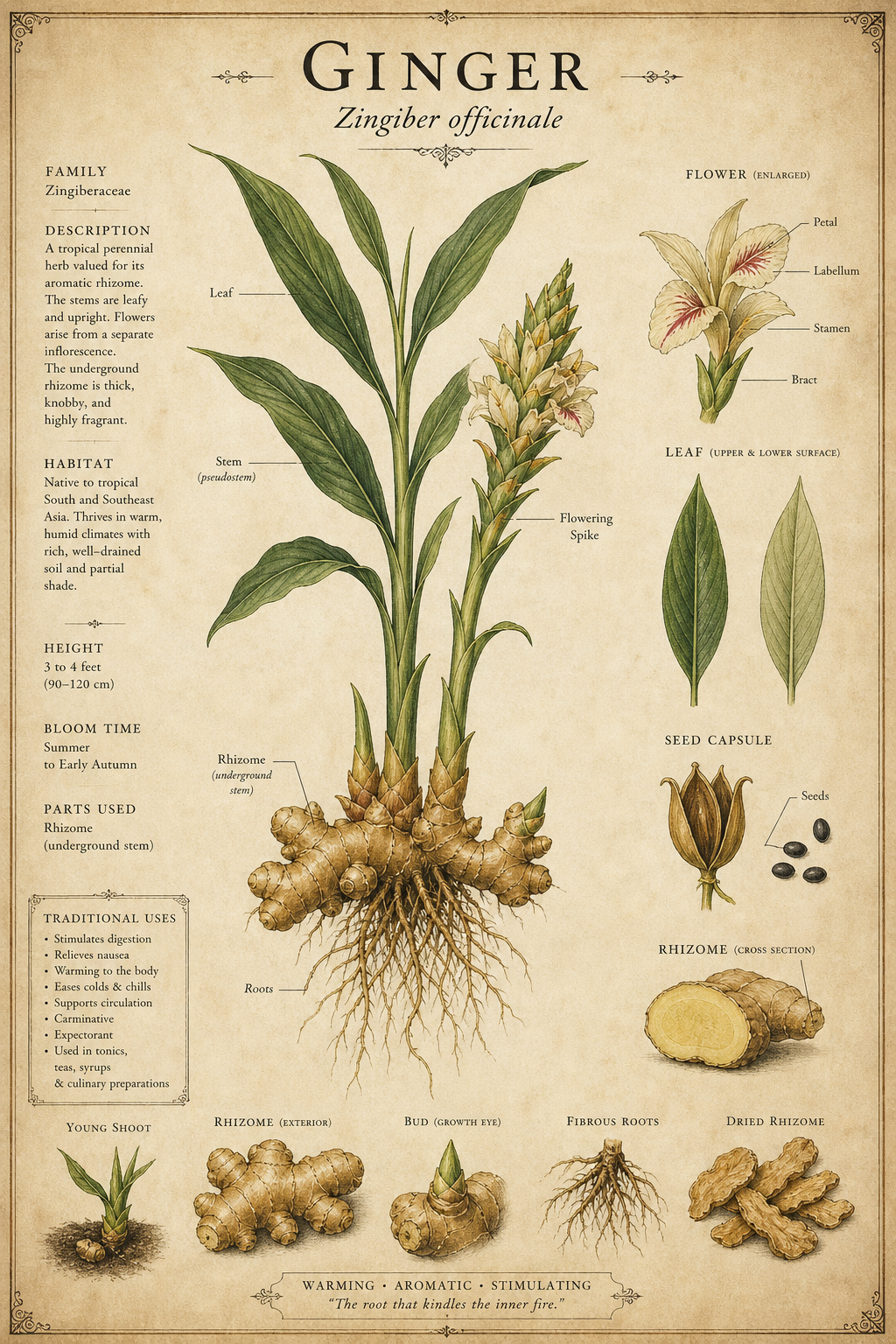
Botanically, Ginger is a tropical perennial in the Zingiberaceae family, the same family as turmeric, cardamom, and galangal. The part most people know is not technically a root, but a rhizome: a thickened underground stem that stores energy and sends up new growth. This alone tells us something about Ginger’s nature. It is stored fire. Hidden heat. A creeping underground engine.
Historically, Ginger was one of the great spice trade plants. It moved through kitchens, apothecaries, temples, trade routes, and domestic medicine cabinets for centuries. It was valued not only because it tasted good, but because it helped preserve warmth in the body, especially in cold weather, weak digestion, travel sickness, and respiratory chill.
For the modern herbalist, Ginger remains one of the most useful household herbs. It is accessible, affordable, effective, and deeply versatile. It belongs in the kitchen, the apothecary, the winter cabinet, the travel bag, and the witch’s materia magica.
Botanical Identification
Ginger is a tropical, herbaceous perennial that grows from thick, aromatic rhizomes. In warm climates, it produces upright leafy pseudostems formed from tightly wrapped leaf sheaths. Mature plants commonly reach around 3–4 feet tall with a spreading rhizome system beneath the soil. (Wisconsin Horticulture)
The leaves are long, narrow, lance-shaped, and arranged alternately along the upright stems. They are smooth, green, and grasslike in appearance, giving the plant a reed-like elegance.
The flowers arise from separate stalks that emerge from the rhizome. Ginger flowers are often pale yellow, cream, or greenish with purple or reddish markings depending on variety and growing conditions. The flowering stalk is shorter and denser than the leafy shoots, with bracted inflorescences that look almost cone-like. (Wikipedia)
The rhizome is thick, branching, knobby, tan to golden-brown on the outside, and pale yellow to warm gold within. Fresh Ginger has a sharp, citrusy, spicy, resinous scent. Dried Ginger is hotter, deeper, and more concentrated.
Growth habit: Tropical rhizomatous perennialHeight: Usually 3–4 feet tallSpread: 2–3 feet in favorable conditionsLeaves: Narrow, lance-shaped, smooth, greenFlowers: Pale yellow or cream with purple/red markings; borne on separate flowering stalksScent: Hot, spicy, citrusy, pungent, aromaticHabitat: Humid tropical and subtropical forest margins; cultivated in warm climatesBloom season: Usually late summer to fall in suitable climatesLookalikes: Galangal, turmeric, cardamom relatives, ornamental gingers, and wild gingers. True culinary Ginger is Zingiber officinale. Wild ginger species such as Asarum canadense are unrelated and should not be treated as interchangeable.
Traditional Uses
Ginger has been used for thousands of years across Asian, Middle Eastern, African, and European healing traditions. It appears again and again as a remedy for cold digestion, nausea, coughs, chills, poor appetite, damp respiratory complaints, and conditions where warmth and movement are needed.
In traditional Chinese medicine, fresh Ginger is often used to release the exterior, warm the middle, settle nausea, and harmonize formulas. Dried Ginger is considered hotter and more deeply warming, used when cold has settled further into the body.
In Ayurveda, Ginger is one of the classic digestive spices. It is used to kindle agni, the digestive fire, and to help move ama, or metabolic stagnation. Ginger tea before meals has long been used to awaken appetite and prepare digestion.
European and American folk medicine used Ginger in teas, syrups, plasters, baths, and warming cordials. It was a common household remedy for chills, stomach upset, menstrual coldness, poor circulation, winter coughs, and convalescence.
Domestically, Ginger has always lived between food and medicine. It appears in broths, cakes, beers, candies, pickles, teas, and spice blends. This is one of the great virtues of Ginger: it does not need to be exoticized or complicated to be useful. It can work from the soup pot.
Modern Herbal Actions
Ginger is best understood as a warming, moving, stimulating herb. It does not simply “support digestion” in the vague wellness sense. It warms the stomach, encourages circulation, relieves gas, settles nausea, and helps the body push outward through sweat when chill is present.
Carminative: Ginger helps relieve gas, bloating, and digestive tension. Carminatives are aromatic herbs that help the gut release trapped wind and spasmodic discomfort.
Antiemetic: Ginger is widely used for nausea and vomiting, especially motion sickness and mild digestive nausea. The European Medicines Agency recognizes Ginger rhizome as a traditional herbal medicine for motion sickness, mild spasmodic gastrointestinal complaints, bloating, flatulence, and temporary loss of appetite. (ema.europa.eu)
Warming digestive stimulant: Ginger encourages appetite and digestive fire. It is especially suited to cold, sluggish digestion where the stomach feels heavy, slow, or damp.
Diaphoretic: Ginger can help promote sweating. This makes it useful in early cold-season discomfort when the body feels chilled and needs help moving heat toward the surface.
Circulatory stimulant: Ginger brings warmth to the blood and periphery. It is often used when hands and feet feel cold or when circulation feels stagnant.
Expectorant: Ginger’s warmth can help loosen and move mucus, especially when respiratory complaints are cold, damp, and heavy. Health Canada lists Ginger as traditionally used as an expectorant and cough-supporting herb for bronchitis, coughs, and colds. (Health Canada)
Anti-inflammatory support: Ginger contains pungent constituents such as gingerols and shogaols, which have been studied for inflammatory pathways. This does not make Ginger a cure-all pain herb, but it does explain why it often appears in formulas for sore, cold, stiff, or stagnant patterns. (Alternative Medicine Review)
Preparations
Ginger is flexible, but preparation changes its personality.
Fresh Ginger Tea / Infusion
Best for nausea, mild chill, digestion, and everyday warming. Slice or grate fresh Ginger and steep covered. Fresh Ginger is bright, juicy, aromatic, and more surface-moving.
Decoction
Best when a stronger, deeper preparation is desired. Simmer sliced fresh or dried Ginger for 10–20 minutes. This produces a hotter, more penetrating medicine.
Dried Ginger Powder
Hotter and more concentrated than fresh Ginger. Useful in capsules, spice blends, electuaries, honey, baking, and warming formulas.
Tincture
Good for travel nausea, digestive sluggishness, and formulas where Ginger acts as a warming catalyst. A little goes a long way.
Glycerite
Useful for people who avoid alcohol, though Ginger’s heat extracts beautifully in alcohol. A glycerite can be pleasant for children’s formulas when appropriate.
Oxymel
Excellent for cold-season formulas. Ginger, honey, and vinegar together create a sharp, warming, moving preparation suited to damp respiratory patterns and sluggish digestion.
Syrup
Lovely for coughs, chills, nausea, and winter blends. Ginger syrup pairs well with lemon, cinnamon, clove, elderberry, thyme, or marshmallow depending on the direction.
Infused Honey
One of the best kitchen medicines. Fresh chopped Ginger in honey creates a warming, spicy preparation for tea, sore throats, nausea, and cold mornings.
Poultice / Compress
Fresh Ginger can be used externally as a warming compress for cold, stiff, sore areas. Always dilute and test carefully; Ginger can irritate skin.
Bath
A Ginger bath is deeply warming and sweating. Best for cold, chilled states — not for overheated, inflamed, feverish, or heat-aggravated conditions.
Smoke / Incense
Dried Ginger may be used sparingly in incense for heat, speed, courage, protection, and lust workings. It is sharp and fiery, so blend with grounding resins or woods.
Wash
A Ginger wash can be used magically for road opening, courage, money movement, and clearing stagnant energy from thresholds. Use lightly; this is not a gentle floral wash.
Magical Uses
Ginger is a firestarter.
In folk magic, Ginger is used when a working needs heat, speed, force, courage, lust, protection, or momentum. It is not the herb for passive wishing. It is the herb for lighting the match under the thing and making it move.
Use Ginger in prosperity work when money has gone cold or opportunities have stalled. Add it to road-opening work when the path exists but nothing is moving. Use it in courage work when fear has frozen the will. Ginger does not remove every obstacle, but it helps restore the heat required to confront them.
In protective magic, Ginger is useful because it is sharp, hot, and active. It can be added to powders, washes, oils, and charm bags meant to keep harmful forces from settling in. Think of it less as a wall and more as a live coal at the threshold.
For love and lust workings, Ginger brings heat, desire, blood, and urgency. It should be used with maturity and clear direction. Ginger does not soften. Ginger intensifies.
In spirit work, Ginger can be offered when asking for movement, vitality, courage, and quickening. It is especially fitting for workings where the body must participate: dance, breath, sex, sweat, labor, protection, and embodied magic.
Good magical uses include:
Road-opening work
Prosperity and money movement
Courage and confidence
Lust and passion
Protective powders and washes
Warming cold spellwork
Speeding slow workings
Breaking stagnation
Fire magic
Mars workings
Solar vitality rites
Ginger is not subtle. Use it when subtle has stopped working.
Astrological Correspondences
Ginger carries strong Martial virtue through its heat, pungency, stimulation, speed, and ability to move blood, sweat, and force through the body. Mars rules action, heat, courage, defense, inflammation, blood, sharpness, and the will to move. Ginger is Mars in the kitchen: accessible, hot, practical, and not interested in excuses.
It also carries Solar qualities through its warming vitality and ability to rekindle inner fire. The Sun governs life force, confidence, radiance, heart, warmth, and embodied strength. Ginger does not merely agitate; when used well, it restores brightness to systems that have gone cold and dim.
Elementally, Ginger is Fire with a secondary Earth anchor. The Fire is obvious: heat, spice, stimulation, sweat, circulation, courage. The Earth is in the rhizome itself, the underground storage organ that holds concentrated force beneath the soil.
Ginger has ties to Aries through heat, initiation, courage, and forward motion. It also speaks to Scorpio through blood, intensity, desire, and deep internal heat. Leo may be considered through its Solar warmth, vitality, and heart-centered confidence.
Seasonally, Ginger belongs to cold weather, early illness, winter kitchens, damp mornings, and any threshold where the body needs heat to return. It is especially useful in late autumn and winter formulas, though it can be used year-round when the pattern calls for warmth.
Lunar use depends on the work. Use Ginger on a waxing Moon to build courage, desire, money, and momentum. Use it on a waning Moon to sweat out cold, move stagnation, and burn through lingering heaviness. Solar timing suits vitality and confidence work; Mars timing suits protection, courage, and aggressive road-opening.
Growing & Harvesting
Ginger prefers warmth, humidity, rich soil, and consistent moisture. It is native to tropical and subtropical conditions and thrives in moist, partly shaded environments. In cooler climates, it can be grown in containers or treated as a warm-season annual. (Wisconsin Horticulture)
Plant healthy rhizome pieces with visible growth buds. Use loose, fertile, well-draining soil rich in organic matter. Ginger likes moisture but does not want to sit in rot. Think damp forest edge, not swamp.
Soil: Rich, loose, fertile, well-draining
Sun: Partial shade to filtered light; avoid harsh scorching sun
Water: Consistent moisture; do not let it dry out completely during active growth
Climate: Tropical/subtropical; container growing recommended in cold climates
Planting: Plant rhizome pieces shallowly with buds facing upward
Harvest: Young Ginger can be harvested earlier for tender, mild rhizomes; mature Ginger is harvested after the foliage begins to yellow and die back
Parts gathered: Rhizome
Drying: Slice thinly and dry thoroughly in a warm, ventilated place or dehydrator
Storage: Store dried Ginger in airtight jars away from light, heat, and moisture. Fresh Ginger can be refrigerated, frozen, or preserved in honey, vinegar, or syrup.
For high desert growers, Ginger will need protection. It is not a plant that wants your wind, cold nights, and rude sunburn nonsense. Grow it in a pot, greenhouse, warm indoor space, or shaded protected area during the hottest months. Give it warmth without scorching, moisture without rot, and patience.
Warnings & Contraindications
Ginger is widely used as food and is generally well tolerated in culinary amounts, but medicinal dosing deserves respect.
Use caution with Ginger if taking anticoagulant or antiplatelet medications, including warfarin, because Ginger may affect bleeding risk or platelet activity. It may also interact with blood-sugar-lowering medications and should be used carefully by people prone to hypoglycemia or taking diabetes medication. (NCBI)
Pregnancy use is nuanced. Ginger is commonly used for nausea in pregnancy, and NCCIH notes that Ginger supplements during pregnancy may be safe, but pregnant people should consult a qualified healthcare provider before using medicinal amounts. Safety during breastfeeding is less clear. (NCCIH)
Avoid large medicinal doses before surgery unless cleared by a clinician.
Ginger may aggravate heartburn, reflux, ulcers, gallbladder irritation, or strong heat signs in sensitive people. Constitution matters. A person who is already hot, inflamed, flushed, dry, irritable, or acid-prone may not need more fire.
Topically, Ginger can irritate the skin. Always dilute and patch test.
Do not use Ginger as a substitute for medical care in severe vomiting, persistent nausea, chest pain, high fever, unexplained bleeding, severe abdominal pain, or worsening illness.
Final Thoughts
Ginger is the old fire kept under the floorboards.
It warms the stomach, wakes the blood, clears the chill, and tells stagnant things to move. In medicine, it is practical and immediate. In magic, it is heat with a purpose. Ginger reminds us that not all healing is soft; sometimes the remedy is the spark, the sweat, the bite, the blessed irritation that brings life back into motion.
Sources / Further ReadinG
European Medicines Agency. Zingiber officinale Roscoe, rhizoma: European Union Herbal Monograph.
National Center for Complementary and Integrative Health. “Ginger: Usefulness and Safety.”
Wisconsin Horticulture Extension. “Ginger, Zingiber officinale.”
Missouri Botanical Garden Plant Finder. “Zingiber officinale.”
Health Canada Natural Health Products Ingredients Database. “Ginger — Zingiber officinale.”
Bode, A. M., & Dong, Z. “The Amazing and Mighty Ginger.” Herbal Medicine: Biomolecular and Clinical Aspects. NCBI Bookshelf.
Mills, Simon, and Kerry Bone. Principles and Practice of Phytotherapy.
Hoffmann, David. Medical Herbalism.
Grieve, Maud. A Modern Herbal.