Fennel | Foeniculum vulgare
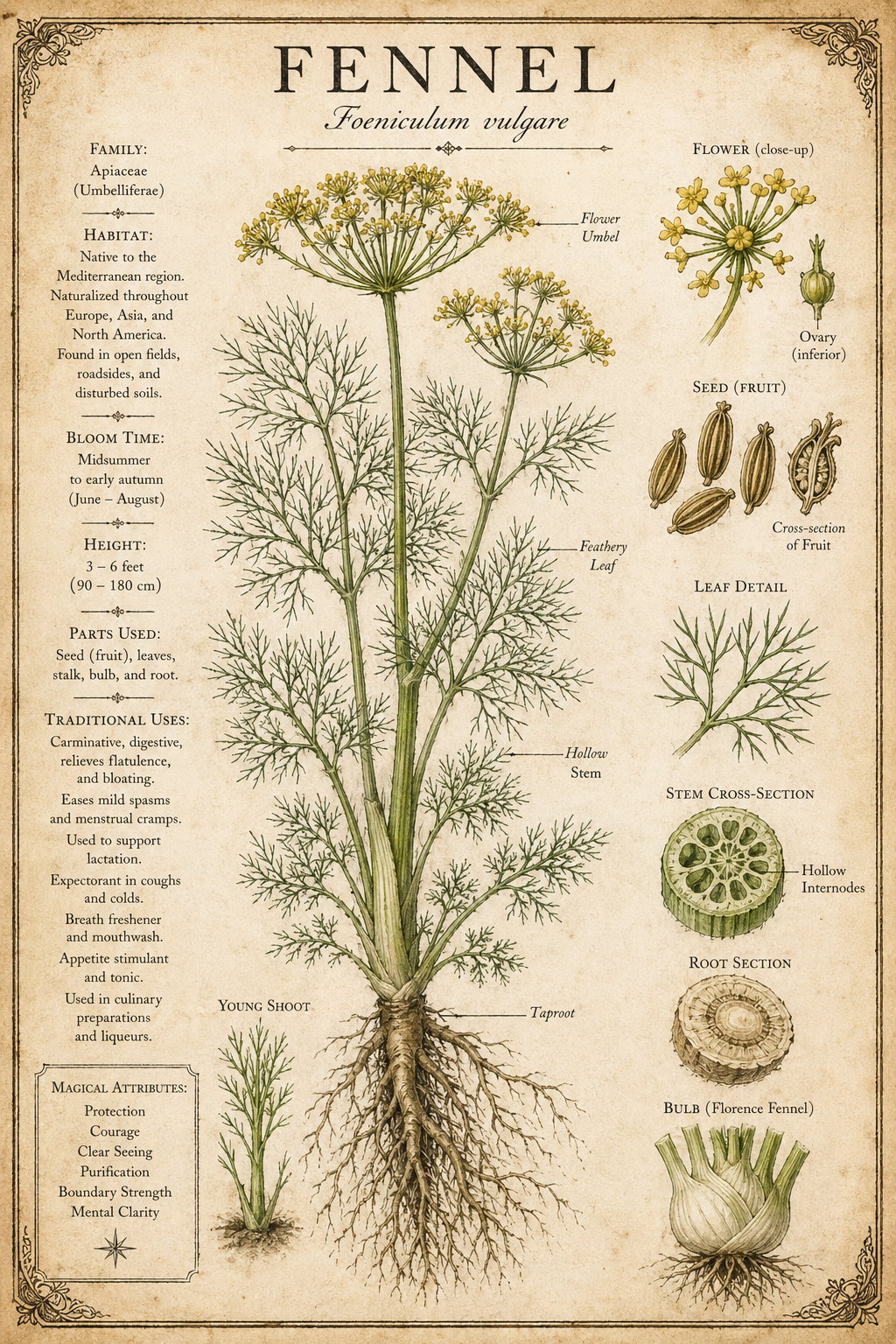
Anise-sweet digestive herb, breath-opener, and seed of warmthFennel is a tall, aromatic member of the carrot family known for its feathery leaves, golden umbels, and sweet, licorice-like seeds. Historically, it has been valued as both food and medicine across Mediterranean, European, Middle Eastern, and Ayurvedic traditions. In modern herbalism, fennel is best known as a carminative herb, helping ease gas, bloating, digestive tension, and mild spasmodic discomfort. Magically, fennel is a plant of protection, courage, clarity, and boundary-strengthening: a bright green torch at the edge of the threshold.
Quick Correspondence Block
Planet: Mercury, with Solar warmth
Element: Air and Fire
Zodiac: Gemini, Virgo, Leo
Primary Actions: Carminative, aromatic, antispasmodic, expectorant, galactagogue, mild digestive stimulant
Parts Used: Seed/fruit, leaf, stalk, bulb, root
Preparation Style: Tea, infusion, tincture, syrup, culinary use, steam, incense
Magical Uses: Protection, clarity, courage, digestion of experience, warding, boundary work
Spirit of the Herb: Bright, clever, watchful, warming, and protective
Overview
Fennel is one of those herbs that lives comfortably between kitchen, apothecary, and spell shelf. It is food, medicine, breath-sweetener, stomach-settler, and threshold guardian all at once.
Botanically, fennel belongs to the Apiaceae family, the same family as dill, parsley, carrot, angelica, anise, and poison hemlock. That family connection matters because fennel carries the classic umbrella-shaped flower structure of the carrot family, and while it is a generous plant, it also asks for clear identification.
In the garden, fennel grows tall and airy, with blue-green stems, fine threadlike leaves, and yellow umbels that attract pollinators. The seed, often called “fennel seed” though botanically it is the dried fruit, is the primary medicinal part used in Western herbalism. The European Medicines Agency lists sweet fennel fruit as traditionally used for mild spasmodic gastrointestinal complaints, bloating, flatulence, minor menstrual cramping, and coughs associated with colds. (ema.europa.eu)
Energetically, fennel is warming, moving, drying to excess dampness, and gently opening. It helps things pass: gas, breath, milk, stuck digestion, and sometimes the emotional heaviness that gathers in the belly when we have swallowed too much and processed too little.
Botanical Identification
Fennel is an upright herbaceous perennial or biennial, depending on climate and cultivation. USDA lists Foeniculum vulgare as a biennial/perennial herb, and Missouri Botanical Garden describes common fennel as an herbaceous perennial typically reaching 4–6 feet tall. (USDA Plants Database)
Growth habit:
Tall, upright, branching, hollow-stemmed, and strongly aromatic.
Height / spread:
Usually 3–6 feet tall, sometimes taller in rich soil and favorable climates.
Leaves:
Fine, feathery, threadlike, and deeply divided. The leaves resemble dill but are often more blue-green and carry a stronger sweet-anise scent.
Flowers:
Small yellow flowers appear in flat-topped compound umbels. These umbels are classic Apiaceae architecture: many tiny flowers held like little golden parasols.
Seeds / fruit:
The dried fruits are ridged, oval, aromatic, greenish to brown, and sweetly pungent.
Scent:
Sweet, anise-like, warm, slightly spicy, and volatile-rich.
Habitat:
Native to the Mediterranean region but widely naturalized. It prefers sunny, open places, disturbed ground, roadsides, fields, and garden edges.
Bloom season:
Usually mid to late summer, followed by seed development.
Lookalikes / confusion species:
Fennel may be confused with dill, anise, wild carrot, and more dangerously with toxic Apiaceae plants such as poison hemlock. Fennel’s strong anise scent is a major clue, but scent alone should never be the only identification point. Do not wild-harvest fennel-family plants unless you are fully confident in Apiaceae identification.
Traditional Uses
Fennel has been used for centuries as both a digestive herb and a food plant. In many traditions, it was served after meals to ease heaviness, freshen the breath, and calm the stomach. This is why fennel seeds still appear in culinary traditions as an after-dinner chew, spice, or tea.
In European folk herbalism, fennel was used for digestion, wind, coughs, nursing support, and menstrual discomfort. It was also used domestically in breads, sausages, fish dishes, pickles, liqueurs, and sweets. In household medicine, fennel’s sweetness made it especially useful when preparing remedies for people who disliked bitter or harsh herbs.
In older magical traditions, fennel was protective. It was hung over doors, tucked into keyholes, carried for courage, and used to ward off harmful influence. Like many aromatic herbs, it was understood to repel stagnation: not only physical dampness or digestive gas, but spiritual heaviness, dullness, envy, and intrusive energy.
Fennel’s old reputation is not soft in the modern “love and light” sense. It is a watchful herb. It clears the belly, sharpens the senses, and stands at the gate with a lantern.
Modern Herbal Actions
Fennel is primarily used for the digestive and respiratory systems.
Carminative:A carminative herb helps ease gas, bloating, and digestive pressure. Fennel’s aromatic oils relax and move through the digestive tract, making it especially useful after heavy meals.
Antispasmodic:Fennel can help relax mild spasms in the gut. This is why it is traditionally used for cramping, griping, and digestive tension.
Aromatic digestive stimulant:Its scent and flavor wake up digestion. Aromatic herbs often signal the body to prepare for food, secretion, movement, and assimilation.
Mild expectorant:Fennel has traditional use for coughs connected with colds, especially when mucus feels stuck or the chest needs gentle warming movement. The EMA includes sweet fennel fruit as traditionally used as an expectorant in coughs associated with colds. (ema.europa.eu)
Galactagogue:Fennel has a long folk history of use for supporting milk flow. This use requires caution, especially with concentrated preparations, because fennel contains hormonally active compounds and is not appropriate for every person.
Mild menstrual support:Because of its antispasmodic and warming nature, fennel has been traditionally used for minor menstrual cramping. The EMA includes minor spasms associated with menstrual periods among traditional uses for sweet fennel fruit. (ema.europa.eu)
Preparations
Fennel is easy to prepare and very beginner-friendly when used in normal culinary or tea amounts.
Tea / infusion:
The most common herbal preparation. Lightly crush the seeds before steeping to release the aromatic oils. Use for gas, bloating, mild cramping, post-meal heaviness, or as a gentle respiratory tea.
Tincture:
Useful when a stronger, shelf-stable digestive preparation is desired. Best used in small amounts before or after meals.
Glycerite:
A good option for people who avoid alcohol. Fennel’s sweetness works well in glycerin-based preparations.
Syrup:
Excellent for cough formulas, especially with thyme, marshmallow, licorice, ginger, or anise depending on the constitution and situation.
Oxymel:
Fennel can be infused into honey and vinegar for a warming digestive or respiratory preparation.
Culinary use:
Seeds, leaves, stalks, pollen, and bulbs are all used in food. Culinary fennel is one of the safest and most traditional ways to work with the plant.
Steam:
A fennel steam may be used for aromatic respiratory support, though essential oil should be avoided unless handled by someone trained in safe dilution and contraindications.
Smoke / incense:
Dried fennel seed or leaf may be added in small amounts to protection, courage, or clarity blends.
Wash:
A strong fennel infusion can be used as a ritual wash for thresholds, doorways, hands, or tools when the working calls for protection, discernment, and movement.
Magical Uses
Fennel is a protection herb with a bright mind. It does not feel heavy, thorny, or aggressive. It protects through clarity, alertness, movement, and refusal to rot in stagnation.
Use fennel when a working needs:
Protection without paranoia
Courage before speaking or acting
Clear digestion of emotional conflict
Boundary work around gossip, envy, or intrusive energy
Threshold cleansing
Strengthening the will after fatigue
Warding the home without making the space feel spiritually locked down
Fennel belongs beautifully in doorway charms, house washes, courage sachets, road-opening support blends, and spellwork where someone needs to stop swallowing their own truth.
For spirit work, fennel can be used before divination when the reader feels foggy, spiritually bloated, or emotionally tangled in another person’s business. It clears without stripping. It sharpens without becoming cruel.
A simple fennel charm can be made with fennel seed, bay leaf, black pepper, and a pinch of salt, tied in cloth and placed near the door. Speak your direction plainly: “Only what is clean, true, and welcome may enter here.”
Astrological Correspondences
Fennel carries strong Mercurial virtue through its aromatic nature, digestive intelligence, and relationship to movement, breath, speech, and exchange. Mercury rules communication, nerves, trade, digestion of information, and the quick pathways of the body. Fennel helps move what is trapped, name what is stuck, and clear the channels between belly, breath, and mind.
It also carries a Solar warmth. The yellow umbels, upright growth, and courage-giving folklore all point toward the Sun’s influence: vitality, confidence, protection, and the strengthening of personal sovereignty.
Elementally, fennel is Air and Fire. Air is present in its feathery leaves, aromatic volatility, breath support, and Mercurial quickness. Fire is present in its warming digestive action, protective brightness, and ability to kindle movement where the body or spirit has gone dull.
Zodiacally, fennel speaks well to Gemini, Virgo, and Leo. Gemini reflects the breath, nerves, language, and exchange. Virgo reflects digestion, herbal skill, and the sorting of what is useful from what is waste. Leo reflects courage, heart, warmth, and visible strength.
Seasonally, fennel belongs to the bright heat of summer, when its yellow umbels rise high and its seeds begin concentrating aromatic power. It also has a place in late summer and early autumn, when digestion, harvest, preservation, and sorting become central themes.
Lunar timing depends on the work. Use fennel on a waxing Moon for courage, confidence, and strengthening. Use it on a waning Moon for clearing digestive stagnation, removing unwanted influence, and cleaning thresholds.
Growing & Harvesting
Fennel is generally easy to grow, but it needs space and respect. It forms a deep taproot and dislikes being fussed with once established.
Soil:Moist, organically rich, well-drained soil is ideal. Missouri Botanical Garden notes that fennel is easily grown in moist, organically rich, well-drained soils. (Missouri Botanical Garden)
Sun:Full sun is best.
Water:Keep evenly moist while young. Established common fennel can handle some dryness, but Florence fennel grown for bulbs needs more consistent moisture.
Climate notes:Common fennel is often grown as a perennial in zones 4–9. It may self-seed freely, so remove spent flower heads before seed drop if you do not want volunteers. (Missouri Botanical Garden)
Harvest timing:Leaves can be harvested throughout the growing season. Seeds are harvested when the umbels begin to dry and the fruits turn from green to tan or brown.
Parts to gather:Seed/fruit is the main medicinal part. Leaves and bulbs are primarily culinary, though still aromatic and useful.
Drying notes:Cut seed heads when nearly dry and place them upside down in a paper bag. Allow them to finish drying somewhere warm, airy, and shaded.
Storage notes:Store dried fennel seed whole in an airtight jar away from heat, light, and moisture. Crush only before use to preserve volatile oils.
Garden caution:Fennel can inhibit or compete with some nearby plants and may cross-pollinate with dill. Give it its own place in the herb garden instead of tucking it into crowded vegetable beds.
Warnings & Contraindications
Fennel is generally safe in normal culinary amounts for most people, but medicinal and concentrated use requires more care.
Avoid or use only with professional guidance during pregnancy, especially in medicinal doses or concentrated preparations.
Use caution with hormone-sensitive conditions or hormone-related medications. Fennel contains compounds with estrogenic activity, and excessive fennel oil may affect hormone therapy, oral contraceptives, or hormone replacement therapy. (e-lactancia.org)
Avoid fennel essential oil internally unless under qualified clinical supervision. Concentrated fennel oil carries more risk than tea or culinary seed.
People allergic to Apiaceae-family plants, including celery, carrot, parsley, dill, anise, or coriander, should use caution.
Do not wild-harvest unless you are skilled in identifying Apiaceae plants. Poison hemlock and other toxic relatives can be deadly.
Use caution with infants and young children. Traditional use exists, but dosing and safety are not the same as casual adult tea use.
Discontinue use if allergic reactions, skin irritation, nausea, worsening symptoms, or unusual hormonal symptoms occur.
Final Thoughts
Fennel is a golden-green herb of digestion, courage, breath, and boundary. It teaches that protection does not always need iron gates and black thorns; sometimes protection is clarity, warmth, a settled stomach, and the ability to recognize what does not belong inside you.
Sources / Further ReadinG
European Medicines Agency. Foeniculi dulcis fructus — Sweet Fennel Fruit Herbal Monograph.
Missouri Botanical Garden. Foeniculum vulgare Plant Finder.
USDA Plants Database. Foeniculum vulgare Mill.
Health Canada Natural Health Product Monograph: Bitter Fennel.
Grieve, Maud. A Modern Herbal.
Hoffmann, David. Medical Herbalism.
Chevallier, Andrew. Encyclopedia of Herbal Medicine.
Wood, Matthew. The Earthwise Herbal.
Tierra, Michael. The Way of Herbs.