Dandelion | Taraxacum officinale
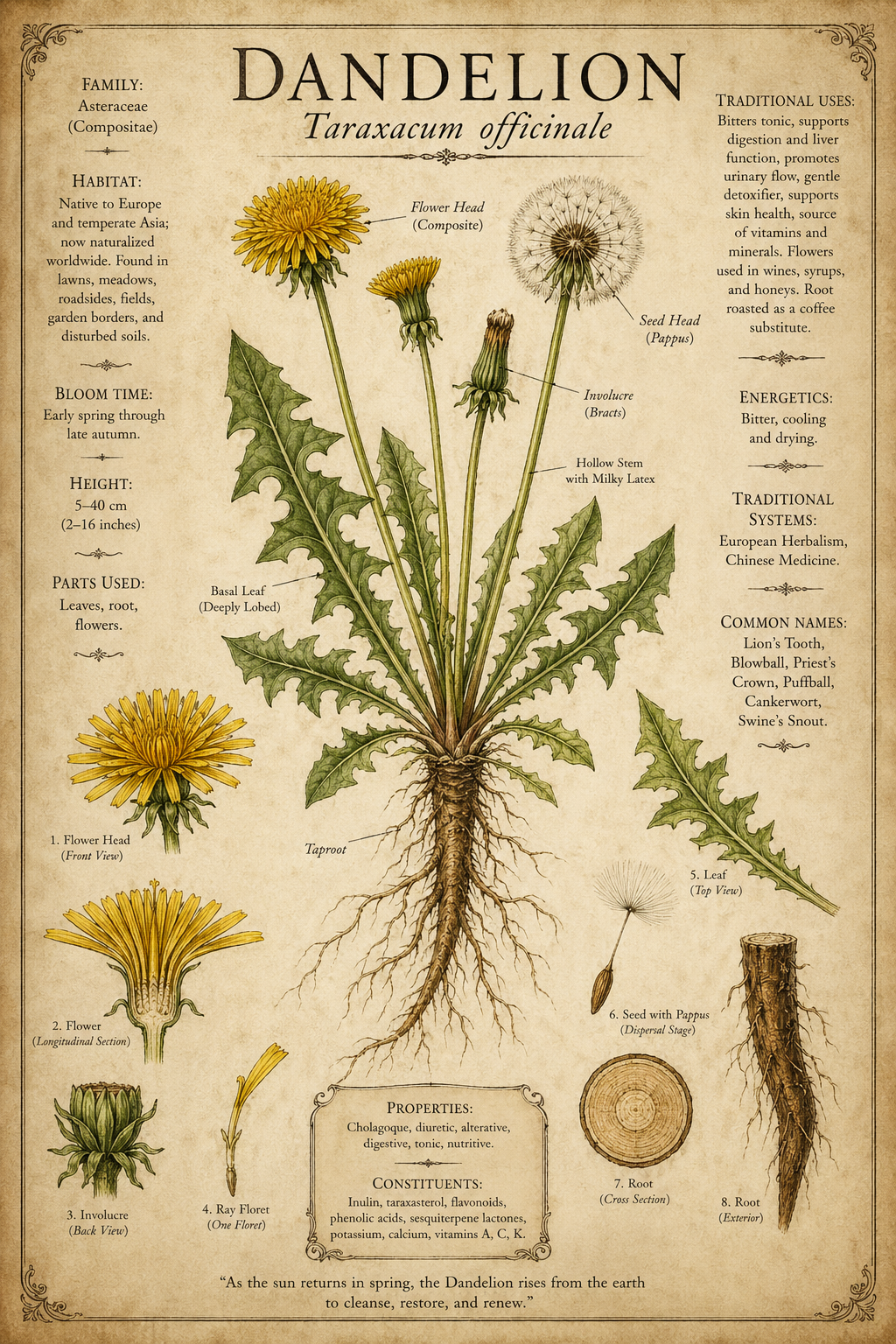
Sun-rooted bitter, field medicine, golden resilience.Dandelion is a perennial herb of disturbed ground, lawns, roadsides, meadows, and garden edges, known for its toothed basal leaves, hollow flower stems, golden composite flowers, milky latex, and deep taproot. Though often dismissed as a weed, it has a long history in European, North American, and Chinese traditional medicine, especially as a bitter spring tonic and digestive ally. Modern herbalists value dandelion leaf for urinary movement and mineral-rich nourishment, while the root is most often used for liver, bile, digestion, and gut-supportive bitterness. Magically, dandelion is a plant of endurance, solar return, wishes, divination, and thriving where one was never invited.
Quick Correspondence Block
Planet: Sun, Jupiter
Element: Air, Fire, Earth
Zodiac: Leo, Sagittarius, Taurus
Primary Actions: Bitter, hepatic, cholagogue, diuretic, alterative, nutritive
Parts Used: Leaf, root, flower
Preparation Style: Tea, tincture, vinegar, food, decoction, infused oil
Magical Uses: Wishes, resilience, divination, prosperity, solar courage, spirit communication
Spirit of the Herb: The golden survivor who teaches thriving in unwanted places.
Overview
Dandelion is one of the great misunderstood medicines of the common world. It grows where soil has been cut, compacted, disturbed, ignored, or over-managed, and still it sends down a root, lifts a bright sun-face, and feeds the early pollinators before many cultivated plants have even remembered themselves.
Herbalists value dandelion because it is accessible, abundant, and deeply practical. The leaf moves water. The root wakes digestion. The flower brings brightness, oil, and old folk charm. Every part of the plant has a place, and every part teaches a different kind of medicine.
Ecologically, dandelion is a pioneer and a survivor. It colonizes disturbed ground quickly, forms a basal rosette above a taproot, and produces wind-dispersed seeds that can travel with astonishing efficiency. (Wikipedia)
Botanical Identification
Dandelion is a low-growing perennial herb in the Asteraceae family. It grows from a central taproot and forms a basal rosette of leaves close to the ground. The flower stems are hollow, leafless, and usually hold one yellow flower head each. (Wikipedia)
Growth habit: Perennial basal rosette with a deep taproot.
Height / spread: Commonly around 5–40 cm tall, though flower stems may sometimes grow taller. (Wikipedia)
Leaves: Deeply toothed, smooth, lobed leaves growing from the base. The name “dandelion” comes from the French dent de lion, meaning “lion’s tooth,” referring to the leaf shape. (Wikipedia)
Flowers: Bright yellow composite flower heads made entirely of ray florets.
Stem: Hollow, leafless, and filled with white milky latex when broken. (Wikipedia)
Scent: Mildly green and bitter; roots smell earthy, especially when cut or roasted.
Habitat: Lawns, fields, roadsides, gardens, pastures, disturbed soil, and open sunny places.
Bloom season: Most abundant in spring, with repeat flowering through much of the growing season.
Lookalikes: Cat’s ear, hawkweed, hawksbeard, and coltsfoot. True dandelion has smooth basal leaves, a hollow leafless stem, milky latex, and one flower head per stem. Cat’s ear often has hairy leaves and branched solid stems. (Wikipedia)
Traditional Uses
Dandelion has been used in traditional medicine across Europe, North America, and China. (Wikipedia) In European folk practice, the root was especially associated with liver function, digestion, sluggishness, and spring cleansing after winter heaviness. (herbalgram.org)
The leaves were eaten as bitter spring greens, often before flowering when they are less intensely bitter. The roots were dried, roasted, and used as a caffeine-free coffee substitute, while the flowers were used in wines, vinegars, syrups, fritters, and folk preparations. (Wikipedia)
Its old common names tell you exactly how people experienced it: lion’s tooth, blowball, priest’s crown, puffball, and “pee-a-bed,” the last one being a very blunt folk nod to its urinary action. No poetry needed. The ancestors noticed.
Modern Herbal Actions
Dandelion is best understood by plant part.
Dandelion leaf is primarily used as a diuretic, meaning it helps increase urinary flow. Unlike harsh water-moving approaches, dandelion leaf is also mineral-rich, making it a classic herbalist choice when the goal is gentle movement rather than depletion.
Dandelion root is a bitter hepatic and cholagogue. A hepatic supports liver function, while a cholagogue encourages bile flow. In plain language: dandelion root helps wake up digestion, especially when there is sluggish appetite, heaviness after meals, or that boggy “winter body” feeling.
Dandelion flower is gentler and more folkloric in the apothecary. It is used in infused oils, vinegars, wines, and foods, and carries more of the plant’s solar, brightening, skin-softening, and charm-working nature.
Modern research interest has also looked at dandelion’s phytochemicals, including flavonoids, caffeic acid derivatives, terpenes, triterpenes, sesquiterpenes, and root inulin, a prebiotic fiber. (Wikipedia) Much of the clinical evidence is still developing, so traditional use and modern herbal practice should not be overstated as a cure-all.
Preparations
Tea / Infusion:
Best for the leaf. Use as a mineral-rich bitter green infusion when water movement, spring cleansing, or gentle urinary support is desired.
Decoction:
Best for the root. Simmer dried root to extract its bitter, earthy, digestive qualities.
Tincture:
Useful for dandelion root when a stronger bitter digestive preparation is desired before meals.
Vinegar:
Excellent for leaves, roots, and flowers. Dandelion vinegar makes a beautiful mineral-rich spring preparation and can be used in food.
Food:
Young leaves can be eaten fresh or cooked. Roots can be roasted. Flowers can be used in syrups, fritters, wines, and infused honeys.
Oil Infusion:
Dandelion flowers may be infused into oil for massage blends, skin-softening preparations, and solar body oils.
Salve:
Flower-infused oil can be turned into a simple salve for dry skin, rough hands, or ritual anointing.
Bath:
Leaves and flowers can be used in cleansing baths, especially for spring renewal, brightness, and clearing stagnant emotional heaviness.
Smoke / Incense:
Not the strongest incense herb alone, but dried root or flower may be added sparingly to blends for wish work, solar resilience, or spirit messages.
Wash:
A dandelion leaf or root wash can be used in folk magic for clearing stagnation, opening roads through persistence, and returning vitality to a neglected space.
Magical Uses
Dandelion is not soft because it is common. It is common because it is powerful.
This is a plant of persistence, survival, solar courage, and unwanted abundance. Dandelion does not ask permission to return. It grows through lawns, cracks, fence lines, neglected beds, and hostile soil. That makes it excellent in workings for resilience, prosperity after hardship, self-trust, and taking up space after being diminished.
Use the seed head for wish magic, but not in the fluffy “just manifest it” way. Dandelion wishes are best paired with action. Blow the seeds after speaking a direction, then do the work that gives the wish somewhere to land.
The root belongs in workings for grounding, endurance, ancestral repair, and drawing nourishment from difficult places. The flower belongs to solar charms, confidence, visibility, joy, and calling warmth back into the body. The leaf is useful in cleansing and release work, especially where stagnation, resentment, or old emotional water needs to move.
Astrological Correspondences
Dandelion carries strong Solar virtue through its golden flower, daytime opening, vitality, visibility, and association with warmth, resilience, and life-force return. It is not the noble, polished Sun of kings and temples. It is the roadside Sun. The feral Sun. The “I am still here” Sun.
It also carries Jupiterian qualities through abundance, spread, generosity, and its relationship with growth, nourishment, and restoration. Jupiter shows in the plant’s willingness to feed pollinators, humans, soil, and spellwork without becoming precious about it.
Elementally, dandelion bridges Fire, Air, and Earth. Fire lives in the yellow flower and solar medicine. Air lives in the seed puff, wish craft, breath, and dispersal. Earth lives in the taproot, mineral body, and bitter digestive work.
Its zodiac ties include Leo for solar courage and visibility, Sagittarius for Jupiterian spread and wild freedom, and Taurus for nourishment, embodiment, and the edible green world.
Seasonally, dandelion belongs especially to spring, when bitter greens return and the body begins to shake off winter stagnation. Magically, it is potent during the waxing Moon for growth and vitality, and during the waning Moon for clearing heaviness, moving stagnation, and releasing what has become too settled.
Growing & Harvesting
Dandelion is easy to grow, sometimes too easy, depending on your relationship with your lawn.
Soil: Adaptable, but grows best in moderately fertile, well-drained soil.
Sun: Full sun to partial shade.
Water: Moderate water; established plants are resilient.
Climate: Widely adapted across temperate regions.
Harvest leaves: Gather young leaves in spring before flowering for the mildest flavor.
Harvest flowers: Pick fully opened flowers on a dry day after dew has lifted.
Harvest roots: Dig roots in fall for richer stored energy, or spring for stronger bitter action.
Drying notes: Dry leaves and flowers quickly in a single layer. Roots should be washed, chopped, and dried thoroughly.
Storage: Store dried plant material in airtight containers away from heat, light, and moisture.
Do not harvest from sprayed lawns, roadsides, public parks, contaminated soil, or places with heavy animal waste. Dandelion is generous, but it is also very good at living in questionable places. Choose clean ground.
Warnings & Contraindications
Avoid dandelion if you have a known allergy to plants in the Asteraceae family, such as ragweed, chamomile, calendula, or daisies. Contact reactions are possible in sensitive people, especially because dandelion latex contains compounds that may irritate those with sesquiterpene lactone sensitivity. (Wikipedia)
Use caution with gallbladder disease, bile duct obstruction, active ulcers, kidney disease, or if you are taking diuretics, lithium, blood thinners, diabetes medications, or medications affected by potassium or fluid balance. Dandelion may also interact with certain antibiotics and anticoagulant or antiplatelet drugs. (WebMD)
Pregnancy and breastfeeding require practitioner guidance, especially with concentrated extracts or high-dose preparations.
Food-level use is generally different from medicinal dosing. A few leaves in dinner is not the same as strong daily tincture, decoction, or capsule use.
Final Thoughts
Dandelion is the golden lesson of the disturbed field: root deeply, rise brightly, feed what you can, and do not confuse being unwanted with being powerless. It is medicine for the body that has grown sluggish, the spirit that has been stepped on, and the witch who needs to remember that survival can still bloom yellow.
Sources / Further ReadinG
Matthew Wood, The Earthwise Herbal: A Complete Guide to Old World Medicinal Plants
Maud Grieve, A Modern Herbal
Thomas Easley & Steven Horne, The Modern Herbal Dispensatory
David Hoffmann, Medical Herbalism
American Botanical Council / Commission E Monographs: Dandelion Root with Herb (herbalgram.org)
Health Canada Natural Health Products Ingredients Database: Dandelion (Health Canada)
Journal of Ethnopharmacology review on Taraxacum phytochemistry and pharmacology (Wikipedia)