Comfrey | Symphytum officinale
Bone-knitter, flesh-mender, keeper of rapid repair.Comfrey is a deeply respected, and equally debated, herb in traditional herbalism, known for its powerful ability to support tissue repair and regeneration. Used for centuries across Europe, it earned names like “knitbone” for its role in mending sprains, fractures, and wounds. In modern practice, Comfrey is almost exclusively used externally, where it excels in healing skin, soothing inflammation, and restoring damaged tissue. Magically, it is a plant of restoration and protection, working quickly to mend what has been broken…physically or otherwise.
Quick Correspondence Block
Planet: Saturn, Venus
Element: Water, Earth
Zodiac: Capricorn, Taurus
Primary Actions: Vulnerary, demulcent, anti-inflammatory, cell proliferant
Parts Used: Leaf, root
Preparation Style: Oil infusion, salve, poultice, compress, wash
Magical Uses: Healing, protection, stability, prosperity, safe travel
Spirit of the Herb: The quiet worker that rebuilds what has been torn.
Overview
Comfrey is a plant of speed and depth. It grows fast, spreads wide, and sends its roots deep into the earth pulling minerals upward and concentrating them in its leaves. This same signature appears in its medicine: Comfrey helps the body rebuild tissue quickly and efficiently.
Historically, it has been used for wounds, bruises, sprains, fractures, and skin injuries. However, its strength is exactly why modern herbalists approach it with care. Comfrey can heal tissue so rapidly that it may close surface wounds before deeper healing is complete, making proper use and application essential.
This is not a casual herb. It is a skilled tool in the hands of someone who understands timing.
Botanical Identification
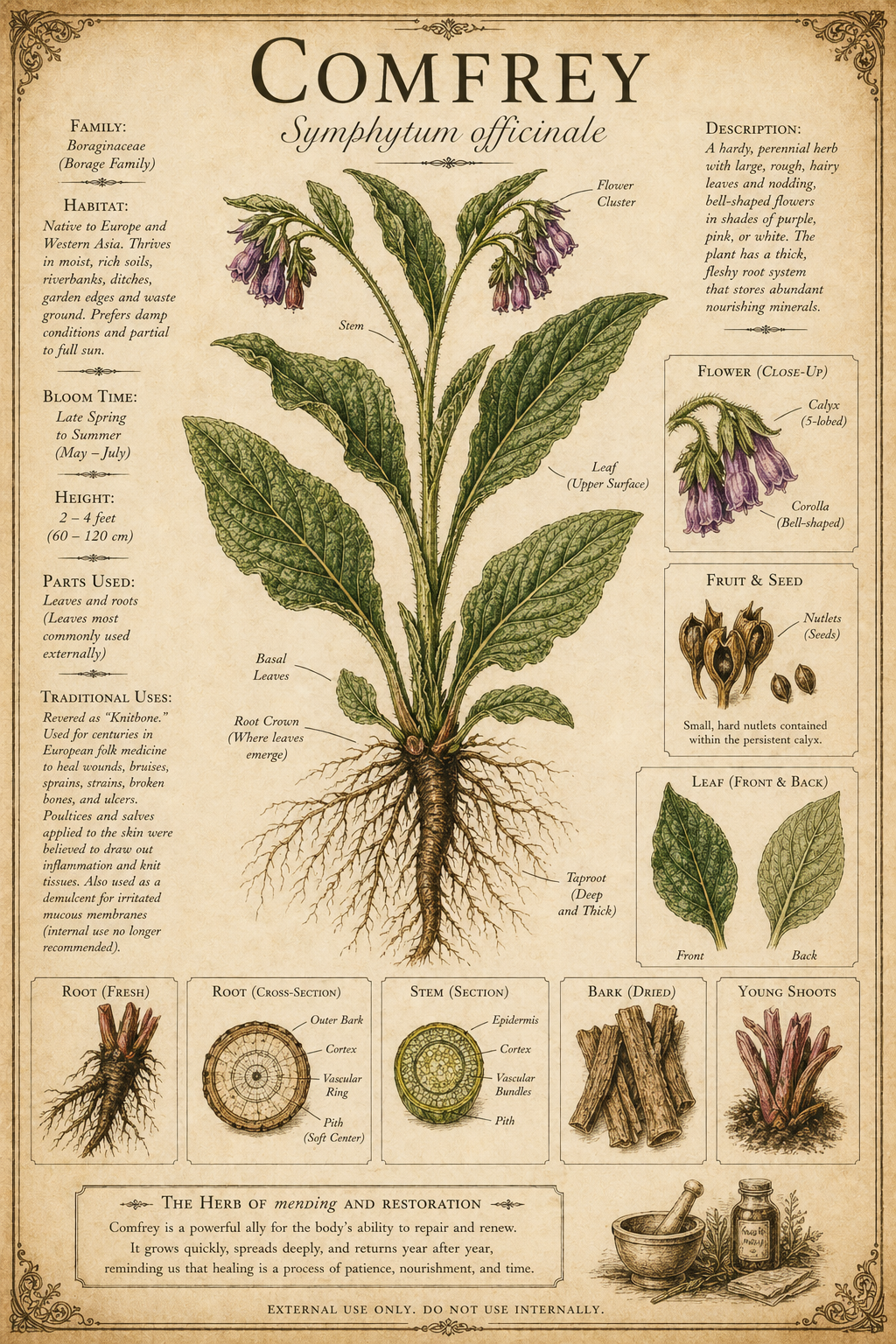
Symphytum officinale is a hardy perennial in the Boraginaceae family.
Growth habit:
Clumping perennial with large basal leaves and upright flowering stalks.
Height / spread:
Typically 2–4 feet tall, spreading easily through roots.
Leaves:
Large, lance-shaped, rough and fuzzy (almost prickly). Deep green and slightly drooping.
Flowers:
Bell-shaped, drooping clusters in shades of purple, pink, or cream.
Scent:
Mild, green, earthy.
Habitat:
Moist soils, riverbanks, ditches, garden edges. Thrives in rich, damp environments.
Bloom season:
Late spring through summer.
Distinctive features:
Thick black taproot with white interior
Rapid regrowth after cutting
Leaves that feel coarse and hairy
Lookalikes / confusion species:
Other Boraginaceae family members, though Comfrey’s large size and rough leaves make it fairly distinctive once known.
Traditional Uses
Comfrey has been used for centuries as a wound and bone-healing herb.
Folk medicine:
Applied to bruises, sprains, fractures, and wounds. Often used as poultices or compresses.
European herbalism:
Known as “knitbone,” it was used to support broken bones and damaged tissue.
Internal historical use:
Once used internally for ulcers and respiratory irritation due to its demulcent properties but this practice is no longer considered safe.
Domestic use:
A common garden herb for topical remedies and compost enrichment due to its mineral-rich leaves.
Comfrey has always carried a reputation for rapid healing, sometimes described as almost too effective.
Modern Herbal Actions
Modern herbalism uses Comfrey almost exclusively externally.
Vulnerary:
Supports wound healing and tissue repair.
Cell proliferant:
Encourages the growth of new cells, largely due to compounds like allantoin.
Anti-inflammatory:
Reduces swelling and irritation in injuries.
Demulcent (topical):
Soothes irritated or damaged skin.
Tissue restorative:
Supports recovery of muscles, ligaments, and skin.
Comfrey is especially useful for:
bruises
sprains
strains
minor fractures (supportive care)
dry or damaged skin
scar care (after proper healing stage)
Preparations
Infused Oil:
The most common preparation. Used as a base for salves and massage oils.
Salve / Balm:
Ideal for skin repair, muscle soreness, and localized injuries.
Poultice:
Fresh or rehydrated leaves applied directly to unbroken skin for acute injuries.
Compress / Wash:
Used for swelling, bruising, and inflammation.
Liniment:
Sometimes used in blends for deeper tissue work.
Not recommended:
Internal teas or tinctures for general use due to safety concerns.
Magical Uses
Comfrey is a protector and rebuilder.
Use it in workings for:
physical and energetic healing
protection during travel (traditionally carried in bags or pockets)
financial stability and steady growth
mending relationships or personal damage
grounding after upheaval
strengthening boundaries
It is especially powerful in rebuilding work after loss, injury, burnout, or conflict.
Comfrey does not rush recklessly, it rebuilds with intention, but once it begins, it commits fully.
Astrological Correspondences
Comfrey carries strong Saturnian virtue through its relationship with structure, bones, endurance, and the slow intelligence of true repair. Saturn governs what holds the body together: skeletal integrity, connective tissue, discipline, time, and the long process of rebuilding after injury or depletion. Comfrey does not offer quick glamour, it offers structural return. It teaches that healing is not always dramatic. Sometimes it is quiet, layered, and earned.
It also carries a softer Venusian current through its moistening, tissue-soothing, and restorative qualities. Where Saturn rebuilds the framework, Venus nourishes what lives around it: skin, fascia, tenderness, and the body’s capacity to soften after strain. Venus governs restoration, nourishment, comfort, and the return of harmony after damage.
Elementally, Comfrey is primarily Earth, with a deep undercurrent of Water. The earth is found in its roots, mineral density, physical structure, and grounding medicine. The water is in its soothing mucilage, tissue support, and its ability to restore moisture and softness where there has been dryness, friction, or damage.
Zodiacally, Comfrey aligns strongly with Capricorn for bones, endurance, structure, and long-term recovery. It also resonates with Taurus for the physical body, stability, nourishment, and the instinct to preserve what is worth keeping whole.
Seasonally, Comfrey belongs to the season of late spring into full summer, when growth is abundant, roots are deep, and the body is actively building. In ritual timing, it is especially powerful during the waning Moon, when the work turns inward toward repair, restoration, integration, and the slow knitting back together of what has been strained, fractured, or worn thin.
Growing & Harvesting
Comfrey is incredibly easy to grow…sometimes too easy.
Soil:
Rich, moist, well-draining soil.
Sun:
Full sun to partial shade.
Water:
Prefers consistent moisture.
Climate notes:
Hardy and adaptable. Thrives in many climates, including your high desert with adequate watering.
Harvest timing:
Leaves can be harvested multiple times per season.
Parts gathered:
Leaves and roots.
Harvest notes:
Leaves: best before flowering for softer texture
Root: harvested in fall when energy is concentrated below ground
Drying notes:
Leaves dry quickly; roots require slicing and thorough drying.
Storage notes:
Store dried material in airtight containers away from light and moisture.
Important:
Once planted, Comfrey is difficult to remove due to its deep root system.
Warnings & Contraindications
Comfrey must be used with respect.
Do NOT use internally in modern herbal practice due to pyrrolizidine alkaloids (PAs), which can cause liver damage.
Do not apply to:
deep wounds
puncture wounds
infected wounds
wounds that have not been properly cleaned
It may heal the surface too quickly, trapping infection inside.
Avoid use with:
pregnancy
breastfeeding
liver conditions
long-term or excessive use
Topical caution:
Use on closed skin or properly managed wounds only.
Final Thoughts
Comfrey is one of the most powerful healing plants in the apothecary but power requires precision.
It is the herb of deep repair, of knitting together what has been torn, of restoring structure where there was damage. But it demands that you understand timing, layers, and the difference between surface healing and true recovery.
In the apothecary drawer, Comfrey belongs under Reconstruction and Return.
Sources / Further ReadinG
Hoffmann, David. Medical Herbalism
Wood, Matthew. The Earthwise Herbal
Tilgner, Sharol. Herbal Medicine from the Heart of the Earth
Mills & Bone. Principles and Practice of Phytotherapy
European Medicines Agency. Symphytum officinale Monograph