Cinnamon | Cinnamomum verum
Sacred bark of warmth, fire, and living circulation.Cinnamon is one of the oldest and most revered spices in human history, valued across cultures as both medicine and ritual substance. Derived from the inner bark of tropical evergreen trees, it has long been used to stimulate digestion, warm the body, and protect against stagnation and decay. In modern herbalism, Cinnamon remains a potent ally for circulation, blood sugar balance, and digestive fire. Magically, it is a herb of activation—drawing prosperity, igniting desire, and setting intention into motion.
Quick Correspondence Block
Planet: Sun, Jupiter
Element: Fire
Zodiac: Leo, Sagittarius
Primary Actions: Carminative, stimulant, antimicrobial, circulatory tonic, warming
Parts Used: Inner bark
Preparation Style: Tea, tincture, powder, syrup, oxymel, oil infusion
Magical Uses: Prosperity, success, protection, love, courage, activation
Spirit of the Herb: The flame that moves what has gone still.
Overview
Cinnamon is not subtle. It is heat, movement, and unmistakable presence. Used for thousands of years in Ayurveda, Traditional Chinese Medicine, and global folk systems, it has been treasured as both a spice of luxury and a medicine of vitality.
At its core, Cinnamon addresses cold, stagnant, and sluggish states in the body. Where there is poor circulation, weak digestion, or metabolic stagnation, Cinnamon brings warmth and motion. It is especially valued in conditions where the body feels depleted, cold, or slow to respond.
As a magical ally, Cinnamon does not wait…it accelerates. It pushes intention outward, fuels prosperity work, and strengthens personal magnetism. This is a bark that carries both solar radiance and the expansive force of Jupiter.
Botanical Identification
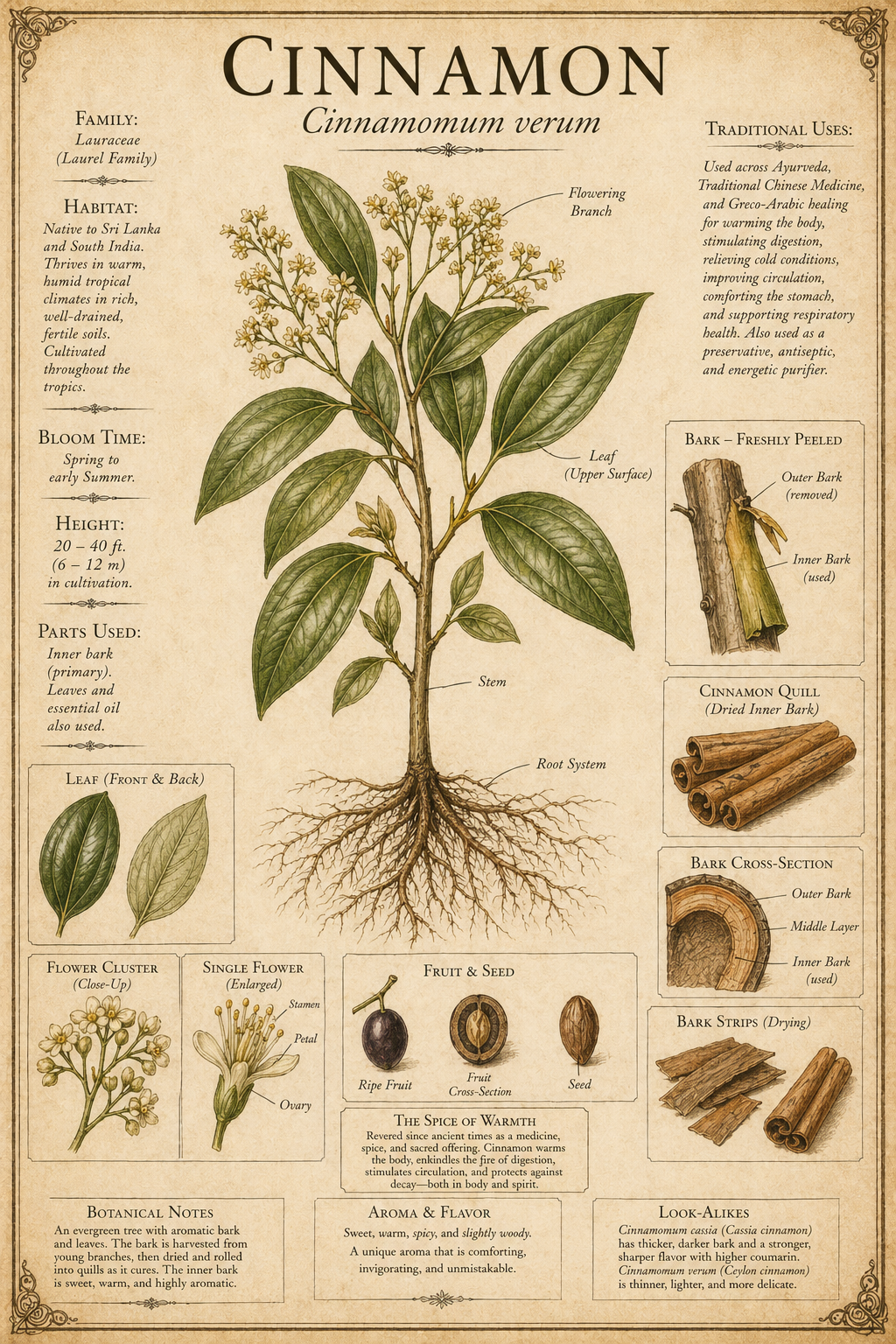
Cinnamon comes from several species in the Cinnamomum genus, most notably Cinnamomum verum (true cinnamon) and Cinnamomum cassia (cassia cinnamon).
Growth habit:
Evergreen tropical tree.
Height / spread:
Typically 20–40 feet in cultivated environments, though often coppiced smaller for harvest.
Leaves:
Opposite, oval, glossy green with distinct parallel veins. Aromatic when crushed.
Flowers:
Small, pale yellow to greenish-white, arranged in loose clusters.
Scent:
Warm, sweet, spicy, unmistakably aromatic.
Habitat:
Native to Sri Lanka and parts of South India (verum), with broader cultivation across tropical regions.
Bloom season:
Variable depending on climate; generally spring to early summer.
Distinctive feature:
The medicinal material is the inner bark, harvested and rolled into quills as it dries.
Lookalikes / confusion species:
Cinnamomum cassia (stronger, harsher, higher coumarin content)
Other Cinnamomum species used regionally
Traditional Uses
Cinnamon has deep roots across multiple healing systems:
Ayurveda:
Used as a warming spice to stimulate agni (digestive fire), improve circulation, and balance cold/damp conditions.
Traditional Chinese Medicine:
Cinnamon bark (Rou Gui) is used to warm the interior, support kidney yang, and dispel cold.
Greco-Arabic Medicine:
Valued for digestion, respiratory conditions, and as a preservative against decay.
Folk & Domestic Use:
Used for colds, sluggish digestion, menstrual discomfort, and as a general warming tonic. Also widely used in food preservation and as a flavoring agent.
Historically, Cinnamon was also a luxury trade item (worth more than gold at certain points) carrying both medicinal and economic power.
Modern Herbal Actions
Cinnamon is widely used internally in modern herbalism.
Carminative:
Relieves gas, bloating, and digestive discomfort by supporting smooth digestive function.
Stimulant (circulatory):
Encourages blood flow, warming cold extremities and improving overall circulation.
Antimicrobial:
Traditionally used to inhibit bacteria, fungi, and microbes—especially in the digestive tract.
Metabolic support:
Commonly used in blood sugar regulation protocols, particularly in insulin resistance patterns.
Warming tonic:
Supports individuals who tend toward coldness, fatigue, and sluggish metabolism.
Cinnamon is especially suited for cold, damp, or stagnant constitutions, where the system needs movement and heat.
Preparations
Tea / Infusion:
Best made as a decoction or long steep due to the bark’s density. Ideal for digestion and warming.
Decoction:
Simmer bark pieces for 10–20 minutes for deeper extraction.
Tincture:
Used for metabolic and circulatory support. Often combined with other warming herbs.
Powder:
Added to food, capsules, or herbal blends. One of the most accessible forms.
Syrup / Oxymel:
Excellent for respiratory and digestive support, especially in cold seasons.
Oil Infusion:
Used externally in warming oils for sore muscles or circulation support (mild dilution recommended).
Smoke / Incense:
Burned for purification, prosperity, and energetic activation.
Magical Uses
Cinnamon is a force multiplier.
Use it in workings for:
prosperity and financial growth
success in business or ventures
love, attraction, and magnetism
protection and warding
courage and confidence
speeding up spellwork results
igniting motivation and action
Blow powdered cinnamon through your doorway to draw prosperity. Add it to money jars, success oils, or petition work. Burn it to wake up stagnant energy and move your workings forward.
Cinnamon does not whisper. It declares.
Astrological Correspondences
Planetary Rulership:
The Sun gives Cinnamon its warmth, vitality, and radiant presence. Jupiter adds expansion, prosperity, and abundance.
Elemental Nature:
Fire. Active, warming, energizing, and transformative.
Zodiac Ties:
Leo (solar power, charisma, vitality) and Sagittarius (expansion, luck, movement).
Seasonal Timing:
Strongly associated with winter and cold seasons as a warming ally, though energetically solar in nature.
Lunar / Solar Relevance:
Best used during solar workings, Sundays, or waxing Moon phases when building momentum, attraction, or success.
Growing & Harvesting
Cinnamon is a tropical plant and not suited to high desert outdoor cultivation without greenhouse conditions.
Soil:
Rich, well-draining, slightly acidic soil.
Sun:
Full sun to partial shade.
Water:
Consistent moisture, but not waterlogged.
Climate notes:
Thrives in tropical and subtropical climates. Sensitive to frost.
Harvest timing:
Bark is harvested from young branches (typically 2–3 years old).
Parts gathered:
Inner bark.
Harvest method:
Outer bark is stripped away, and the inner bark is peeled and dried into quills.
Drying notes:
Bark curls naturally as it dries. Store whole for best potency.
Storage notes:
Keep in airtight containers away from heat and light. Whole sticks retain potency longer than powder.
Warnings & Contraindications
Cinnamon is generally safe in culinary amounts but requires care in medicinal dosing.
Use caution with:
Pregnancy (large medicinal doses)
Blood-thinning medications
Diabetes medications (monitor blood sugar closely)
Liver conditions (especially with cassia cinnamon due to coumarin content)
Sensitive skin (topical irritation possible)
Cassia vs. Ceylon:
Cassia cinnamon contains higher levels of coumarin, which may be harmful in large or long-term doses. Cinnamomum verum (Ceylon cinnamon) is preferred for regular medicinal use.
Essential oil caution:
Cinnamon essential oil is extremely potent and can cause burns if not properly diluted.
Final Thoughts
Cinnamon is the medicine of movement, warmth, and undeniable presence. It is what you reach for when something in the body, or in life, has gone cold, slow, or stuck.
It is not gentle encouragement.
It is ignition.
In the apothecary drawer, Cinnamon lives under Fire, Fortune, and Forward Motion.
Sources / Further ReadinG
Hoffmann, David. Medical Herbalism
Wood, Matthew. The Earthwise Herbal
Pole, Sebastian. Ayurvedic Medicine
Bensky, Dan. Chinese Herbal Medicine Materia Medica
World Health Organization. Monographs on Selected Medicinal Plants
Tilgner, Sharol. Herbal Medicine from the Heart of the Earth