Ashwagandha | Withania somnifera
Pronunciation: ash-wuh-GAHN-duh · with-AY-nee-uh som-NIF-er-uh Botanical Latin pronunciations vary; this is a practical English rendering.
Root of endurance, recovery, and steadied strength.Ashwagandha is a woody-rooted member of the nightshade family and one of the best-known restorative herbs within Ayurveda. Traditionally classified as a rasayana, a rejuvenating medicine, it has long been associated with strength, recovery, sleep, reproductive vitality, and resilience during periods of depletion. Modern research most consistently supports its possible value for perceived stress and sleep, although many popular claims remain inadequately studied and long-term safety is not yet established. In magical practice, Ashwagandha belongs to the work of rebuilding: grounded courage, replenished reserves, protected rest, and strength that does not require constant struggle. (Office of Dietary Supplements)
Quick Correspondence Block
Planet: Mars, with a secondary lunar influence
Element: Earth
Zodiac: Aries and Capricorn
Primary Actions: Adaptogen, restorative tonic, nervine, mild sedative, reproductive tonic
Parts Used: Root
Preparation Style: Powder, decoction, milk decoction, tincture, capsules, standardized extract
Magical Uses: Resilience, recovery, stamina, grounded courage, protected rest
Spirit of the Herb: The strength that returns after the battle—not the force that keeps fighting forever
Overview
Ashwagandha is an evergreen subshrub in warm climates, though gardeners in colder regions usually grow it as an annual. It belongs to the Solanaceae family alongside tomatoes, peppers, belladonna, and many other familiar nightshades. Its accepted native range stretches broadly across parts of southern Europe, Africa, western and southern Asia, and into Central China and Myanmar, particularly in dry or subtropical environments. (Plants of the World Online)
Its Sanskrit name is commonly explained through ashwa, meaning horse, and gandha, meaning smell. The freshly exposed root has a strong, earthy odor sometimes compared to a wet horse, horse sweat, or green tomato foliage. The name is also traditionally understood as an allusion to the strength and vitality of a horse. Its Latin species name, somnifera, means “sleep-bearing” or “sleep-inducing,” pointing toward its long association with rest and nervous-system restoration. (Office of Dietary Supplements)
Ashwagandha is sometimes marketed as “Indian ginseng,” but it is not a true ginseng and is not botanically related to Panax species. The comparison refers to its reputation as a strengthening and resilience-supporting tonic rather than to any botanical relationship. (Office of Dietary Supplements)
The root is the principal traditional medicinal part. Root and leaf extracts are not interchangeable: their chemical profiles differ, and modern supplements may contain root alone or combinations of root and leaf. For a materia medica grounded in traditional use, root-only preparations are the clearest and most appropriate reference point. (Office of Dietary Supplements)
Ashwagandha is not simply an herbal stimulant. It does not behave like caffeine, nor should it be treated as a whip for an already exhausted body. Its place is more often with the person who has remained vigilant for too long…the one who is tired but cannot settle, weakened by prolonged stress, or slow to regain their footing after illness, grief, overwork, or sustained nervous tension.
Botanical Identification
Family: Solanaceae
Growth habit: Upright or spreading woody herb or subshrub
Typical height: Approximately 2–5 feet in cultivation; occasionally approaching 6 feet in favorable perennial conditions
Spread: Commonly 1–3 feet
Life cycle: Perennial in warm subtropical climates; usually grown as an annual where winters freeze
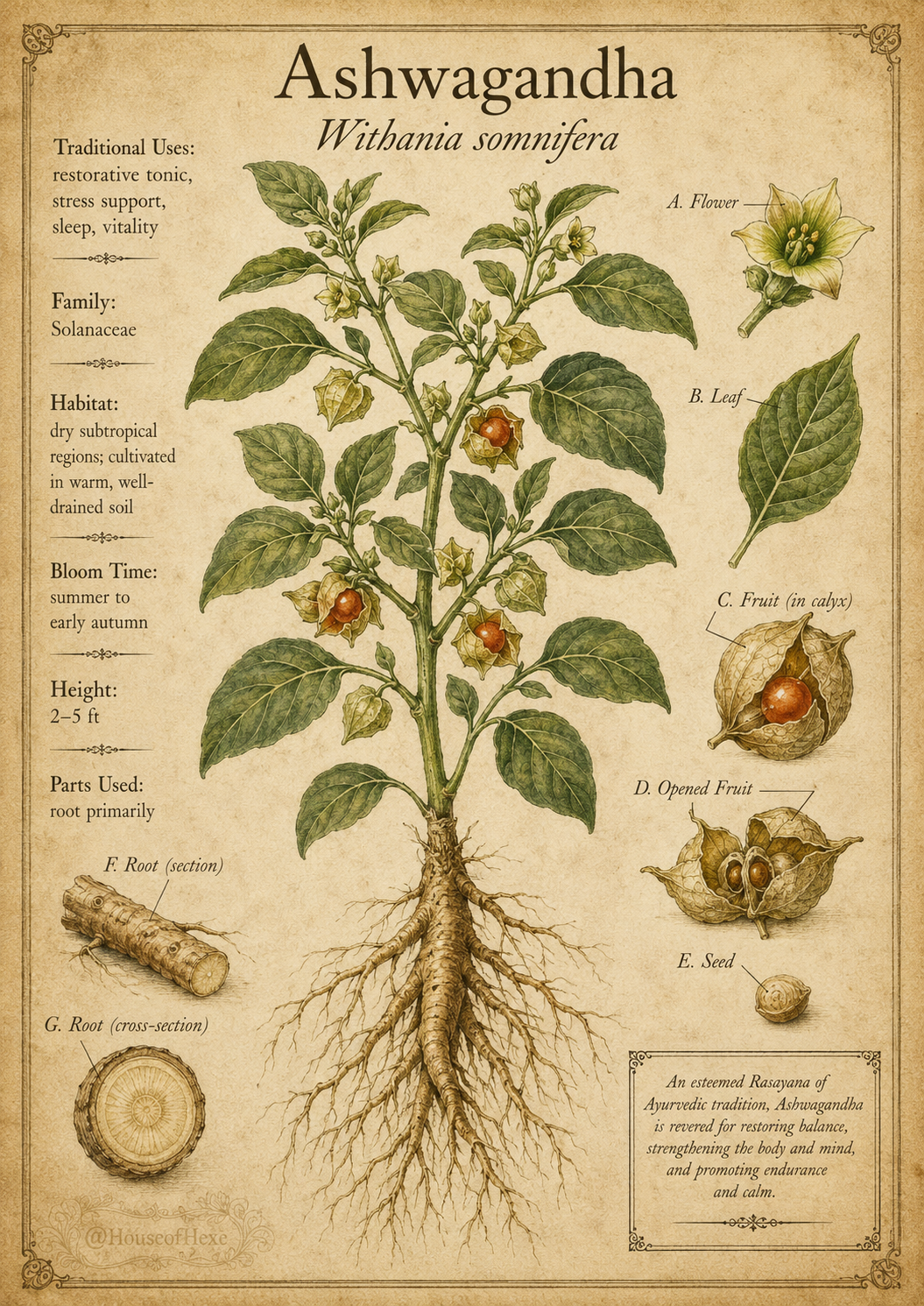
Ashwagandha develops multiple branching stems from a central crown. The stems and young growth are covered with fine, pale gray or silvery hairs, giving the plant a softly dusted appearance. Older stems may become somewhat woody near the base. Kew describes the species as a shrub, subshrub, or woody-based herb capable of reaching approximately two meters. (Plants of the World Online)
Leaves
The leaves are simple, dull green, and broadly ovate, obovate, or oblong, usually with smooth margins. They may appear slightly wavy and frequently carry a gray cast from their fine hairs. The upper surface is comparatively smooth, while the underside is more densely hairy. Leaves commonly reach roughly 1-4 inches long. (Plants of the World Online)
Flowers
The flowers are small, inconspicuous, and produced at the leaf nodes. They are pale green to yellow-green, bell-shaped or shallowly star-shaped, with four or five lobes. The persistent green calyx enlarges after flowering and eventually surrounds the developing fruit. (Plant Toolbox)
Fruit
The ripe fruit is a smooth orange-red to red berry, generally smaller than an inch, enclosed within a papery or lantern-like calyx. As the calyx dries and opens, the bright berry becomes more visible. The fruit is visually attractive but is not the routine medicinal part used in this entry. (Plant Toolbox)
Scent
Both foliage and roots have a distinct nightshade-like odor. Depending upon the observer, it may suggest horse sweat, damp earth, green tomato vines, or freshly disturbed soil. (Plant Toolbox)
Habitat and Bloom Season
Ashwagandha favors dry, sunny, open ground and disturbed habitats in tropical, subtropical, and semi-arid regions. In cultivation it can flower and fruit during its first season, usually from summer into autumn, depending upon planting date and climate. (Plants of the World Online)
Lookalikes and Confusion Species
Ashwagandha may be confused with:
Ground cherries and tomatillos, Physalis species, which also produce berries enclosed in lantern-like calyces.
Other Withania species, especially where their natural ranges overlap.
Various wild Solanum species, including potentially poisonous nightshades with similar leaves or berries.
Do not identify Ashwagandha from a red berry or papery calyx alone. Confirm the hairy stems, leaf shape, flower structure, growth habit, scent, and provenance of the plant. When gathering medicine, the safest practice is to cultivate correctly identified seed rather than wildcrafting an unfamiliar nightshade.
Traditional Uses
Ashwagandha holds an established place within Ayurveda and has also been used in Unani medicine. In Ayurvedic practice it is regarded as a rasayana: a category of medicines and preparations intended to restore vitality, support healthy aging, improve resilience, and rebuild the body following weakness or depletion. Traditional classifications also describe it as balya, or strengthening, and associate it with vajikarana, the branch of Ayurveda concerned with reproductive vitality and generative strength.
Historically, the root has been used in contexts involving:
General weakness and convalescence
Poor sleep associated with depletion
Nervous exhaustion
Musculoskeletal weakness
Reproductive vitality
Age-related decline
Recovery following prolonged illness or physical strain
These are traditional applications, not proof that the herb treats each corresponding modern diagnosis. Traditional systems evaluate constitution, digestion, preparation, accompanying herbs, and the nature of the imbalance rather than treating every tired person with the same capsule.
Powdered root, or churna, is traditionally incorporated into nourishing preparations. Milk, ghee, and honey have all served as vehicles in different formulations, helping place the herb within a broader restorative practice rather than reducing it to an isolated active ingredient. Modern users may substitute a suitable non-dairy milk when needed, though the finished preparation will not be identical to its traditional counterpart.
Ashwagandha has occasionally been flattened by Western marketing into “ancient herbal Xanax” or a universal cure for stress. That description does the herb and its medical lineage a disservice. It is better understood as a deep restorative whose suitability depends upon the person, preparation, dose, and length of use.
Modern Herbal Actions
Adaptogen
An adaptogen is loosely defined as an herb or substance believed to improve the body’s ability to withstand or recover from nonspecific physical, emotional, or environmental stress. It does not mean that the herb simply “lowers cortisol,” nor does it mean that it is appropriate for every stressed person. Ashwagandha is often selected when stress presents alongside depletion, fatigue, poor recovery, restless sleep, or diminished resilience. (Office of Dietary Supplements)
Clinical trials and reviews suggest that certain Ashwagandha extracts may reduce perceived stress and improve some stress-related measurements. However, studies have used different root powders, root extracts, root-and-leaf extracts, withanolide concentrations, and doses, making the results difficult to translate directly into one universal preparation. Many studies have also been small and relatively short. (Office of Dietary Supplements)
Restorative Nervine
A nervine is an herb used to support the nervous system. Ashwagandha is better described as a restorative or tonic nervine than as a rapid tranquilizer. Herbalists often consider it when prolonged tension has led to fatigue, reduced stamina, shakiness, poor sleep, or the feeling of being simultaneously exhausted and unable to fully stand down.
It may be too heavy or sedating for some people, while others find it unexpectedly stimulating. Individual response matters.
Sleep Support
The herb’s association with sleep is reflected in the name somnifera. Clinical evidence suggests that some preparations may modestly improve sleep quality or duration, particularly in people already experiencing disturbed sleep. It should not be assumed to act like a pharmaceutical hypnotic, and it may work better through gradual restoration than through immediate sedation. (NCCIH)
Reproductive and Endocrine Tonic
Traditional use includes reproductive vitality, and limited clinical evidence suggests possible effects on testosterone levels, sperm quality, and related reproductive measures in some men. This is not sufficient grounds to use it casually as a hormone booster. Its potential endocrine activity is one reason people with thyroid disorders, hormone-sensitive prostate cancer, or hormone-related concerns should seek qualified guidance. (NCCIH)
Anti-inflammatory and Immunomodulating Activity
Laboratory and preclinical research has found anti-inflammatory, antioxidant, and immune-modulating activity among Ashwagandha constituents, including withanolides. These findings help explain modern research interest, but they do not establish Ashwagandha as a proven treatment for autoimmune disease, inflammatory disease, cancer, or infection. In fact, possible immune effects are part of the reason it may interact with immunosuppressive treatment. (NCCIH)
Herbalist’s Perspective
Ashwagandha is frequently most useful when the treatment goal is rebuilding capacity rather than forcing performance. It is not an herbal excuse to remain inside circumstances that are continually draining the body. No adaptogen can make chronic sleep deprivation, relentless labor, unsafe conditions, or unmanaged illness harmless.
Preparations
Powder or Churna
Powdered root is one of the most traditional forms. It can be stirred into warm milk, a suitable non-dairy milk, porridge, or another nourishing food. Because the root is earthy, bitter, and somewhat musky, warming spices such as cinnamon, cardamom, ginger, or nutmeg are often used to make it more palatable.
Honey may be added after the preparation has cooled to a comfortably warm temperature.
Powder preserves a broad range of root constituents, but it is not automatically equivalent to a concentrated extract. Milligrams of standardized extract cannot be directly exchanged for milligrams of whole-root powder.
Decoction
A decoction is made by gently simmering a tougher plant part such as a root. Ashwagandha is better suited to decoction than to a brief tea infusion.
The root may be simmered in water alone or in a mixture of water and milk. A milk decoction produces a heavier, more nourishing preparation and fits the herb’s traditional restorative character particularly well.
Tincture
A tincture offers convenience and a longer shelf life. It may suit formulas intended for nervous exhaustion, recovery, or sleep support, particularly when Ashwagandha is combined with other herbs.
The character of a tincture differs from whole-root powder or a milk preparation. It is easier to take but less nutritive as a ritual and delivery method.
Glycerite
A glycerite can be prepared for those avoiding alcohol, although the flavor is quite distinctive. It is generally not the strongest or most traditional preparation, but it can be useful in individualized formulas.
Capsules and Standardized Extracts
Capsules conceal the flavor and allow consistent administration. Standardized extracts concentrate selected compounds, often withanolides, but products vary considerably in plant part, extraction process, and concentration. Clinical research cannot be assumed to apply equally to every bottle labeled “Ashwagandha.” (Office of Dietary Supplements)
Choose products that clearly state:
The botanical name
Whether the extract is root-only or root-and-leaf
The extraction ratio or standardization
Independent identity and contaminant testing
Lot number and manufacturer contact information
Oil, Salve, and Poultice
Topical preparations have a place in some traditional practices, particularly for sore or overworked areas, but they are not the primary modern use of the herb. Patch-test before broader application, especially in anyone sensitive to nightshades.
Smoke or Incense
Ashwagandha is not a preferred smoking herb. Burning an internal medicinal root introduces unnecessary respiratory exposure and does not improve its magical value. For ritual work, use a whole root fragment, contained powder, petition bundle, or altar placement rather than inhaling the smoke.
Magical Uses
Ashwagandha does not have one universally documented classical Western planetary or magical correspondence. The following is a House of Hexe working correspondence, informed by the herb’s root medicine, traditional character, and observed energetic pattern. It is not presented as an ancient Ayurvedic occult doctrine.
Ashwagandha is a herb of resilience, but not the shallow resilience demanded by systems that intend to work a person into the ground. Its magic is the recovery of stolen reserves. It protects rest, reinforces the will to remain embodied, and helps rebuild the quiet strength required to begin again.
Practical Folk-Magic Uses
Recovery after prolonged strain:
Place a small piece of dried root in a brown or dark red cloth packet with a written petition naming what is being restored:
sleep
physical strength
confidence
appetite for life
or the ability to feel safe while resting
Grounded courage:
Use the root in workings for steady nerve rather than reckless bravery. This is useful before long-term healing, difficult conversations, rehabilitation, physical therapy, or any undertaking that requires endurance instead of spectacle.
Protected rest:
Keep a contained root charm near the bed or within a bedside drawer to mark the sleeping space as guarded territory. The working is not “make me unconscious.” It is “nothing is permitted to feed upon the hours in which I rebuild.”
Returning to the body:
Ashwagandha can anchor practices intended to restore embodiment after grief, burnout, dissociation, or prolonged spiritual overextension. Pair the working with food, bathing, sleep, warmth, and practical care. The magic should return the practitioner to the body, not pull them farther away from it.
Long labor and sustained commitment:
Use in spells for apprenticeships, rehabilitation, rebuilding a business, tending land, or completing work that must be approached over months rather than conquered in one feverish night.
Treat the plant’s Ayurvedic lineage respectfully. Its contemporary inclusion in Western folk magic should be named as adaptation and relationship, not falsely described as an inherited Indian witchcraft tradition.
Astrological Correspondences
Planet: Mars, with a Lunar Undertone
Ashwagandha carries a clear Martial current through its association with horses, muscular strength, stamina, heat, courage, reproductive vitality, and the restoration of physical capacity.
Yet this is not Mars at the height of combat. It is Mars returning from the field, washing the blood from its hands, eating a full meal, and sleeping long enough to regain its strength.
The Moon appears beneath that Martial surface through nourishment, sleep, restoration, milk preparations, bodily rhythms, and the rebuilding of safety. Mars supplies the will to live. The Moon provides the conditions in which life can recover.
Element: Earth
The root is the medicine, and the plant prefers lean, dry ground. Its work is slow, embodied, and structural. Earth governs reserves, nourishment, stability, physical restoration, and the patient rebuilding of what stress has worn thin.
Zodiac: Aries and Capricorn
Aries expresses the Martial qualities of vitality, nerve, courage, and the return of physical fire.
Capricorn governs endurance, bones, limits, long labor, and strength built through repetition rather than impulse. Capricorn also reminds us that true resilience includes structure: boundaries, sleep, pacing, and knowing when the body has reached its limit.
Seasonal Timing
Ashwagandha fits naturally into late autumn and winter work: convalescence, storing strength, restoring the nervous system, and tending the body when outward growth has slowed.
Lunar Timing
Use during the dark moon for protected withdrawal and deep rest, then continue into the waxing moon when the intention shifts toward rebuilding strength, appetite, confidence, and capacity.
Growing & Harvesting
Ashwagandha is well suited to hot, relatively dry gardens. It prefers full sun, warmth, and freely draining soil and is vulnerable to root problems when kept continually wet. NC State recommends sandy, well-drained ground and allowing the soil to dry between waterings. (Plant Toolbox)
Soil
Use sandy, loamy, or lightly rocky soil with excellent drainage. Ashwagandha tolerates a broad soil pH range but is frequently cultivated in neutral to slightly alkaline conditions.
Avoid low spots, heavy wet clay, and containers without clear drainage holes.
Sun
Provide full sun - ideally six or more hours of direct sunlight each day. Plants grown in inadequate light tend to stretch and may produce smaller roots. (Plant Toolbox)
Water
Water regularly while seedlings establish, then allow the upper soil to dry before watering again. The plant is relatively drought tolerant once established and dislikes wet feet.
Climate
Ashwagandha is perennial in warm climates but is usually grown as an annual in regions colder than approximately USDA zone 8. Seeds germinate best in warm conditions, and NC State recommends sowing once temperatures are above roughly 70°F. (Plant Toolbox)
For a short-season or high-desert garden, start seeds indoors well before the last frost and transplant only after the soil has warmed and hard freezes have passed. A dark nursery pot or sheltered south-facing bed can provide additional warmth, but container-grown plants may produce smaller roots.
Harvest Timing
Harvest the roots when the plant has flowered and fruited and the foliage begins to yellow, dry, or decline. This usually occurs near the end of the growing season. Mature roots should be firm, well developed, and strongly scented. (Plant Toolbox)
Root Harvest
Lift the entire plant carefully with a garden fork rather than pulling from the stem. Shake away loose soil, trim off the aerial growth, and wash the root quickly in cool water.
Do not leave freshly washed roots sitting wet.
Drying
Slice thick roots lengthwise or into short sections while still fresh; they become considerably harder once dry. Dry in a warm, well-ventilated place away from direct sunlight, or use a dehydrator on a low setting.
The root is sufficiently dry when it is hard throughout and no longer bends or feels cool and damp at its center.
Storage
Store dried root in an airtight container away from heat, moisture, insects, and direct light. Label it with the botanical name, plant part, harvest location, and harvest date.
Keep berries and seed separate from the medicinal root supply. Do not allow the bright fruit to be mistaken for food, especially where children or animals may encounter it.
Warnings & Contraindications
Ashwagandha has a long history of use, but “traditional” does not mean appropriate for every body or safe in every circumstance.
Pregnancy and Breastfeeding
Avoid during pregnancy. NCCIH also advises against use while breastfeeding because adequate safety information is not available. (NCCIH)
Thyroid Disorders
Ashwagandha may affect thyroid hormone levels. Avoid unsupervised use with hyperthyroidism, hypothyroidism, thyroid medication, unexplained thyroid symptoms, or a history of thyrotoxicosis. (NCCIH)
Autoimmune Conditions and Immunosuppressants
Because Ashwagandha may influence immune activity, it is not recommended for unsupervised use in autoimmune disease or alongside immunosuppressive medications. (NCCIH)
Sedatives and Anticonvulsants
Ashwagandha may increase drowsiness or interact with sedatives, sleep medications, anti-anxiety drugs, and anticonvulsants. Use particular caution when driving, caring for children overnight, or combining it with alcohol or other sedating herbs. (NCCIH)
Blood Pressure and Blood Sugar Medication
Potential interactions may occur with antihypertensive or diabetes medications. Combining them may contribute to blood pressure or blood sugar dropping lower than intended. (NCCIH)
Surgery
Discontinue only according to the guidance of the surgical or prescribing team. NCCIH advises against use when preparing for surgery because of possible effects involving sedation, blood pressure, blood sugar, thyroid function, and medication interactions. (NCCIH)
Hormone-Sensitive Prostate Cancer
Because some evidence suggests Ashwagandha may increase testosterone, people with hormone-sensitive prostate cancer should avoid it unless specifically directed by their oncology team. (NCCIH)
Liver Injury
Rare cases of clinically apparent liver injury have been associated with products containing Ashwagandha. Reported cases have commonly appeared within approximately two to twelve weeks of beginning a supplement and may involve jaundice, severe itching, dark urine, pale stools, nausea, or unusual fatigue. Risk appears particularly concerning in people with cirrhosis or advanced chronic liver disease. (NCBI)
Stop use and seek medical evaluation promptly if symptoms of liver injury appear. Do not restart the same product after a suspected reaction.
Common Side Effects
Possible adverse effects include:
Drowsiness
Stomach upset
Nausea
Diarrhea
Vomiting
Headache
These effects may be more pronounced with concentrated extracts or when taken on an empty stomach. (NCCIH)
Nightshade Sensitivity
People with known allergy or pronounced sensitivity to members of the Solanaceae family should approach Ashwagandha cautiously. Topical preparations should be patch-tested.
Long-Term Use
Most available safety data concern short-term use, generally no longer than about three months. Safety over many months or years remains uncertain. A tonic reputation should not be interpreted as permission for indefinite, unmonitored use. (NCCIH)
Product Quality and Plant Part
Root, leaf, and mixed extracts have different chemical profiles. Prefer clearly labeled, root-only products when following traditional root use, and purchase from manufacturers that perform independent testing for identity, heavy metals, pesticides, microbes, and adulterants. (Office of Dietary Supplements)
Final Thoughts
Ashwagandha is not a whip held over an exhausted body. It is the winter storehouse, the guarded bed, the meal eaten after the danger has passed. Medicinally, it asks us to consider whether strength means producing more or finally becoming safe enough to restore what has been spent. Its spirit does not glorify endurance without end. It teaches the older and more difficult form of resilience: knowing when to stop fighting, take root again, and allow strength to return.
SOURCES / FURTHER READING
Plants of the World Online, Royal Botanic Gardens, Kew. Withania somnifera botanical classification, morphology, and distribution. (Plants of the World Online)
NIH Office of Dietary Supplements. “Ashwagandha: Is It Helpful for Stress, Anxiety, or Sleep?” Updated May 2025. (Office of Dietary Supplements)
National Center for Complementary and Integrative Health. “Ashwagandha: Usefulness and Safety.” (NCCIH)
LiverTox, National Institute of Diabetes and Digestive and Kidney Diseases. “Ashwagandha.” Updated December 2024. (NCBI)
Ministry of AYUSH, Government of India. Safety of Ashwagandha: Report of the Expert Committee.
North Carolina Extension Gardener Plant Toolbox. Withania somnifera: identification and cultivation. (Plant Toolbox)