Burdock | Arctium lappa
Root of the deep skin, old blood, and stubborn clearingBurdock is a large biennial member of the Asteraceae family, best known for its broad leaves, hooked burrs, and long medicinal taproot. Historically, it has been used as a food, alterative, bitter tonic, diuretic, and skin herb across European, Asian, and folk herbal traditions. Modern herbalists still value Burdock root for supporting digestion, elimination, skin health, lymphatic movement, and gentle metabolic clearing. Magically, Burdock is a root of protection, uncrossing, grounding, boundary work, and removing what clings too long.
Quick Correspondence Block
Planet: Saturn, Venus
Element: Earth
Zodiac: Capricorn, Taurus, Scorpio
Primary Actions: Alterative, bitter, diuretic, lymphatic, nutritive, mild hepatic support
Parts Used: Root, seed, leaf occasionally
Preparation Style: Decoction, tincture, vinegar, broth, food, poultice, wash
Magical Uses: Protection, uncrossing, grounding, banishing attachments, boundary work, road clearing
Spirit of the Herb: The old root that pulls what festers from the dark.
Overview
Burdock is not delicate medicine. It is old, earthy, stubborn, and patient. It grows where the soil has been disturbed, sending a long taproot downward while its broad leaves gather sunlight above. Its burrs cling to clothing, animal fur, hems, socks, and memory. Burdock teaches through attachment: what catches, what follows, and what must finally be removed.
Medicinally, Burdock root belongs to the great alterative tradition. Alteratives are herbs used over time to support the body’s natural processes of elimination, nourishment, and tissue repair. In old language, Burdock was called a blood purifier. In modern herbal language, that usually points toward its use for skin, lymph, digestion, liver support, kidney elimination, and chronic heat or stagnation that shows through the skin.
The European Medicines Agency recognizes Burdock root as a traditional herbal medicinal product for seborrhoeic skin conditions, temporary loss of appetite, and urinary flushing support, based on long-standing use rather than strong modern clinical trial evidence. (European Medicines Agency (EMA))
Magically, Burdock is a root of removal and return. It does not sparkle. It digs. It works well in protection, uncrossing, banishing clinging influences, grounding the body after spiritual work, and helping a practitioner pull themselves back into their own skin.
Botanical Identification
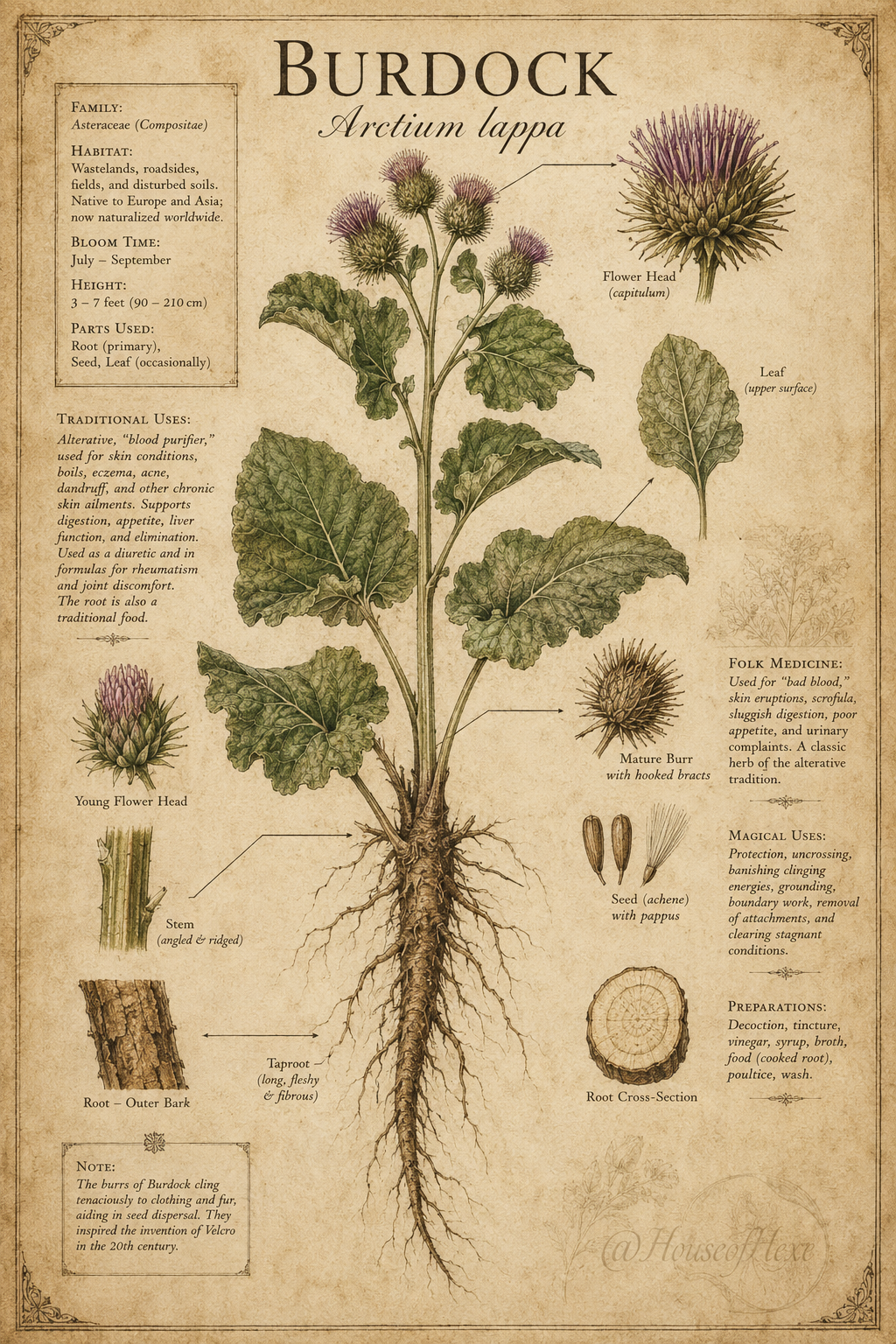
Burdock, Arctium lappa, is a biennial herb in the Asteraceae family. In its first year, it forms a basal rosette of large leaves while developing its long taproot. In the second year, it sends up a tall flowering stalk, blooms, sets burrs, and then dies.
The leaves are large, broad, heart-shaped to oval, and often have a woolly or pale underside. The plant can grow impressively tall in its second year, often reaching several feet depending on species and conditions. Greater burdock may grow roughly 100–300 cm tall, with rough, branching stems and broad leaves. (EDDMaps)
The flowers are purple to pinkish-purple, thistle-like, and surrounded by hooked bracts that mature into burrs. These burrs are one of Burdock’s most recognizable traits. They cling easily to clothing and animal fur and famously inspired the design concept behind Velcro.
The root is long, brown-skinned, pale inside, earthy-scented, and fleshy when fresh. In Japanese cooking, Burdock root is known as gobo and is used as a food.
Lookalikes and confusion species: Burdock may be confused with rhubarb when young because of its large leaves, though rhubarb has very different stems and garden habit. It may also be confused with thistles, but Burdock leaves and stems do not have the same sharp spines as many true thistles. Common burdock, Arctium minus, is closely related and also widely naturalized in North America; it is often treated similarly in folk use, though this entry focuses on Arctium lappa. (Montana State University)
Traditional Uses
Burdock has long been used as both food and medicine. The root was eaten as a vegetable, simmered in broths, added to soups, pickled, cooked with grains, or prepared as a strengthening food during colder seasons.
In European and North American folk herbalism, Burdock root became one of the classic alterative herbs. It was used for skin eruptions, eczema-like conditions, boils, acne, dandruff, sluggish digestion, poor appetite, rheumatic complaints, and “bad blood” conditions. That phrase should not be taken literally in a modern biomedical sense. In traditional herbal language, “bad blood” often meant chronic stagnation, heat, waste burden, poor elimination, skin inflammation, or a body that needed slow, steady clearing.
Burdock also appears in traditional formulas with dandelion, yellow dock, cleavers, nettle, red clover, sarsaparilla, and other herbs used for skin, lymph, liver, kidneys, and chronic constitutional clearing.
Ritually, Burdock has been used for protection, uncrossing, boundary work, and removing stubborn attachments. Its burrs make the magical logic obvious: this plant understands what clings.
Modern Herbal Actions
Burdock is best understood as a slow, nutritive alterative root.
As an alterative, Burdock supports gradual clearing through the skin, liver, lymph, digestion, and kidneys. This is not a dramatic purge. Burdock is better suited to long, steady work than quick intervention.
As a bitter, Burdock root can gently stimulate appetite and digestive secretions. Bitters wake up the digestive system through taste, helping prepare the body to receive and process food.
As a diuretic, Burdock may support urinary flow. This is one reason it appears in traditional urinary and “clearing” formulas. The EMA notes traditional use for flushing the urinary tract, while also cautioning that diuretic use should not replace conventional treatment where needed. (European Medicines Agency (EMA))
As a skin herb, Burdock is traditionally used where skin conditions seem connected to deeper metabolic, digestive, lymphatic, or eliminatory stagnation. It is not a topical quick fix. It is root medicine for patterns that have been building under the surface.
As a nutritive root, Burdock contains inulin, a prebiotic fiber also found in plants like chicory, dandelion, elecampane, and Jerusalem artichoke. Inulin can support gut flora, though it may also cause gas or bloating in sensitive people.
Modern reviews have investigated Arctium lappa for antioxidant, anti-inflammatory, antimicrobial, metabolic, hepatoprotective, and other pharmacological activities, though many findings are still preclinical or not yet strong enough to treat as proven clinical outcomes. (PMC)
Preparations
Decoction:
The classic preparation for Burdock root. Simmer the dried or fresh root to extract its minerals, inulin-rich body, bitterness, and earthy medicine.
Tincture:
Useful when a smaller-dose, shelf-stable preparation is needed. Often combined with dandelion root, yellow dock, cleavers, nettle, red clover, or Oregon grape root depending on the formula.
Vinegar:
A strong folk preparation for mineral-rich roots. Burdock vinegar works well in kitchen herbalism and can be added to food, dressings, or mineral tonics.
Food:
Fresh Burdock root can be cooked as gobo. This is one of the best ways to understand the herb: not as a mysterious supplement, but as earthy, bitter, strengthening root food.
Broth:
Excellent in long-simmered mineral broths, especially with nettle, dandelion root, astragalus, mushrooms, garlic, onions, or bones if the preparation is not vegetarian.
Poultice:
Fresh grated root or leaf may be used externally in folk practice for minor skin irritations, swellings, or stubborn places that need drawing and softening.
Wash:
A cooled decoction may be used as a skin wash for oily, itchy, or irritated skin, though internal work is usually the heart of Burdock’s traditional use.
Powder:
Can be encapsulated, added to formulas, or stirred into food, though the flavor and texture are very earthy.
Magical Uses
Burdock is a plant of the boundary after the boundary has been violated.
It does not simply protect by standing at the door. It finds what has already gotten in, what has hooked itself into your clothing, your field, your habits, your grief, your anger, your body, and your house. Then it asks whether you are ready to pull it out.
Use Burdock for:
Protection work
Uncrossing
Grounding after spirit work
Removing attachments
Breaking lingering energetic residue
Boundary reinforcement
Banishing parasitic influence
House cleansing after conflict
Returning to the body
Road opening after stagnation
Ancestral healing involving old family patterns
Rooting scattered power back into the self
In House of Hexe work, Burdock is not a glamorous herb. It is the root kept in the drawer for when the glamour has failed. It belongs in workings where the problem is not dramatic but persistent: the old pattern, the clinging person, the repeated wound, the spiritual debris that keeps catching on the hem.
Astrological Correspondences
Burdock carries Saturn strongly. It is a root of time, endurance, consequences, boundaries, old patterns, and slow correction. Saturn governs what must be faced honestly, what must be structured, and what must be removed through discipline rather than impulse.
Venus also belongs here, but not the soft pink Venus of surface beauty. Burdock is Venus in the skin, the tissue, the body’s sense of worth, and the slow repair of what has been inflamed or neglected. It supports beauty by tending the ground beneath it.
Elementally, Burdock is Earth. It is root, soil, weight, minerals, digestion, elimination, and embodiment.
Zodiacally, Burdock works well through Capricorn for discipline, boundaries, and long-term repair; Taurus for the body, skin, food, and material grounding; and Scorpio for elimination, shadow work, attachment, and deep clearing.
Seasonally, Burdock belongs to the turning points of root medicine: autumn digging, winter broths, and the long slow work of preparing the body before spring’s outward movement.
Growing & Harvesting
Burdock grows best in deep, loose, fertile soil where its taproot can descend without obstruction. Compacted soil can create twisted or forked roots, which may be less convenient for harvest but still useful.
Growing notes:
Soil: Deep, loose, fertile, well-drained
Sun: Full sun to partial shade
Water: Moderate, especially while establishing
Climate: Hardy biennial, tolerant once established
Height: Several feet tall in second year
Harvest: Root is usually harvested in autumn of the first year or early spring of the second year before flowering
Parts gathered: Root primarily; seeds and leaves less commonly
Drying: Slice roots thinly before drying to prevent mold
Storage: Store dried root in airtight jars away from heat, light, and moisture
Harvest before the plant sends up its second-year flowering stalk. Once it flowers, much of the root’s stored energy has moved upward into reproduction.
In the garden, be mindful: Burdock can become weedy if allowed to seed freely. Remove burrs before they scatter unless you intentionally want it to spread.
Warnings & Contraindications
Burdock is generally well tolerated as a food and traditional herb, but it is not appropriate for everyone.
Use caution with:
Pregnancy
Breastfeeding
Known allergy to Asteraceae family plants
Diuretic medications
Kidney disease
Diabetes medications or blood sugar instability
Dehydration
Electrolyte imbalance
Very sensitive digestion
High inulin sensitivity
Contaminated wild-harvested roots
Because Burdock may have diuretic and blood sugar effects, people using related medications should seek professional guidance. Those sensitive to inulin-rich foods may experience gas, bloating, or digestive discomfort.
Do not wild-harvest roots from roadsides, sprayed fields, contaminated lots, industrial areas, or places with heavy metals or chemical runoff. Burdock roots deeply. That is part of its medicine, but it also means it can draw from compromised soil.
Final Thoughts
Burdock is the medicine of the stubborn root and the hooked burr. It teaches that healing is not always fragrant, immediate, or pretty. Sometimes the work is to dig down, loosen what has hardened, feed the body, clear the skin, strengthen the boundary, and finally remove what has been clinging for too long.
In the old apothecary, Burdock belongs in the drawer marked skin, roots, clearing, protection, and the slow return to yourself.
SOURCES / FURTHER READING
European Medicines Agency. Arctii radix / Burdock Root Herbal Monograph.
European Medicines Agency. Assessment Report on Arctium lappa L., radix.Yosri, N. et al. “Arctium lappa: Ethnopharmacology, Phytochemistry, and Pharmacological Properties.”
Shyam, M. et al. “Harnessing the Power of Arctium lappa Root: A Review of Its Pharmacological Properties and Therapeutic Applications.”
Hoffmann, David. Medical Herbalism.
Grieve, Maud. A Modern Herbal.
Wood, Matthew. The Earthwise Herbal.
Tierra, Michael. The Way of Herbs.