Anise | Pimpinella anisum
Sweet seed, breath-softener, belly warmerAnise is a delicate annual member of the carrot family, grown for its aromatic fruits commonly called seeds. Historically, it has been valued across Mediterranean, Middle Eastern, European, and domestic herbal traditions as a culinary spice, digestive remedy, breath sweetener, and warming household medicine. Modern herbalists still reach for Anise as a carminative, mild expectorant, aromatic digestive, and gentle antispasmodic, especially where gas, bloating, cough, or cold digestive stagnation are present. Magically, Anise belongs to sweetness with protection: dreamwork, purification, luck, blessing, and the softening of fear without weakening the will.
Quick Correspondence Block
Planet: Mercury, Jupiter
Element: Air with Fire
Zodiac: Gemini, Sagittarius, Pisces
Primary Actions: Carminative, aromatic digestive, antispasmodic, expectorant, galactagogue in folk tradition
Parts Used: Fruit, commonly called seed
Preparation Style: Infusion, crushed seed tea, tincture, syrup, cordial, incense, dream sachet
Magical Uses: Dreamwork, purification, luck, protection, sweetening, spirit communication, blessing
Spirit of the Herb: The sweet breath before the door opens.
Overview
Anise is not a loud plant. It does not tower like Angelica or command the garden with heavy roots and broad leaves. Instead, it works by fragrance. A small seed, warm and sweet on the tongue, carrying the unmistakable scent of licorice, fennel, and old-world kitchens.
Medicinally, Anise belongs to the aromatic seeds: plants that warm the belly, relax tension, move trapped wind, and bring comfort where digestion has become tight, cold, or unsettled. The European Medicines Agency recognizes traditional use of Anise fruit for mild spasmodic gastrointestinal complaints, including bloating and flatulence, and also as an expectorant for cough associated with colds. (Fitoterapia)
Spiritually, Anise is a liminal sweetener. It does not erase what is bitter, but it makes the passage easier. It has long been used in charms, dream pillows, purification work, luck workings, and formulas meant to soften fear, invite good spirits, and sweeten the atmosphere of the home.
Botanical Identification
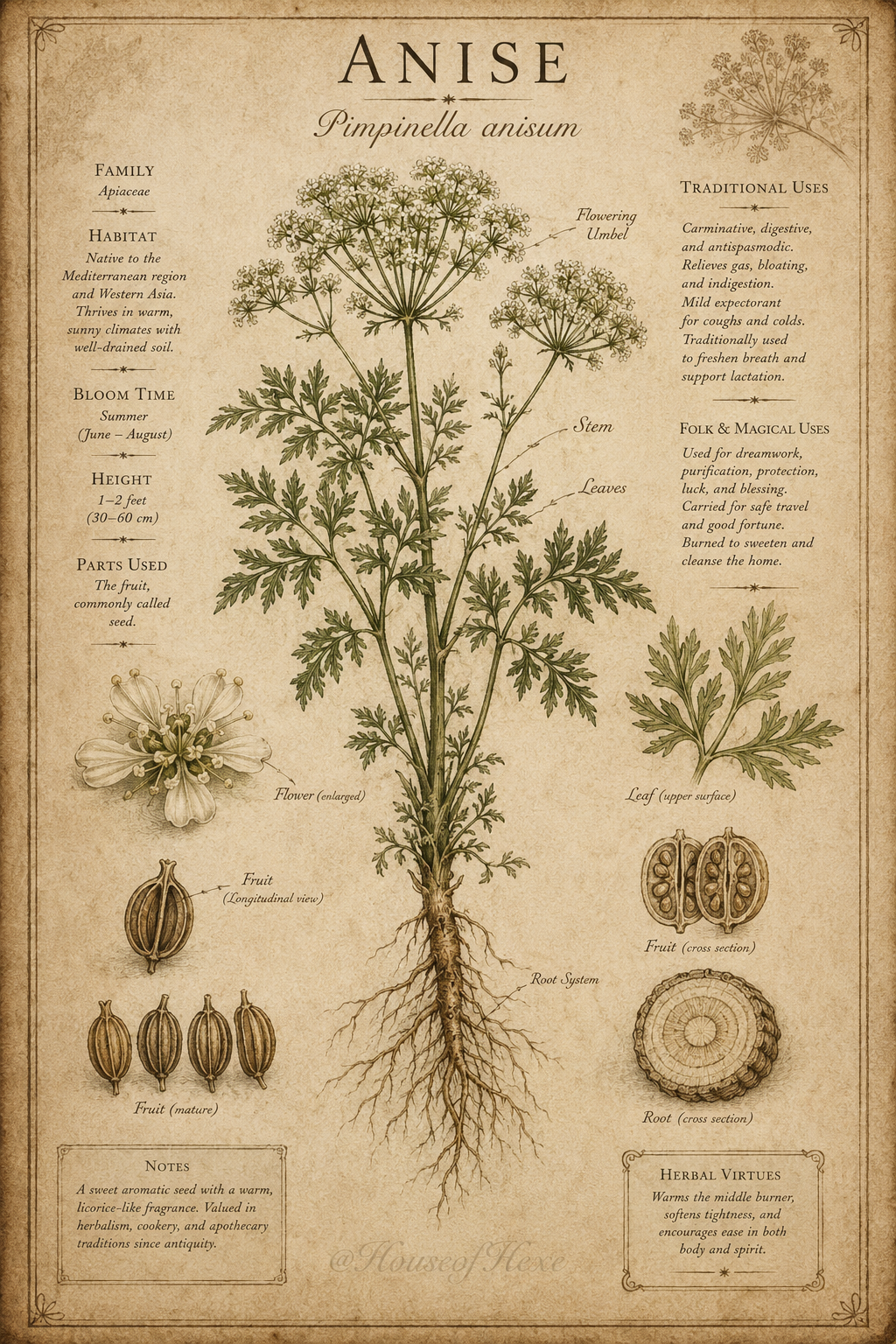
Anise, Pimpinella anisum, is an annual herb in the Apiaceae family, the same family as fennel, dill, parsley, carrot, cumin, coriander, Angelica, and several dangerous poisonous plants.
It usually grows low to moderately tall, often around 1–2 feet depending on conditions. The plant has a delicate, branching habit with lower leaves that are broader and upper leaves that become more finely divided. The flowers are small, white, and arranged in loose umbels. The fruits are small, ribbed, oval, gray-green to brownish, and strongly aromatic when crushed. Though commonly called seeds, the medicinal and culinary part is technically the dried fruit. (ScienceDirect)
The scent is one of the strongest identifiers: sweet, licorice-like, warm, and aromatic due largely to anethole-rich volatile oils. (PMC)
Lookalike caution: Because Anise belongs to the Apiaceae family, beginners should not wild-harvest it casually. Umbel-bearing plants can be difficult to distinguish, and this family includes deadly species such as poison hemlock and water hemlock. For medicine and kitchen use, cultivated or purchased Anise seed is safest.
Traditional Uses
Anise has been used since antiquity as food, spice, medicine, and household remedy. It appears in Mediterranean, Egyptian, Greek, Roman, Middle Eastern, and European traditions as a digestive seed, breath sweetener, warming spice, and remedy for gas, cough, and sluggish digestion. The Herb Society of America notes that Anise was prized for its aromatic fruits and cultivated historically as a spice. (Herb Society of America)
In traditional domestic herbalism, Anise seed was commonly taken after meals, brewed into teas, added to cordials, used in cough syrups, and included in formulas for nursing mothers, digestion, and children’s colic-like discomforts. Its sweet taste made it especially useful where stronger bitter or pungent herbs would be rejected.
Magically, Anise has been carried for protection, placed under pillows for dreamwork, burned for purification, and added to charms for luck, love, clarity, and spirit-friendly household blessing.
Modern Herbal Actions
Anise is best understood as a sweet aromatic relaxant for the belly and breath.
As a carminative, Anise helps relieve gas, bloating, and digestive tension. Carminatives are aromatic herbs that help relax spasms and move trapped wind through the digestive tract.
As an antispasmodic, it may help ease mild cramping or gripping sensations, especially when those discomforts are tied to gas or nervous digestive tension.
As an aromatic digestive, Anise gently stimulates and comforts digestion without the hard bitterness of herbs like gentian or wormwood.
As an expectorant, Anise can support the movement of mucus in coughs associated with colds, especially when the cough is damp, stuck, or accompanied by heaviness in the chest. (Fitoterapia)
As a galactagogue, Anise has folk use in supporting milk flow, though this should be approached cautiously and with professional guidance during pregnancy or breastfeeding.
Preparations
Tea / Infusion:
The classic preparation. Crush the seeds lightly before steeping to release the volatile oils. Anise tea is especially suited for gas, bloating, meal heaviness, and mild cough formulas.
Tincture:
Useful in small-dose digestive formulas, especially with fennel, chamomile, catnip, lemon balm, ginger, or dandelion root.
Syrup:
A good preparation for cough blends where Anise’s sweetness improves flavor and helps soften the formula.
Cordial / Liqueur:
Historically appropriate. Anise has long been used in spirits and digestifs, carrying both digestive and ritual warmth.
Glycerite:
A useful option when working with children or alcohol-free formulas, though internal use for children should still be cautious and age-appropriate.
Powder:
Can be used in culinary preparations, spice blends, incense, or charm powders. For medicine, freshly crushed seed is preferred over old powder.
Incense / Smoke:
Anise seed may be burned in small amounts for purification, dreamwork, blessing, and spirit communication.
Dream Sachet:
Anise can be placed in a small cloth bag with mugwort, lavender, chamomile, or skullcap for dream recall and sleep rituals.
Magical Uses
Anise is a sweetener of thresholds. It belongs to the moment before sleep, the breath before prayer, the cup after a heavy meal, and the charm tucked quietly near the bed.
Use Anise for:
Dream recall and prophetic dreaming
Protection during sleep
Purification of the home
Sweetening difficult energy
Luck and blessing work
Gentle spirit communication
Calming fear before divination
Opening the breath before spellwork
Softening bitterness after conflict
Attracting kind spirits and helpful influence
In House of Hexe work, Anise is not a sugary herb of denial. It does not pretend the world is harmless. It makes the spirit less rigid, the belly less knotted, and the room more hospitable to blessing.
Astrological Correspondences
Anise carries strong Mercurial virtue through its relationship to breath, digestion, speech, movement, and subtle communication. It helps things move: gas, mucus, words, dreams, messages, and spiritual impressions.
It also carries Jupiterian warmth through its traditional role in blessing, abundance, good fortune, and household well-being. Jupiter expands what is useful and benevolent. Anise does this gently, through sweetness rather than force.
Elementally, Anise is primarily Air, with a thread of Fire. Air lives in its fragrance, breath, communication, dream movement, and nervous system affinity. Fire lives in its warmth, spice, digestion, and protective spark.
Zodiacally, Anise may be worked with through Gemini for breath, speech, dreams, and messages; Sagittarius for blessing, luck, and spiritual expansion; and Pisces for dreams, spirit contact, sleep, and softened emotional passage.
Growing & Harvesting
Anise prefers full sun, warm weather, and well-drained soil. It does best when direct-sown, as it can resent transplanting. In cooler or high-elevation climates, start with a protected warm sowing window and give the plant as much steady warmth as possible.
Growing notes:
Soil: light, well-drained, moderately fertile
Sun: full sun
Water: moderate, consistent moisture while establishing
Climate: warm growing season preferred
Height: often 1–2 feet
Harvest: gather seed heads when fruits turn gray-green to brown and begin to dry
Drying: cut umbels and dry upside down over a clean cloth or paper bag
Storage: store whole seeds in an airtight jar away from heat and light
Use: crush only when ready to prepare for best aroma
In dry climates, mulch lightly and avoid letting young plants bake before they are established.
Warnings & Contraindications
Anise seed in normal culinary amounts is generally well tolerated by most people, but medicinal doses and essential oil require more caution.
Avoid or use professional guidance with:
Pregnancy
Breastfeeding
Estrogen-sensitive conditions
Use of hormone-sensitive medications
Known allergy to Apiaceae family plants
Children under 12 for medicinal dosing unless guided by a qualified practitioner
Essential oil use internallyHigh-dose or long-term medicinal use
The EMA monograph does not recommend Anise fruit preparations for children under 12 due to lack of adequate data. (Fitoterapia) Anethole-rich essential oils should be avoided during pregnancy, breastfeeding, and estrogen-dependent cancers according to a review on reproductive toxicity of essential oils. (PMC)
Do not confuse Anise with Star Anise. They are different plants. Anise is Pimpinella anisum in the Apiaceae family. Star Anise is Illicium verum. Japanese star anise, Illicium anisatum, is toxic and should not be used.
Final Thoughts
Anise is small medicine with an old voice. It warms the belly, sweetens the breath, loosens what is held too tightly, and teaches that softness can still be protective. In the old apothecary, Anise belongs in the drawer marked digestion, dreams, coughs, blessing, and the gentle return of ease.
SOURCES / FURTHER READING
European Medicines Agency. Community Herbal Monograph on Pimpinella anisum L., fructus.
Soussi, M. et al. “A Multidimensional Review of Pimpinella anisum.” 2023.
Shojaii, A. and Fard, M.A. “Review of Pharmacological Properties and Chemical Constituents of Pimpinella anisum.”
Herb Society of America. “Anise, Pimpinella anisum.”
Hoffmann, David. Medical Herbalism.
Grieve, Maud. A Modern Herbal.
Herbal Academy. “Anise Monograph: Pimpinella anisum.”