Yarrow | Achillea millefolium
Herb of blood, wound, fever, boundary, courage, divination, protection, ancestral field medicine, and the thousand-leaved warriorYarrow is one of the old wound herbs, known across fields, roadsides, battle stories, folk medicine, and household apothecaries. Achillea millefolium belongs to the Asteraceae family and grows as a hardy perennial across temperate regions; Kew lists its native range as Greenland, subarctic and temperate Eurasia, while noting its long use as medicine, food, animal forage, and in other cultural applications. (Plants of the World Online)
Quick Correspondence Block
Planet: Mars, Venus, Saturn
Element: Fire, Water, Earth
Zodiac: Aries, Scorpio, Virgo, Capricorn
Primary Actions: Astringent, styptic, vulnerary, diaphoretic, bitter, aromatic, anti-inflammatory-adjacent, digestive-supportive, menstrual-supportive
Parts Used: Flowering tops, leaves, aerial parts
Preparation Style: Tea, infusion, tincture, poultice, compress, salve, oil, bath, steam, vinegar, wound wash, charm bundle, divination stalks
Magical Uses: Protection, boundaries, courage, blood mysteries, love divination, wound healing, psychic defense, ancestral medicine, battlefield magic, oath work
Spirit of the Herb: The battlefield healer at the threshold: sharp, steady, watchful, compassionate without softness, and old enough to know that protection and tenderness often share the same root.
Overview
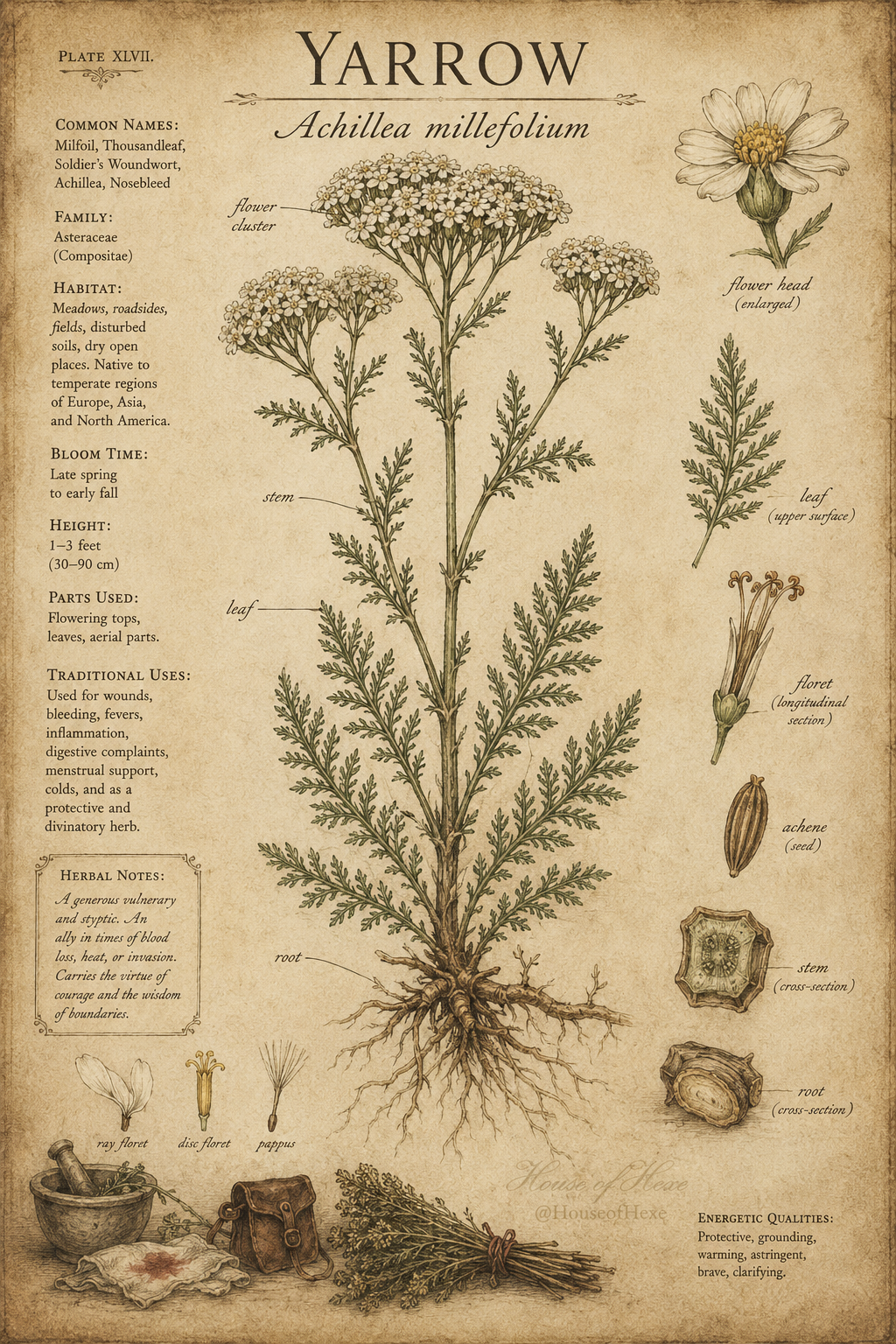
Yarrow is a plant of edges. It grows where roads cut through fields, where disturbed soil remembers movement, where the wild and the human world meet. Its leaves are finely divided, almost fernlike, giving rise to the name millefolium, meaning “thousand-leaved.” Its flowers gather in pale, flat-topped clusters, modest from a distance and intricate when examined closely.
Historically, Yarrow has been associated with wounds, blood, fever, digestion, menstrual complaints, and the practical medicine of ordinary people. Reviews of Achillea species describe traditional use for anti-hemorrhagic, healing, and analgesic purposes across multiple regions. (PMC)
Yarrow matters because it belongs to the older kind of herbalism: the kind carried in pockets, tucked into belts, gathered from field edges, and used before medicine became something locked behind institutions. It is not glamorous. It is useful. That is part of its power.
In magical practice, Yarrow holds the virtues of blood, boundary, courage, and protection. It is a plant for the wounded and the guarded, the lover seeking an omen, the witch strengthening a charm, the healer washing a threshold, and the practitioner learning that softness without a boundary becomes a wound waiting to happen.
Botanical Identification
Achillea millefolium is a perennial herb in the Asteraceae family. It spreads by rhizomes and often forms patches over time. The plant is hardy, resilient, and adaptable, especially in meadows, roadsides, fields, disturbed ground, grasslands, and dry open places.
Growth Habit
Yarrow grows upright, often reaching one to three feet tall depending on soil, moisture, and climate. It may appear delicate because of its leaves, but the plant itself is tough, persistent, and drought tolerant once established.
Leaves
The leaves are one of Yarrow’s clearest signatures. They are finely divided, feathery, and aromatic when crushed. This thousand-cut appearance is part of the plant’s old identity and is reflected in the species name millefolium.
Flowers
Yarrow produces clusters of small composite flower heads, usually white to pale cream in the wild form, though cultivated varieties may appear yellow, pink, red, or orange. For medicinal and traditional use, the white wild type is generally the one most commonly referenced.
Scent
Yarrow has a strong green, bitter, aromatic scent. It is not sweet in the way chamomile is sweet, nor resinous like frankincense. Its scent is medicinal, sharp, fieldlike, and slightly camphorous.
Roots and Spread
Yarrow spreads through underground rhizomes. This makes it valuable for holding soil, filling difficult areas, and returning again after disturbance.
Traditional Uses
Yarrow’s old reputation is inseparable from wounds. The genus name Achillea is tied to Achilles, the warrior of Greek myth, and the plant’s long association with battlefield medicine. Whether one treats the myth as literal history or symbolic memory, the relationship is clear: Yarrow belongs to blood, injury, courage, and repair.
Wound Herb - Yarrow has long been used as a styptic and vulnerary herb, meaning it was traditionally applied to wounds to help check bleeding and support healing. Modern reviews continue to examine Yarrow’s wound-healing and anti-inflammatory potential, though traditional use remains much older than the clinical literature. (PMC)
Fever and Sweat - Yarrow is also a classic diaphoretic herb, traditionally used to support sweating during fevers, especially when taken hot as tea. In old household medicine, this placed Yarrow among the herbs used when the body needed help moving heat outward through the skin.
Digestion - Yarrow’s bitterness and aromatic quality make it useful in traditional digestive formulas. It has been used where digestion is sluggish, appetite is low, gas is present, or the stomach feels tense from stress.
Menstrual Support - Yarrow has a long association with the blood mysteries of the body. It has been traditionally used for menstrual irregularity, pelvic stagnation, cramping, and excessive bleeding, though this is also where caution becomes important.
Folk Protection - Beyond the body, Yarrow has been placed in charms, carried for courage, used in love divination, and worked into household protections. Its magic is not separate from its medicine. A plant that helps blood stay where it belongs naturally becomes a plant of boundaries.
Modern Herbal Actions
Modern herbalism still recognizes Yarrow as a complex plant with multiple actions. A 2023 review discussed Achillea millefolium in relation to inflammation, wound healing, gastrointestinal spasms, and other pharmacological areas, while also making clear that research varies by preparation, constituent profile, and study type. (PMC)
Astringent - Yarrow has a drying, tightening quality. This is part of why it has been used traditionally for wounds, weeping tissues, and excessive secretions.
Styptic - As a styptic herb, Yarrow has been used to help slow minor bleeding. This does not mean it replaces emergency care for serious wounds. It means that within traditional household medicine, it held a place as a practical first-aid plant.
Vulnerary - Yarrow is a wound herb. Poultices, washes, infused oils, and salves have all been used traditionally where the skin needs support.
Diaphoretic - Hot Yarrow tea may encourage sweating, especially when paired with elderflower, peppermint, or ginger depending on the pattern.
Bitter and Digestive - Yarrow stimulates digestion through its bitter and aromatic virtues. It is especially suited to formulas where the gut feels dull, cold, tense, or stagnant.
Anti-inflammatory Support - Research has explored Yarrow’s anti-inflammatory and antioxidant properties, with ongoing interest in its extracts and phytochemical constituents. (PMC)
Preparations
Yarrow is a generous apothecary plant, but it asks for thoughtful preparation. Its leaves and flowering tops may be used fresh or dried, depending on the working.
Tea
Yarrow tea is often used for fever support, digestion, menstrual support, and general herbal practice. It is bitter, aromatic, and best approached as medicine rather than a casual sipping tea.
Hot Infusion
A hot infusion is traditional for diaphoretic use. Cover the cup while steeping to preserve the volatile oils.
Tincture
Yarrow tincture is useful for formulas where a stronger preparation is desired. It captures both bitter and aromatic qualities well.
Poultice
Fresh Yarrow may be crushed and applied as a traditional field poultice for minor wounds, bites, or skin irritation. This is old practical herbalism at its most direct.
Compress or Wash
A strong infusion may be used externally as a wash or compress. This is especially appropriate where Yarrow’s astringent and vulnerary virtues are desired.
Infused Oil and Salve
Yarrow-infused oil may be worked into salves for skin, bruises, minor wounds, and protective body care.
Bath or Ritual Wash
Yarrow can be added to baths for energetic repair, boundary restoration, courage, and protection after emotional or spiritual strain.
Charm Bundle
Dried Yarrow may be tied into charm bundles with red thread for protection, courage, love divination, or strengthening the energetic body.
Magical Uses
Yarrow’s magic is old, practical, and deeply embodied. It is not a plant of vague sweetness. It is a plant of repair, defense, blood wisdom, and the kind of courage that appears after something has already hurt.
Protection
Yarrow protects by strengthening the boundary. It is not only a warding herb in the dramatic sense. It teaches the body, home, and spirit how to hold their own shape.
Courage
Because of its martial history and battlefield associations, Yarrow belongs naturally to courage work. It may be carried before difficult conversations, legal matters, confrontations, medical procedures, or rites of personal endurance.
Wound Healing
Yarrow is used magically for wounds of the body, heart, lineage, and spirit. It does not erase what happened. It helps the torn place remember how to close.
Love Divination
Yarrow has a long presence in love charms and divination practices, especially in European folk tradition. It may be placed beneath pillows, carried, or used in rites seeking dreams, omens, or clarity about affection.
Psychic Boundaries
Yarrow is excellent for practitioners who absorb too much from other people. It is useful in baths, teas, and charm work for those who leave every room carrying emotions that were never theirs.
Blood Mysteries
Yarrow belongs to the mysteries of blood: bleeding, stopping, cycling, injury, vitality, sacrifice, kinship, and inheritance. This makes it powerful in ancestral work, menstrual rites, protection charms, and rites of embodied sovereignty.
Ancestral Field Medicine
Yarrow has the feeling of something gathered because it was needed, not because it was fashionable. It belongs to the old medicine bundle, the kitchen shelf, the midwife’s cloth, the soldier’s pocket, the witch’s threshold.
Astrological Correspondences
Primary Rulership: Mars
Yarrow’s clearest planetary current is Mars. It governs blood, injury, courage, defense, heat, inflammation, severing, and survival. Yarrow does not express Mars only as aggression. It expresses Mars as the will to live, the power to close a wound, and the courage to stand at the edge of harm without collapsing.
Secondary Rulership: Venus
Venus appears through Yarrow’s relationship to love divination, relational repair, beauty after injury, and the restoration of harmony. This is not soft Venus alone. This is Venus after the bruise, Venus with a bandage, Venus learning that love requires boundaries.
Saturnian Current
Saturn appears in Yarrow’s boundary work, its drying astringency, its relationship to discipline, endurance, and containment. Saturn teaches form. Yarrow helps restore it.
Elemental Nature
Fire and Water are both present. Fire appears through fever, blood, Mars, courage, and the movement of heat. Water appears through wounds, tears, menstruation, emotional repair, and the fluids of the body. Earth steadies the plant through its rhizomes, resilience, and practical field medicine.
Zodiac Ties
Aries belongs to Yarrow through Mars, blood, courage, and battlefield medicine. Scorpio appears through blood mysteries, wounds, hidden pain, and regeneration. Virgo appears through practical healing, herbal discipline, and the apothecary shelf. Capricorn appears through boundaries, endurance, and the long work of repair.
Seasonal Timing
Yarrow belongs to midsummer fields, Mars workings, waning Moon boundary rites, fever season, protection charms, and any moment when the practitioner must gather themselves after rupture.
Growing & Harvesting
Yarrow is one of the easier medicinal herbs to grow, especially in dry, sunny places. It is well suited to gardens that experience heat, wind, poor soil, or neglect.
Soil
Yarrow prefers well-drained soil and often does well in leaner ground. Rich soil may make it lush but weaker in character.
Sun
Full sun is ideal. In very hot climates, it can tolerate some afternoon protection, but it generally prefers open light.
Water
Once established, Yarrow is drought tolerant. Overwatering or soggy soil can weaken the plant.
Harvesting
Harvest the flowering tops when the plant is in bloom and the flowers are fresh, aromatic, and fully open. The leaves may also be harvested.
Drying
Dry Yarrow in a warm, shaded, well-ventilated place. Keep it out of direct sun to preserve color and volatile oils.
Storage
Store dried Yarrow in airtight jars away from light, heat, and moisture. Its aromatic strength fades with time, so it is best refreshed yearly.
Warnings & Contraindications
Yarrow is traditional, useful, and widely known, but it is not without caution.
Avoid during pregnancy unless guided by a qualified practitioner, especially because of its traditional relationship with menstruation and uterine action.
Use caution with blood-thinning medications, bleeding disorders, or before surgery.
Those allergic to Asteraceae plants such as ragweed, chamomile, daisies, or chrysanthemums may react to Yarrow.
Yarrow may cause skin irritation in some people when used topically. WebMD notes possible skin irritation and advises caution with use. (WebMD)
Do not use Yarrow as a substitute for emergency care in serious bleeding, deep wounds, infection, fever that does not resolve, or unexplained menstrual bleeding.
Final Thoughts
Yarrow is the herb of the wound that closes.
It does not teach untouched purity. It teaches survival, repair, protection, and the wisdom of knowing where the boundary must be strengthened. It belongs to the person who has bled and kept going, the house that needs sealing, the practitioner who has become too porous, and the lineage that remembers medicine growing at the edge of the field.
In the old herbal library, Yarrow belongs in the drawer marked Blood, Wound, Fever, Boundary, Courage, Protection, Love Omens, and the Thousand Leaves of Repair.
SOURCES / FURTHER READING
Kew Plants of the World Online. “Achillea millefolium L.”
Far, B. F., et al. “Achillea millefolium: Mechanism of Action, Pharmacokinetic, and Safety.”
Saeidnia, S., et al. “A Review on Phytochemistry and Medicinal Properties of the Genus Achillea.”
Villalva, M., et al. “Antioxidant, Anti-Inflammatory, and Antibacterial Properties of Achillea millefolium Extract.”
WebMD. “Yarrow: Uses, Side Effects, and More.”
Hoffmann, David. Medical Herbalism.
Grieve, Maud. A Modern Herbal.