Blue Vervain | Verbena hastata
Nervine spear, holy herb, boundary keeper.Blue Vervain is a tall, elegant wetland perennial with narrow spikes of blue-purple flowers that rise like candelabras from damp meadows, streambanks, and marsh edges. Historically, vervain has carried a reputation as a sacred altar herb, used for protection, purification, oath-making, and spiritual authority. In modern herbalism, Blue Vervain is best known as a bitter nervine for tension, overwhelm, clenched shoulders, stress-patterned digestion, and the kind of exhaustion that comes from holding everything too tightly. It is not a fluffy calming herb; it is the herb that looks at your jaw, your liver, and your nervous system and says, “Unclench.”
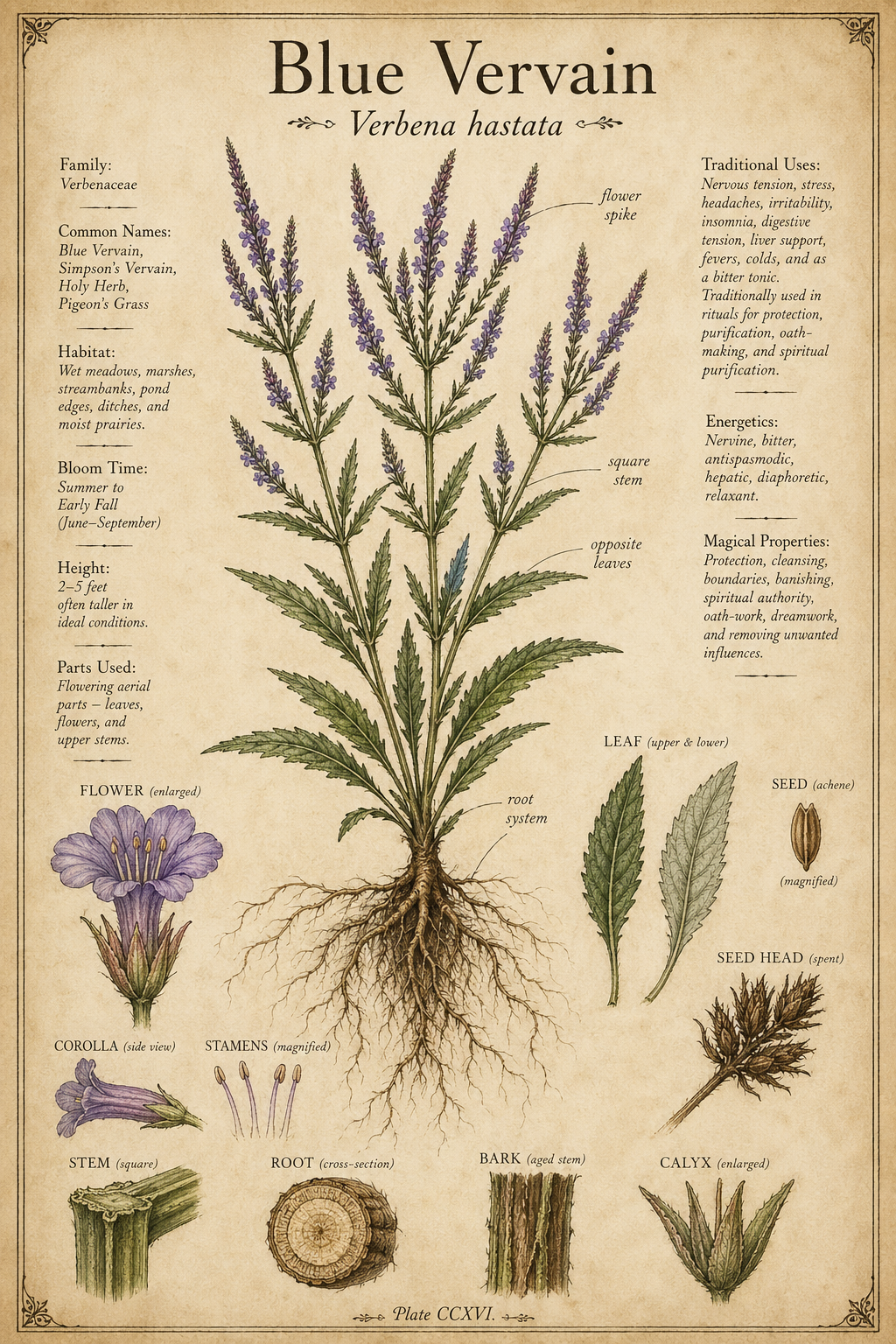
Quick Correspondence Block
Planet: Venus / Mercury
Element: Water with Air
Zodiac: Virgo, Libra, Aquarius
Primary Actions: Nervine, bitter, antispasmodic, hepatic, diaphoretic, mild relaxant
Parts Used: Flowering aerial parts
Preparation Style: Tincture, tea, glycerite, flower essence, ritual wash
Magical Uses: Protection, cleansing, boundaries, oath-work, spirit communication, releasing tension
Spirit of the Herb: The sacred spear that softens the over-controlled body.
Overview
Blue Vervain is a plant of tension and release. It grows upright and severe, with square stems and thin flower spikes that look almost architectural, yet it belongs to wet places: marshes, pond edges, damp meadows, and river margins. That alone tells you much of its medicine. It teaches structure without rigidity, discipline without spiritual constipation.
Herbalists often reach for Blue Vervain when stress lives in the neck, jaw, shoulders, digestion, liver, and sleep. It is particularly suited to people who are driven, clenched, perfectionistic, easily irritated, or carrying responsibility like a punishment. This is not the soft cradle of chamomile or the dreamy hush of passionflower. Blue Vervain is bitter, corrective, and deeply intelligent.
Ecologically, it is a native North American perennial valued by pollinators and seed-eating birds. It is especially at home in moist soils and rain garden conditions, where its tall violet-blue flower spikes add structure and movement to the landscape. (Plant Finder)
Botanical Identification
Blue Vervain is a tall, upright perennial in the Verbenaceae family.
Growth habit: Upright, branching perennial with stiff square stems.
Height: Commonly 2–5 feet, sometimes taller in ideal wet soil.
Leaves: Opposite, lance-shaped, sharply toothed, and rough-textured.
Flowers: Small blue to violet-purple tubular flowers arranged on narrow spikes. The spikes often form a branching, candelabra-like shape.
Scent: Mildly green and bitter; not strongly aromatic.
Habitat: Wet meadows, marshes, pond edges, streambanks, ditches, moist prairies, and rain gardens.
Bloom season: Summer into early fall.
Roots: Fibrous and rhizomatous, slowly spreading into colonies when happy. (Plant Finder)
Lookalikes / confusion species:Blue Vervain may be confused with other Verbena species, especially hoary vervain or purpletop vervain. Blue Vervain prefers wetter ground and has narrow upright spikes of small blue-purple flowers. Always confirm the square stem, opposite toothed leaves, wetland habitat, and spike arrangement before harvesting.
Traditional Uses
Vervain has long carried a reputation as a sacred plant. In European and Mediterranean folklore, vervain was associated with altars, protection, purification, sacred speech, and ritual authority. The name Verbena has often been linked with holy plants used in temple or altar contexts.
In folk medicine, vervain species were used as bitter tonics, fever herbs, digestive supports, and nervous system remedies. Traditional uses also include headaches, jaundice, menstrual complaints, melancholy, insomnia, and tension-patterned illness, though modern clinical evidence remains limited. (Drugs.com)
Among Indigenous North American traditions, Blue Vervain also appears in medicinal and spiritual contexts. Native Plant Trust notes an Iroquois use of a cold infusion of mashed leaves as a “witchcraft medicine” to make unwanted people go away which is perhaps one of the most Blue Vervain things a plant could ever do. (Go Botany)
Modern Herbal Actions
Blue Vervain is primarily understood as a nervine bitter.
A nervine is an herb that supports the nervous system. Blue Vervain is especially suited to stress that becomes rigid: tight muscles, clenched jaw, irritability, pressure headaches, insomnia from overthinking, and the inability to soften.
A bitter stimulates digestive secretions through taste. Blue Vervain’s bitterness can support sluggish digestion, especially where stress suppresses appetite or creates digestive tension.
An antispasmodic helps ease spasms or gripping tension. Herbalists often think of Blue Vervain where the body feels wired, held, and contracted.
A hepatic supports liver function in traditional herbal language. This does not mean “detox miracle.” It means the herb has a historical relationship with bile flow, bitter stimulation, and liver-patterned stagnation.
A diaphoretic can support sweating during feverish states, especially when combined with other appropriate herbs.
Blue Vervain is often used for people who are exhausted but cannot rest, angry but cannot express it, overwhelmed but still performing, or spiritually over-disciplined to the point of brittleness.
Preparations
Blue Vervain is potent and bitter. Small, steady preparations are usually better than heroic dosing.
Tea / Infusion:
Useful but intensely bitter. Best in small amounts or blended with more pleasant nervines like lemon balm, skullcap, oatstraw, or passionflower.
Tincture:
Often the preferred herbalist preparation. Tincture allows small dosing without forcing down large cups of bitter tea.
Glycerite:
Useful for people avoiding alcohol, though bitterness still comes through. A glycerite may soften the flavor but should not erase the plant’s bite entirely.
Oxymel:
A good option when using Blue Vervain as a bitter, sour, tension-moving preparation. Vinegar and honey can make the medicine more approachable.
Flower Essence:
Excellent for control patterns, perfectionism, over-efforting, and spiritual rigidity.
Ritual Wash:
Use as a floor wash, threshold wash, or hand wash for protection, boundaries, and removing clinging influence.
Smoke / Incense:
Can be used ritually, though it is not the most aromatic burning herb. Better blended with mugwort, rosemary, juniper, lavender, or frankincense depending on the working.
Magical Uses
Blue Vervain is a boundary herb with priestess bones.
Use it when the work requires spiritual cleanliness, oath-keeping, sovereignty, and the removal of unwanted influence. It is not soft protection. It is the kind of protection that stands upright at the edge of the marsh with a spear and says, “No closer.”
Magically, Blue Vervain is useful for:
Protection and spiritual boundary setting
Breaking obsessive energetic loops
Cleansing after conflict
Releasing tension after magical work
Strengthening spoken charms and vows
Calling back scattered authority
Banishing unwanted attention
Dreamwork that requires clarity rather than fantasy
Ritual baths for emotional and energetic unclenching
For House of Hexe work, Blue Vervain belongs in formulas for “stop gripping the damn sword by the blade.” It helps separate discipline from self-punishment.
Astrological Correspondences
Blue Vervain carries a strong Mercury signature through its nervous system affinity, bitter intelligence, tension patterns, and relationship to speech, vows, and sacred words.
It also carries Venus through its traditional holy-herb status, its blue-purple flowering beauty, and its ability to restore harmony where the body has become too sharp.
Elementally, it is Water moved by Air. It grows in damp places, yet its medicine speaks through the nerves, breath, thought, and tension patterns.
Zodiac ties:
Virgo for bitter medicine, digestion, service, correction, and over-functioning.
Libra for restored balance, sacred agreements, and relational boundaries.
Aquarius for nervous system charge, electricity, and the tension between individuality and collective responsibility.
Seasonally, Blue Vervain belongs to high summer into early fall, when heat, duty, growth, and exhaustion begin to accumulate in the body.
Growing & Harvesting
Blue Vervain is a strong choice for rain gardens, pond edges, damp meadows, and pollinator plantings.
Soil: Moist to wet soil; loamy soil preferred, but it can tolerate disturbed wetland conditions.
Sun: Full sun to partial sun.
Water: Appreciates consistent moisture and does not thrive in drought.
Climate: Hardy perennial in many temperate North American regions.
Garden use: Rain gardens, wet meadows, pond borders, native plantings, pollinator gardens. (Plant Finder)
Harvest timing: Harvest flowering aerial parts when the plant is in bloom and vibrant, usually summer into early fall.
Parts gathered: Flowering tops, leaves, and upper stems.
Drying notes: Bundle loosely or dry on screens in a warm, shaded, well-ventilated area. Because the stems can be sturdy, make sure the plant dries fully before storage.
Storage notes: Store dried Blue Vervain in an airtight jar away from heat, light, and moisture. Use within one year for best potency.
Warnings & Contraindications
Avoid Blue Vervain during pregnancy. It has traditional associations with uterine stimulation, and several herbal safety sources recommend pregnancy caution. (LearningHerbs)
Use caution with large doses. Blue Vervain is quite bitter and may cause nausea, vomiting, or digestive upset when overused. (LearningHerbs)
Use caution if taking blood pressure medication, hormone therapy, blood thinners, or medications with narrow therapeutic windows. Some sources specifically caution around blood pressure medication and hormone therapy, while broader vervain sources advise caution with blood thinners. (Western Native Seed)
Avoid or use only with professional guidance during breastfeeding, with significant chronic illness, or when using prescription medications.
This entry is educational and does not replace medical care.
Final Thoughts
Blue Vervain is the medicine of the clenched hand, the locked jaw, the sacred vow, and the boundary finally spoken aloud. It does not seduce the body into rest; it reminds the body that control is not the same thing as power. In the old apothecary, Blue Vervain belongs in the drawer marked: for those who carry too much and call it devotion.
Sources / Further ReadinG
Native Plant Trust — Verbena hastata plant profile
Go Botany / Native Plant Trust — Blue Vervain identification and habitat
Lady Bird Johnson Wildflower Center — Verbena hastata native plant profile
Drugs.com Natural Products — Vervain traditional uses and evidence summary
LearningHerbs — Blue Vervain uses and safety notes
Botanical Safety Handbook, American Herbal Products Association
Grieve, Maud. A Modern Herbal
Hoffmann, David. Medical Herbalism
Wood, Matthew. The Earthwise Herbal