Arnica | Arnica montana
Mountain bruise-herb, golden wound-flower, keeper of blunt traumaArnica is a bright alpine member of the Asteraceae family, long valued for bruises, sprains, soreness, and the aftermath of impact. Historically, it belongs to the medicine chest of mountain folk, athletes, laborers, and anyone who knew the body sometimes needs help clearing the echo of injury. In modern herbalism, Arnica remains primarily a topical herb for closed-skin trauma, muscle aches, and localized inflammation. Magically, it carries the signature of recovery after force: protection of the body, clearing shock, and calling vitality back into damaged places.
Quick Correspondence Block
Planet: Mars, Sun
Element: Fire
Zodiac: Aries, Leo
Primary Actions: Vulnerary, anti-inflammatory, rubefacient, analgesic, trauma herb
Parts Used: Flowers, sometimes root historically
Preparation Style: Infused oil, salve, liniment, poultice, topical wash
Magical Uses: Protection, shock clearing, courage, recovery, energetic repair
Spirit of the Herb: The golden field medic who says, “You are not broken. Come back to yourself.”
Overview
Arnica is one of the great wound herbs of European mountain medicine, though it must be approached with respect. It is not a gentle everyday tea herb. It is a sharp, golden, externally used remedy for the places where the body has been struck, strained, bruised, or overworked.
It grows with a solar brightness and a martial temperament: upright, yellow-flowered, and strongly associated with impact, inflammation, and the body’s response to trauma. Herbalists most often reach for Arnica when there is bruising, swelling, sprain, localized muscle pain, or soreness from blunt injury, especially when the skin is unbroken.
The European Medicines Agency recognizes Arnica flower preparations as traditional herbal medicines for relief of bruises, sprains, and localized muscular pain based on long-standing use. (European Medicines Agency (EMA))
Botanical Identification
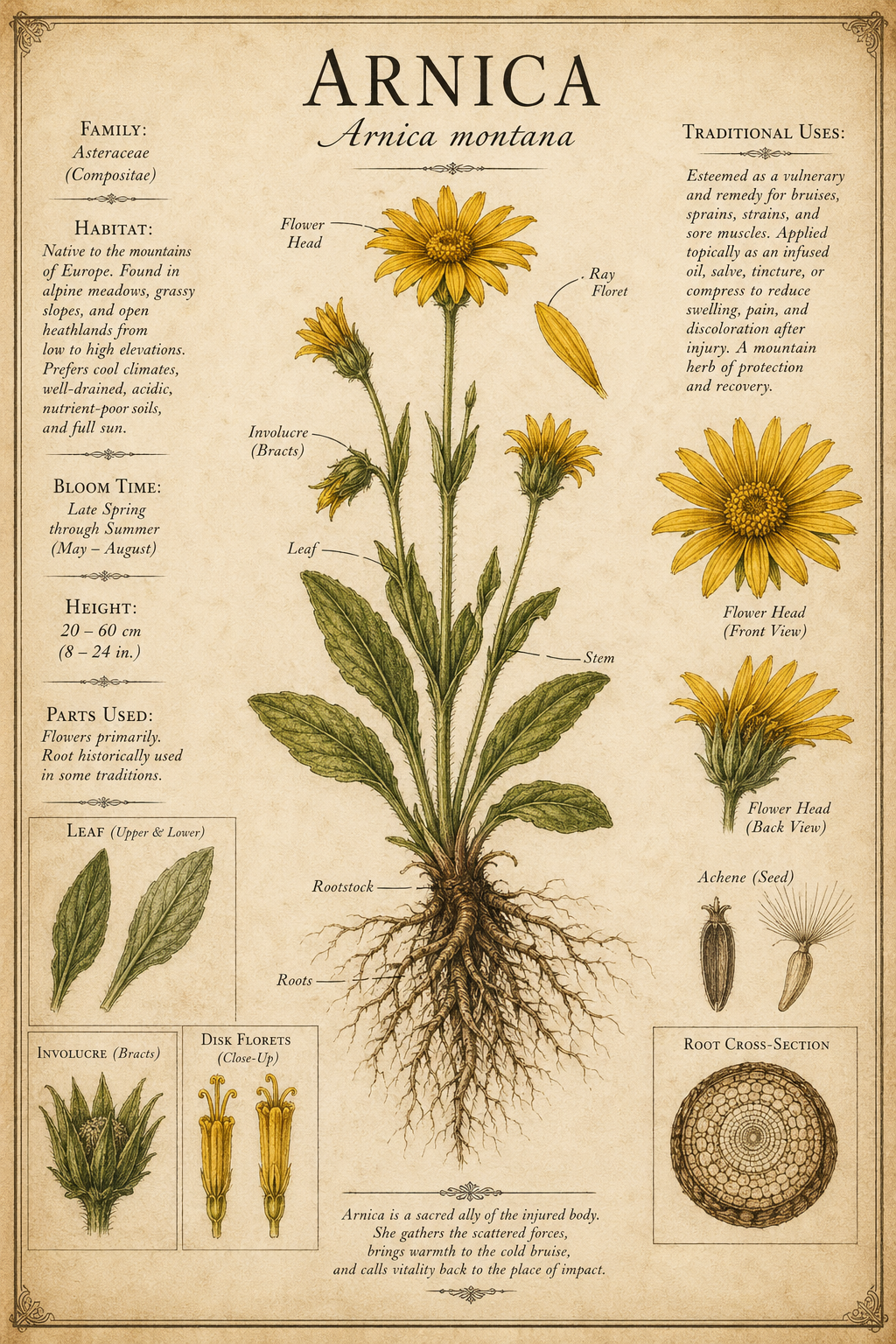
Arnica montana is a perennial herb in the Asteraceae family.
Growth habit:
Low basal rosette with upright flowering stems.
Height / spread:
Typically around 8–24 inches tall, depending on growing conditions.
Leaves:
Basal leaves are oval to lance-shaped, slightly hairy, and arranged close to the ground. Stem leaves are usually fewer and opposite.
Flowers:
Golden-yellow, daisy-like composite flowers with slightly ragged rays. They often look a little wild or wind-tossed rather than perfectly symmetrical.
Scent:
Aromatic, resinous, faintly medicinal.
Habitat:
Native to parts of Europe, especially acidic mountain meadows, heathlands, and alpine pastures. It prefers poor, acidic, well-drained soils and does not enjoy rich lime-heavy ground.
Bloom season:
Late spring through summer, depending on elevation and climate.
Lookalikes / confusion species:
Other yellow-flowered Asteraceae can be mistaken for Arnica, especially by beginners. Positive identification matters. Some North American Arnica species are also used regionally, but they are not automatically interchangeable with Arnica montana.
Traditional Uses
Arnica was historically used as a trauma herb: for falls, bruises, strains, sprains, and the sore places that follow physical labor. It appears in European folk medicine as an external remedy for injuries where the skin remained closed.
In domestic medicine, Arnica was commonly prepared as a tincture, oil, compress, or salve. The tincture was often diluted before use, while infused oils and salves became popular for massage into sore muscles and bruised areas.
Ritually, Arnica belongs to the class of herbs that help the body and spirit recover after impact. Not every wound is a cut. Some wounds are the echo left behind after force, fear, strain, or shock. Arnica’s old magic is the work of calling the self back into the body.
Modern Herbal Actions
Arnica is primarily used externally.
Vulnerary:Supports the healing process of injured tissue. With Arnica, this applies only to closed skin.
Anti-inflammatory:Traditionally used to ease swelling and inflammation after blunt trauma.
Analgesic:Helps reduce the sensation of localized pain when applied topically.
Rubefacient:A rubefacient mildly stimulates local circulation by bringing warmth and blood flow to the surface. This is part of why Arnica is used for bruises, soreness, and stagnant-feeling injuries.
Trauma herb:Useful where the body has been hit, strained, overworked, or shocked.
Arnica flower preparations are traditionally used for bruises, sprains, and localized muscle pain; Health Canada also lists topical Arnica as traditionally used to help relieve pain and inflammation in muscles and joints. (Health Canada)
Preparations
Infused Oil:
One of the best forms for home apothecary use. Dried Arnica flowers are infused into oil and used in small amounts on bruises, sore muscles, and areas of closed-skin trauma.
Salve / Balm:
Excellent for targeted topical use. Arnica pairs well with calendula, St. John’s Wort, comfrey leaf, lavender, ginger, or cayenne depending on the formula’s purpose.
Liniment:
A stronger external preparation, often alcohol-based. Best for sore muscles, strains, and areas where quick absorption is desired. Avoid broken skin.
Compress / Wash:
Diluted Arnica tincture may be used as a compress, but it must be properly diluted and kept away from mucous membranes, eyes, and open wounds.
Poultice:
Less common today, but historically relevant. Use caution, especially for sensitive skin.
Not recommended:
Internal tea, casual tincture dosing, or use on open wounds. Arnica is not an internal-use herb for general home practice.
Magical Uses
Arnica is a field medic in the magical apothecary.
Use it in workings for:
recovery after conflict
protection of the physical body
clearing shock from the energetic field
courage after injury or fear
strengthening boundaries after being “hit” emotionally or spiritually
returning vitality after depletion
charm bags for resilience and protection during hard labor or travel
Arnica is not soft protection. It is not the gentle hand on the forehead. It is the herb that kneels beside you after the fall, checks your pulse, and tells you to get your spirit back behind your ribs.
For folk magic, dried Arnica may be added to protection jars, recovery sachets, or healing petitions. It is especially suited to workings done after an accident, argument, illness, fright, or spiritual blow.
Astrological Correspondences
Planetary Rulership:
Arnica carries a strong Mars signature through its relationship with injury, inflammation, trauma, impact, and recovery after force. The Sun also speaks through its golden flowers, vitality, and restorative brightness.
Elemental Nature:
Fire. Arnica warms, stimulates, activates, and moves.
Zodiac Ties:
Aries for injury, impact, inflammation, and the warrior body. Leo for vitality, solar restoration, courage, and the heart of recovery.
Seasonal Timing:
Summer-blooming Arnica carries the medicine of high sun and mountain meadows. It is gathered when the plant is bright, open, and fully expressing its solar force.
Lunar / Solar Relevance:
Best aligned with solar workings, Mars days, or waxing Moon rituals for recovery, strength, and return of vitality.
Growing & Harvesting
Arnica montana is not always easy to cultivate. It prefers conditions that mimic its native mountain habitat.
Soil:
Acidic, well-drained, low-fertility soil. Avoid lime-heavy or overly rich soil.
Sun:
Full sun to partial sun.
Water:
Moderate moisture, but not soggy conditions.
Climate notes:
Best suited to cooler mountain or alpine-like climates. It may struggle in hot, dry, lowland gardens without careful placement.
Harvest timing:
Harvest flowers when fully open and vibrant.
Parts gathered:
Flowers are the primary medicinal part used today.
Drying notes:
Dry gently in a single layer away from direct sunlight. Good airflow is important.
Storage notes:
Store dried flowers in an airtight jar away from heat, light, and moisture. Label clearly: External Use Only.
Sustainability note:
Wild Arnica montana has faced pressure from overharvesting and habitat loss in parts of Europe. Cultivated sources are preferable whenever possible.
Warnings & Contraindications
Arnica requires serious respect.
For external use only in normal herbal practice.
Do not apply Arnica to:
open wounds
broken skin
mucous membranes
eyes
deep punctures
infected wounds
Avoid internal use unless under the guidance of a qualified medical professional. Arnica can be toxic when ingested in non-homeopathic amounts.
Use caution or avoid Arnica with:
pregnancy
breastfeeding
children
ragweed / Asteraceae allergies
sensitive skin
blood-thinning medications
upcoming surgery
high blood pressure or heart conditions
Topical Arnica may cause irritation, rash, blistering, or allergic reaction, especially in people sensitive to ragweed, daisies, chrysanthemums, calendula, or other Asteraceae plants. The EMA monograph lists Arnica for topical traditional use and notes hypersensitivity to Arnica or other Asteraceae as a contraindication. (European Medicines Agency (EMA))
Final Thoughts
Arnica is golden emergency medicine for the closed wound, the deep bruise, the stunned muscle, and the body that has taken impact. It is not casual. It is not soft. It is a mountain herb with a battlefield temperament: bright, direct, and fiercely useful when treated with discipline.
In the old occult botanical library, Arnica belongs in the drawer marked After the Blow.
Sources / Further ReadinG
European Medicines Agency. Arnicae flos — Herbal Medicinal Product.
European Medicines Agency. Community Herbal Monograph on Arnica montana L., flos.
Health Canada. Arnica montana Monograph.
Hoffmann, David. Medical Herbalism.
Grieve, Maud. A Modern Herbal.
Wood, Matthew. The Earthwise Herbal.
Tilgner, Sharol. Herbal Medicine from the Heart of the Earth.