Angelica Root | Angelica archangelica
Guardian root, threshold herb, protector of the breath and belly.Angelica is a tall, aromatic member of the carrot family traditionally valued as both medicine and protector. Historically, it was grown in European physic gardens and used for digestion, respiratory congestion, feverish states, and spiritual protection. Modern herbalists still reach for the root as a warming bitter, carminative, expectorant, and circulatory stimulant. Magically, Angelica stands at the gate: a plant of blessing, boundary, purification, courage, and ancestral protection.
Quick Correspondence Block
Planet: Sun, Jupiter
Element: Fire with Earth
Zodiac: Leo, Sagittarius, Capricorn
Primary Actions: Aromatic bitter, carminative, expectorant, diaphoretic, warming circulatory stimulant
Parts Used: Root, seed, leaf, stem
Preparation Style: Decoction, tincture, cordial, bitters, incense, wash
Magical Uses: Protection, blessing, uncrossing, courage, threshold work, spirit defense
Spirit of the Herb: The guardian at the gate.
Overview
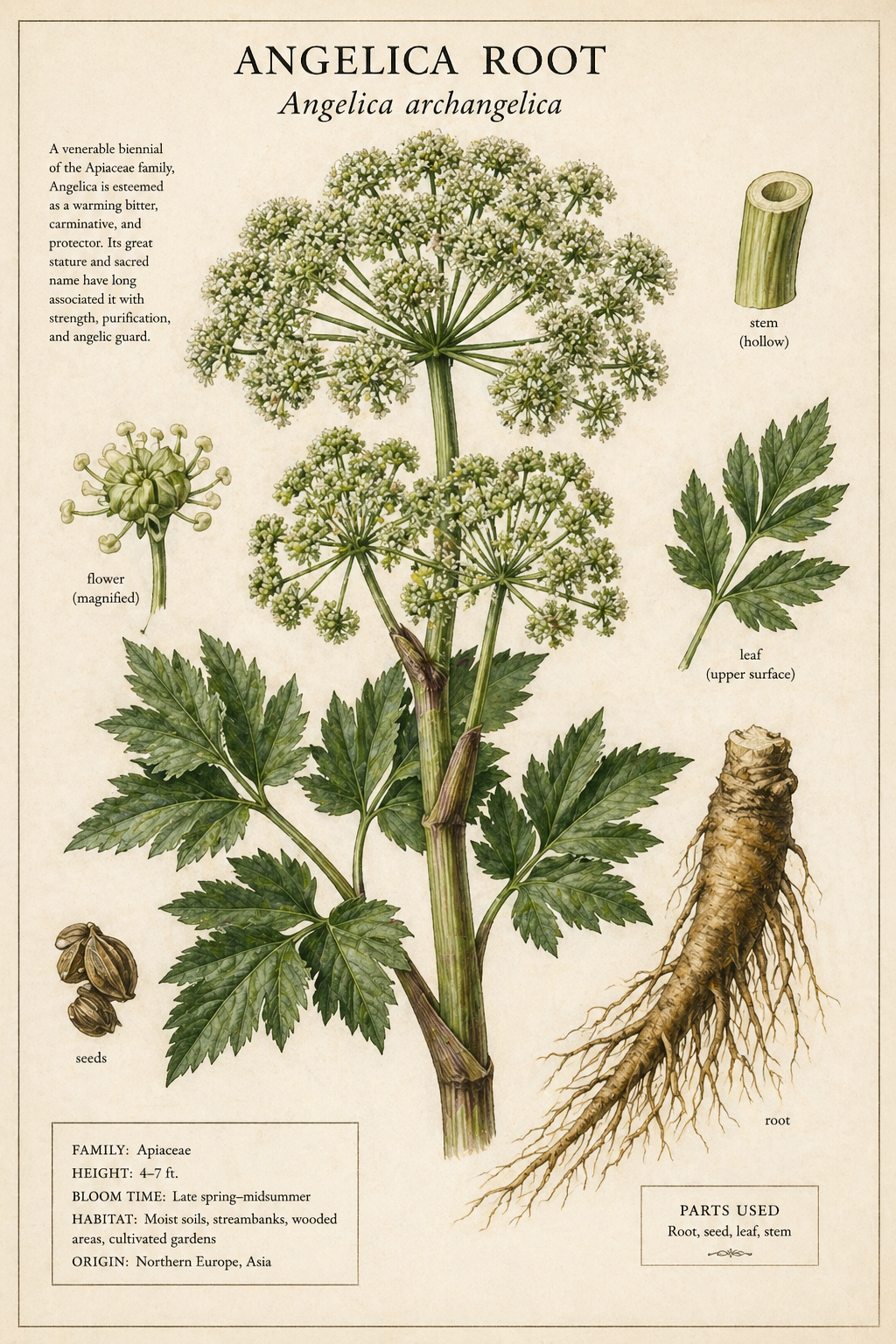
Angelica is not a quiet herb. She rises tall, green, and commanding, often reaching human height or taller, with broad leaves and great rounded umbels of pale greenish-white flowers. Everything about the plant feels architectural: hollow stems, strong scent, deep root, and an unmistakable presence.
Medicinally, Angelica belongs to the old class of warming aromatic roots. It wakes the stomach, moves stagnant digestion, opens the breath, warms cold tissue states, and helps the body push through damp, sluggish conditions. Traditional herbal systems used it where cold, heaviness, phlegm, poor appetite, or low vitality had settled into the body.
Spiritually, Angelica has long carried the reputation of a holy protector. Its very name calls to the angelic, but its magic is not soft or ornamental. Angelica is a gatekeeper plant. It guards thresholds, strengthens spiritual boundaries, clears foul influence, and helps the practitioner stand upright again after fear, grief, illness, or spiritual depletion.
Botanical Identification
Angelica is a biennial or short-lived perennial in the Apiaceae family, the same family as parsley, carrot, fennel, dill, and several dangerous poisonous plants.
It grows as a large basal rosette in its first year, then sends up a tall flowering stalk in its second year. Mature plants may reach 4–7 feet tall depending on climate and growing conditions. The leaves are large, divided, bright to deep green, and somewhat glossy, with toothed leaflets. The stems are thick, hollow, ridged, and often flushed with green or purple.
The flowers appear in large rounded umbels rather than flat-topped clusters. They are usually pale green, cream, or greenish-white. The scent is one of the best identifiers: strong, musky, sweet, resinous, celery-like, and slightly junipered.
Angelica prefers cool, moist environments, rich soil, partial shade, stream edges, damp meadows, woodland margins, and northern gardens. It usually blooms in its second year, often in late spring through summer.
Lookalike caution:
Do not wild-harvest Angelica unless you are highly confident in Apiaceae identification. This family includes deadly plants such as poison hemlock and water hemlock. Angelica’s aromatic scent, large size, leaf structure, and flower shape help distinguish it, but beginner foragers should use cultivated or purchased root.
Traditional Uses
Angelica has a long history in European folk medicine, monastery gardens, Nordic foodways, and household medicine. It was used as a warming digestive herb, a remedy for cold stomach, gas, poor appetite, and sluggish digestion. Health Canada’s natural health product monograph recognizes traditional use of Angelica archangelica for aiding digestion, relieving flatulent dyspepsia, supporting sweating in feverish conditions, and use as a diuretic. (Health Canada)
In older European herbals, Angelica was also associated with plague protection, purification, and resistance against corruption, both physical and spiritual. It was carried, burned, infused into wines or cordials, and used in protective household preparations.
Culinarily, Angelica stems were candied, the root and seed flavored liqueurs and bitters, and the plant became especially associated with aromatic spirits such as gin, Chartreuse, and other herbal liquors. (Wikipedia)
Modern Herbal Actions
Angelica root is best understood as a warming, aromatic mover.
As a bitter, it stimulates digestive secretions and helps prepare the stomach for food. This makes it useful when appetite is low, digestion feels cold or slow, or meals sit heavily.
As a carminative, it helps relieve gas, bloating, and intestinal tension. Carminatives are aromatic herbs that relax digestive spasms and help trapped wind move.
As an expectorant, Angelica can support the lungs when there is cold, damp congestion. It is not the first herb for dry, irritated coughs, but it suits phlegmy, heavy, chilled respiratory states.
As a diaphoretic, it can encourage sweating during feverish or chilled conditions, especially when the body feels locked up and unable to release.
As a circulatory stimulant, it brings warmth and movement. This does not mean it is appropriate for everyone; it is best suited to cold, stagnant, damp patterns rather than hot, inflamed ones.
Preparations
Tea / Infusion:Angelica root is dense and aromatic, so a simple infusion can work, but it is often stronger when prepared as a short decoction.
Decoction:Best for dried root. Simmer gently to extract the heavier root constituents. This is the most traditional preparation for digestive and respiratory use.
Tincture:A strong option for bitters formulas, digestive drops, and small-dose use. Angelica’s aromatic root extracts well in alcohol.
Bitters:Excellent in digestive bitters blends with orange peel, gentian, dandelion root, fennel, or cardamom.
Cordial / Liqueur:Historically appropriate and very Angelica. This preparation carries both medicine and ritual: warming, aromatic, protective, and digestive.
Oxymel:Useful when combining Angelica with respiratory herbs, especially for cold damp cough patterns.
Syrup:Can be used in small amounts for respiratory formulas, though the root’s bitterness and strong flavor should be balanced carefully.
Incense / Smoke:Dried root may be burned in small amounts for protection, exorcism, clearing, and threshold work. It is strong; use with intention.
Wash:Angelica root can be prepared as a spiritual wash for doors, floors, thresholds, ritual tools, or the body when protection and cleansing are needed.
Magical Uses
Angelica is a protection herb, but not in a flimsy “good vibes only” way. It is old-guard protection: doors locked, lamps lit, spine straight, spirit watching.
Use Angelica root for:
Protection from malice, envy, and spiritual interference
Blessing the home before new work begins
Strengthening wards and thresholds
Uncrossing and cleansing after heavy contact
Courage before difficult conversations
Calling back spiritual authority
Ancestor work, especially protective lineage work
Creating boundaries after illness, grief, or energetic depletion
Angelica belongs near doors, windows, altars, and working spaces. It can be added to floor washes, protection jars, incense blends, charm bags, and ritual baths. In House of Hexe work, Angelica is not decorative. It is the root you reach for when the house needs to remember who it belongs to.
Astrological Correspondences
Angelica carries strong Solar virtue through its protective, strengthening, vitalizing nature. It brings warmth, courage, visibility, and spiritual authority. The Sun rules life force, protection, blessing, and the power to stand in one’s own center.
It also carries Jupiterian qualities through its tall stature, expansive umbels, traditional association with blessing, and ability to open movement in the body. Jupiter governs protection, growth, faith, guardianship, and sacred law.
Elementally, Angelica is primarily Fire, with a deep Earth anchor. The fire is in its warmth, aromatic bite, digestive stimulation, and protective force. The earth is in the root, the boundary, the gate, the body brought back into form.
Zodiacally, Angelica may be worked with through Leo for courage and solar protection, Sagittarius for blessing and spiritual guardianship, and Capricorn for boundaries, thresholds, structure, and old-root authority.
Seasonally, Angelica fits the hinge points: late winter into spring, autumn into winter, and any ritual moment where the body or house must cross from vulnerability into protection.
Growing & Harvesting
Angelica prefers rich, moist soil and partial shade, especially in hot climates. In cooler regions, it can tolerate more sun, but in dry or high desert conditions it will appreciate afternoon protection, steady moisture, and deep mulch.
It is usually grown as a biennial. The first year is leaf and root development. The second year brings the tall flowering stalk and seed. Once it flowers and sets seed, the plant may die back, though it often self-sows when happy.
Growing notes:
Soil: rich, moist, fertile
Sun: partial shade preferred in hot climates
Water: consistent moisture
Climate: cool temperate conditions are ideal
Height: often 4–7 feet
Harvest root: usually fall of the first year or early spring of the second year
Harvest seed: when fully mature and dry
Drying: slice root and dry thoroughly with good airflow
Storage: airtight jar, cool dark place, label clearly
Because Angelica is in the Apiaceae family, label seedlings carefully and do not confuse them with other umbel-bearing plants.
Warnings & Contraindications
Do not use Angelica during pregnancy. Health Canada’s monograph specifically lists pregnancy as a contraindication. (Health Canada)
Angelica may increase photosensitivity in some people, especially with excessive use or topical exposure. Use caution with strong sun exposure. (The Naturopathic Herbalist)
Avoid or use professional guidance with:
Pregnancy
Breastfeeding
Blood-thinning medications
Heavy menstrual bleeding
Active gastritis, ulcers, or inflammatory digestive conditions
Known allergy to Apiaceae family plants
Photosensitivity disorders
Children unless guided by a qualified practitioner
Do not wild-harvest unless you are confident in identification. The Apiaceae family contains deadly poisonous lookalikes.
Final Thoughts
Angelica Root is medicine with a spine. It warms the belly, opens the breath, strengthens the threshold, and teaches the body how to stand guarded without becoming closed. In the old apothecary, Angelica belongs in the drawer marked protection, digestion, winter sickness, and holy defiance.
Sources / Further ReadinG
Health Canada. Angelica archangelica Natural Health Product Monograph. (Health Canada)
Hoffmann, David. Medical Herbalism.
Grieve, Maud. A Modern Herbal.
Herbal Reality. “Angelica — Angelica archangelica.” (Herbal Reality)
Naturopathic Herbalist. “Angelica archangelica.” (The Naturopathic Herbalist)
Botanical and culinary history notes on Angelica archangelica.