
Energy Work
The practice of sensing, directing, cleansing, strengthening, and restoring the subtle forces that move through the body, spirit, land, home, and ritual field.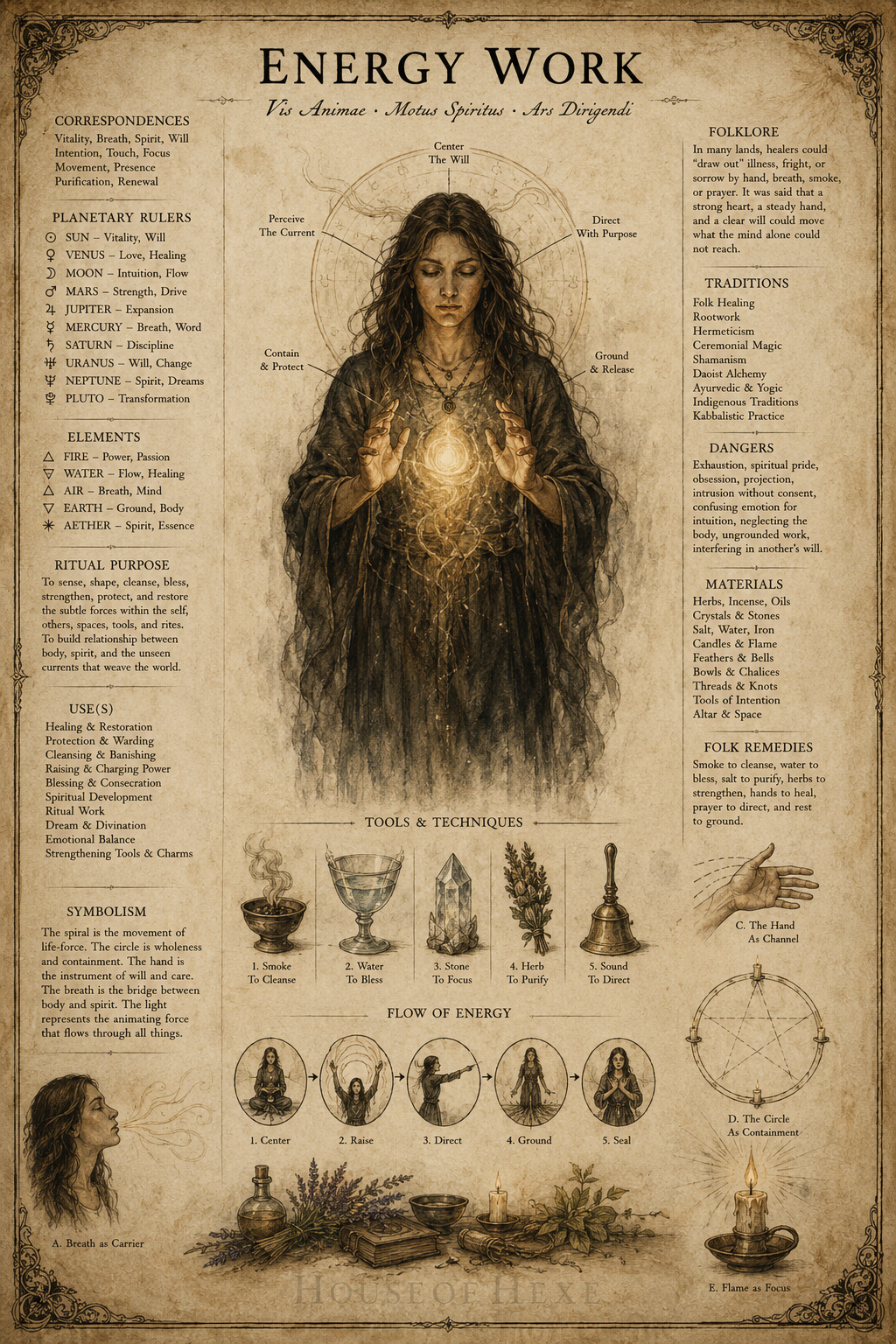
Energy work is one of the most widely spoken of and most poorly defined ideas in modern magical practice. The phrase itself is relatively modern, but the acts it names are ancient: laying on hands, breathwork, prayer over the body, cleansing the home, raising power in ritual, blessing water, moving sickness out of the flesh, strengthening the spirit, restoring balance, and recognizing that living things possess currents not fully described by anatomy alone.
Long before energy work became a phrase used in workshops, healing circles, and contemporary witchcraft, human beings understood that the body was not merely physical. Breath, spirit, warmth, vitality, luck, temperament, soul, and life-force were often treated as related mysteries. Across cultures, people observed that illness could cling to a house, grief could sit in the bones, fear could disturb the breath, and sacred places could feel charged, watchful, or alive.
To work with energy is to work with relationship, attention, sensation, and subtle pattern. It is not always dramatic. It does not require spectacle, trembling hands, elaborate claims, or spiritual performance. At its most disciplined, energy work is the art of becoming perceptive enough to notice what is present, steady enough not to invent what is not, and trained enough to respond with care.
Modern people often reduce energy work to vague feeling, personal mood, or aesthetic language. Traditional practice is more grounded than that. It belongs to the threshold between body and spirit, prayer and touch, breath and intention, ritual and nervous system, unseen current and ordinary care.
✦ ✦ ✦
Origins
The phrase energy work is modern, but the worldview beneath it is ancient. Nearly every traditional culture held some understanding that life was animated by more than flesh alone. The names changed by region, language, philosophy, and religion, but the observation remained: living beings carried vitality, presence, breath, spirit, or force.
In Greek thought, pneuma referred to breath, spirit, and animating principle. In Roman and later esoteric language, spiritus carried similar associations with breath and life. In Chinese medicine and Daoist practice, qi described vital movement within the body and cosmos. In Indian traditions, prana referred to life-force carried through breath and subtle channels. In many Indigenous, folk, and animist systems, vitality was not separated neatly from land, ancestor, weather, animal, plant, and spirit.
These systems should not be treated as interchangeable. Each belongs to a particular cultural, medical, religious, and philosophical world. Yet their existence reveals something important: human beings across time repeatedly recognized that health, spirit, emotion, place, and power moved in patterns.
In folk practice, this understanding often appeared without formal theory. A healer blew prayer over a wound. A mother passed an egg over a child to draw out fright. A cunning person swept illness from the body with herbs. A charm was spoken over water. A fever was prayed away. A house was smoked after death. A hand was placed over pain with words, breath, and intention.
Energy work, in the broadest sense, is the inheritance of these observations.
✦ ✦ ✦
Core Principles
Energy work begins with perception. Before anything can be moved, raised, cleared, sealed, or blessed, it must first be observed. This observation is not the same as imagination, though imagination may help give symbol and language to what is sensed. A disciplined practitioner learns the difference between sensation, emotion, projection, intuition, and fantasy.
The second principle is relationship. Energy does not exist as an abstract substance floating outside the world. It moves through bodies, rooms, objects, tools, spirits, plants, land, memory, and ritual space. A home can feel heavy because grief has lived there. A tool can feel strong because it has been used repeatedly with purpose. A shrine can feel awake because it has been tended. A practitioner can feel drained because their boundaries, body, or habits are neglected.
The third principle is direction. Energy work is not only sensing. It is the deliberate shaping of attention, breath, gesture, prayer, symbol, and will toward a purpose. A blessing directs force toward protection or flourishing. A cleansing directs force toward removal. A grounding practice directs excess or scattered force back into stability. A ritual circle directs power into containment.
The fourth principle is embodiment. Energy work is not meant to make the practitioner less human. It should not pull them away from the body, the home, the land, or common sense. The older arts understood that spirit moved through matter. Breath, posture, sleep, food, grief, illness, fear, touch, and place all influence the work.
✦ ✦ ✦
Energy Work in Magical, Folk, and Healing Traditions
In magical practice, energy work often appears through raising power, casting circles, blessing tools, charging objects, cleansing rooms, strengthening wards, enchanting herbs, and directing intention through ritual action. The practitioner may use breath, voice, hands, movement, candle flame, smoke, water, salt, iron, thread, prayer, or spoken command.
In folk healing, energy work is often inseparable from prayer and physical remedy. A plant may be applied to the body while words are spoken. A charm may be repeated over water before it is drunk or washed with. A healer may pass hands, eggs, knives, smoke, or bundles of herbs around the body to remove fright, envy, illness, or spiritual contamination. These acts are not always called energy work by the people who practice them, but they often operate through similar principles of transfer, cleansing, blessing, and restoration.
In spiritualist, occult, and esoteric systems, energy work may appear through magnetism, aura work, trance healing, mediumistic healing, subtle bodies, planetary force, ceremonial invocation, and the movement of power through symbols or ritual forms. The language differs, but the underlying question remains: how does unseen force move, gather, attach, strengthen, weaken, or transform?
In witchcraft, energy work is practical. It is not merely about feeling something in the hands. It is the difference between a spell that has structure and a spell that is only performance. It is the difference between a room that has been physically cleaned and spiritually cleared, between an altar that is decorated and an altar that is awake, between a charm bag full of ingredients and a charm bag that has been fed, fixed, and worked.
✦ ✦ ✦
Methods, Tools, and Systems
Energy work may be practiced through the body alone, but traditional systems often use tools because tools teach the hand, focus the mind, and give shape to unseen movement. A tool does not replace skill. It trains it.
Breath is among the oldest methods. Breath steadies the body, carries prayer, marks transition, and directs attention. A practitioner may breathe into the hands before healing work, exhale sharply during banishing, breathe slowly to ground, or speak a charm on the breath so that word and spirit move together.
The hands are another primary instrument. They sense temperature, pressure, tingling, resistance, emptiness, heaviness, or movement. Some practitioners feel energy as warmth. Others feel it as pressure, current, texture, pulse, or knowing. The sensation is less important than consistency, discernment, and the ability to test one’s perception over time.
Smoke is traditionally used to cleanse, carry prayer, drive out stagnant forces, and alter the atmosphere of a room or body. Herbs, resins, woods, and incense each carry their own virtues. Smoke work should not be reduced to one plant or one aesthetic. It belongs to a vast range of traditions, each with its own materials, prayers, and rules.
Water receives, carries, blesses, reflects, and washes. Consecrated water, moon water, holy water, spring water, storm water, river water, and herbal washes all appear in different systems. Water is especially useful in work involving cleansing, emotional restoration, blessing, dream, memory, and threshold rites.
Salt, iron, ash, oil, thread, bells, candles, stones, eggs, bones, and written charms may also be used. These materials give the work body. They allow energy to be gathered, sealed, transferred, absorbed, anchored, or dismissed.
✦ ✦ ✦
Raising, Directing, and Grounding Power
Raising power is the act of gathering force toward a working. This may be done through chanting, drumming, dancing, breath, prayer, repetitive motion, focused silence, sexual current, ecstatic movement, or devotional attention. The purpose is not simply to become emotional. The purpose is to gather enough force to carry the rite.
Directing power is the act of giving that force a path. Without direction, raised power can scatter through the practitioner, the room, or the ritual field. Traditional workings use words, gestures, tools, sigils, knots, candles, offerings, petitions, or commands to tell the power where to go and what it is meant to do.
Grounding is the return to stability. It is not optional. A practitioner who raises power without grounding may feel scattered, restless, exhausted, inflated, anxious, or dull afterward. Grounding may be done through food, water, touch, sweeping, breath, contact with soil, washing the hands, closing the rite, or returning attention to ordinary tasks.
Sealing completes the work. A blessing may be sealed. A ward may be sealed. A charm may be tied, breathed into, dressed with oil, or passed through smoke. A cleansing may be followed by protection so the cleared space does not simply become empty and vulnerable. In mature practice, opening, raising, directing, grounding, and sealing belong together.
✦ ✦ ✦
Misuse, Distortion, and False Certainty
Energy work is easily distorted because it often depends on sensation, and sensation can be unreliable when left untrained. A person may mistake anxiety for intuition, excitement for power, dislike for spiritual contamination, attraction for destiny, or fatigue for psychic attack. The body speaks, but it does not always speak in simple sentences.
Modern spirituality often turns energy work into performance. People may claim to feel everything, see everything, heal everything, clear everything, or know everything through energy alone. This is not mastery. It is often spiritual ego wearing the language of sensitivity.
Another distortion is dependency. A practitioner may become afraid to act without checking the energy of every room, person, object, decision, or relationship. This does not deepen power. It weakens discernment. Energy work should make a person more capable of living, not less able to tolerate uncertainty.
False certainty is especially dangerous in healing contexts. Feeling heat in the hands does not make someone a doctor. Sensing heaviness around a person does not give permission to diagnose illness, trauma, possession, curse, or spiritual failure. Traditional practitioners often had deep responsibility to their communities. Modern practitioners should carry the same sobriety.
✦ ✦ ✦
House of Hexe Perspective
At House of Hexe, energy work is treated as a foundational discipline, not a personality trait.
I do not teach energy work as proof that someone is special. I teach it as practice: observation, repetition, grounding, boundary, and care. Many students come to energy work wanting confirmation that they are powerful, sensitive, chosen, empathic, or psychically open. What they often need first is steadiness. They need to learn what their own body feels like before they try to read the room. They need to know the difference between intuition and fear. They need to stop treating every discomfort as a sign.
Energy work becomes useful when it becomes reliable. That reliability is built through small repeated acts: centering before ritual, washing the hands after difficult work, grounding after readings, cleansing tools before use, noticing how different herbs shift a room, observing how grief feels in the body, learning when a space is truly heavy and when the practitioner is simply tired.
The House approach is practical. Feel what you feel, but test it. Sense what you sense, but do not worship your first impression. Clean the room. Drink water. Learn your nervous system. Study older traditions with respect. Do not steal language from closed practices. Do not use energy work as an excuse to avoid skill, history, ethics, or discipline.
Energy work is not the whole of witchcraft, but without it, much of witchcraft becomes hollow gesture. The candle is lit, but nothing is directed. The herb is chosen, but not awakened. The charm is carried, but not fed. The ritual is beautiful, but unfocused. Energy work is what teaches the practitioner to mean what they do.
✦ ✦ ✦
Warnings & Misuse
Energy work should not replace medical care, mental health support, legal action, rest, nutrition, boundaries, or ordinary problem-solving. A cleansing may support a grieving home, but it does not replace grief work. A grounding exercise may help anxiety, but it does not replace needed care. A blessing may strengthen a body, but it does not diagnose disease.
Be cautious when working on other people. Consent matters. So does humility. Not everyone wants to be touched, prayed over, scanned, cleansed, healed, or energetically adjusted. Even well-meaning energy work can become invasive when the practitioner assumes access to another person’s body or spirit.
Be especially careful with spiritual projection. If you dislike someone, that does not mean their energy is bad. If someone makes you nervous, that does not mean they are cursed, possessed, or malicious. If a room feels heavy, it may hold grief, illness, poor ventilation, clutter, conflict, exhaustion, or memory. Discernment requires patience.
Do not confuse intensity with truth. Strong sensation is not always spiritual accuracy. Sometimes it is emotion. Sometimes it is trauma. Sometimes it is the nervous system. Sometimes it is real current moving through the field. A mature practitioner learns to pause before naming.
✦ ✦ ✦
Related Entries
Altar
Aura
Banishing
Blessing
Cleansing
Consecration
Divination
Grounding
Offering
Protection
Ritual
Spirit Work
Thresholds
Warding
*If links are not active…it is a future post yet to be published. Thank you for understanding!