
Chamomile | Matricaria chamomilla
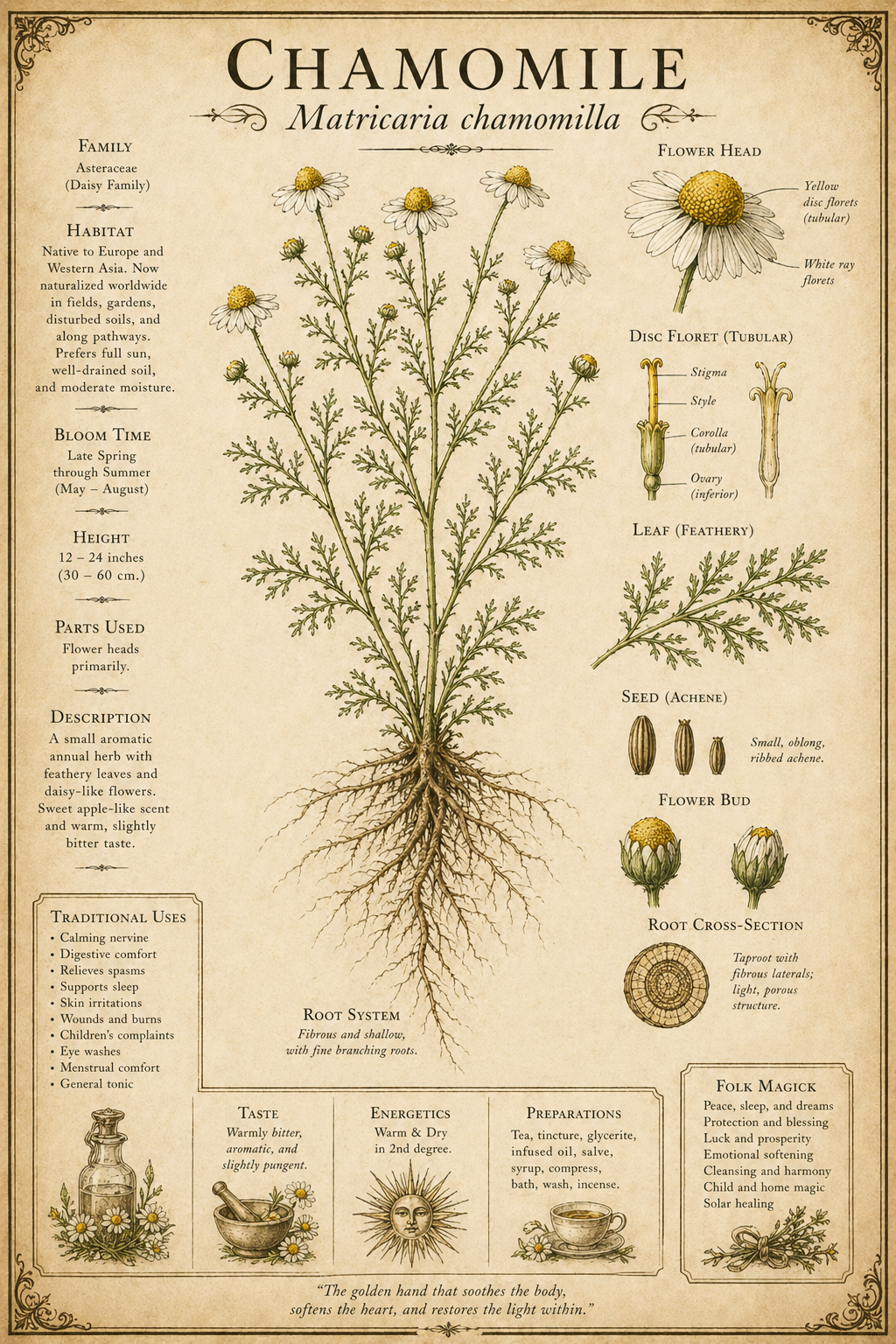
Golden calm, sun herb, softener of the body.Chamomile is a low-growing aromatic annual with daisy-like flowers, feathery leaves, and a sweet apple-hay scent. Historically, it has been one of the great household herbs of Europe and Western herbalism, used for sleep, digestion, children’s complaints, skin, grief, and gentle restoration. In modern herbalism, German Chamomile is best known as a calming nervine, digestive antispasmodic, mild bitter, and soothing topical herb. Magically, Chamomile is a small golden sun in plant form: peace, luck, protection, softness, and the courage to unclench without collapsing.
Quick Correspondence Block
Planet: Sun / Venus
Element: Water warmed by Fire
Zodiac: Cancer, Leo, Pisces
Primary Actions: Nervine, carminative, antispasmodic, mild bitter, anti-inflammatory, vulnerary
Parts Used: Flower heads
Preparation Style: Tea, infusion, tincture, glycerite, infused oil, salve, bath, wash
Magical Uses: Peace, sleep, protection, prosperity, luck, gentle cleansing, emotional softening
Spirit of the Herb: The golden hand on the back that says, “You are safe enough to soften.”
Overview
Chamomile is one of those herbs people think they already know because they have seen it in tea bags and sleepy-time blends. That familiarity is part of its charm, but it also causes people to underestimate it.
This is not just a bedtime flower. Chamomile is a digestive herb, a nervous system herb, a skin herb, a child-friendly household herb, and a flower of emotional repair. It belongs to the medicine cabinet, the garden path, the bath, the dream pillow, and the old kitchen shelf where practical magic was never separate from daily care.
German Chamomile, Matricaria chamomilla / Matricaria recutita, is an aromatic annual in the Asteraceae family, commonly grown for its flower heads and long associated with calming tea, digestive comfort, and gentle relaxation. (Missouri Botanical Garden)
Chamomile’s medicine is soft, but not weak. It is especially suited to irritation: irritated nerves, irritated digestion, irritated skin, irritated children, irritated spirits, and irritated people pretending they are “fine.”
Botanical Identification
Chamomile is a delicate-looking but surprisingly resilient annual herb.
Growth habit: Upright to gently sprawling annual with branching stems.
Height: Commonly 1–2 feet tall. (Missouri Botanical Garden)
Leaves: Fine, feathery, bright green, and deeply divided.
Flowers: Small daisy-like flower heads with white rays and raised yellow centers.
Scent: Sweet, apple-like, grassy, honeyed, and lightly bitter.
Habitat: Herb gardens, disturbed soils, sunny beds, field edges, and cultivated medicinal gardens.
Bloom season: Late spring through summer, depending on climate and sowing time.
Lookalikes / confusion species:
Chamomile may be confused with pineapple weed, mayweed, feverfew, or other small daisy-like Asteraceae plants. German Chamomile has a hollow, cone-shaped yellow center when the flower head is split open, a sweet apple scent, and fine feathery leaves. Roman Chamomile, Chamaemelum nobile, is a different plant: a perennial, lower-growing, and often used similarly but not botanically identical.
Traditional Uses
Chamomile is one of the great domestic herbs of Western herbalism. It appears again and again in household medicine for sleep, digestion, fevers, children’s restlessness, skin irritation, eye washes, wound care, and emotional distress.
In traditional European herbalism, Chamomile was often used when the body was hot, tense, inflamed, sour, colicky, or unable to settle. It was the tea given when someone could not sleep, the wash used when skin was angry, the steam used when the head and sinuses felt heavy, and the bitter aromatic infusion taken when digestion had gone tight and rebellious.
The European Medicines Agency recognizes traditional use of Matricaria recutita flower for minor gastrointestinal complaints such as bloating and mild spasms, symptoms of the common cold, minor inflammations of the mouth and throat, and several skin/mucosal applications. (European Medicines Agency (EMA))
Magically and domestically, Chamomile has long been associated with peace, luck, prosperity, purification, and protection of the home. It is not dramatic magic. It is cup-of-tea magic. Wash-the-threshold magic. Sleep-without-spiraling magic.
Modern Herbal Actions
Chamomile is primarily a calming nervine, digestive relaxant, and soothing anti-inflammatory herb.
A nervine supports the nervous system. Chamomile is especially suited to irritability, restlessness, emotional sensitivity, stress-related tension, and sleep trouble tied to agitation rather than deep depletion.
A carminative helps ease gas, bloating, and digestive discomfort. Chamomile’s aromatic bitterness makes it useful when stress and digestion are tangled together.
An antispasmodic helps relax gripping, cramping, or spasmodic tension. This is why Chamomile appears so often in formulas for belly cramps, nervous stomach, menstrual discomfort, and children’s digestive upset.
A mild bitter gently wakes up digestion through taste. Chamomile is not as forcefully bitter as Blue Vervain or Gentian, but it still has enough bitterness to matter.
A vulnerary supports the healing of irritated or damaged tissue. Chamomile is often used externally in washes, compresses, infused oils, salves, and baths for red, itchy, reactive, or tender skin.
This is the herb for the person whose body says “too much” through the stomach, the skin, the nerves, and the sleep cycle.
Preparations
Chamomile is versatile, accessible, and beautifully suited to both internal and external preparations.
Tea / Infusion:
The classic preparation. Use for sleep, digestion, emotional overwhelm, cranky nervous systems, and general household comfort. Cover the cup while steeping to preserve the aromatic oils.
Strong Infusion:
Useful for baths, compresses, skin washes, hair rinses, and ritual cleansing.
Tincture:
Good when stronger digestive or nervous system support is desired without drinking multiple cups of tea.
Glycerite:
Excellent for children, alcohol-free formulas, and sweeter calming blends.
Oxymel:
Beautiful for cold-season formulas, especially when paired with honey and vinegar for throat, digestion, and immune-season support.
Syrup:
Useful in gentle sleep, cough, or children’s formulas when appropriate.
Oil Infusion:
One of Chamomile’s best topical preparations. Use for irritated skin, massage oil, belly rubs, baby-care style formulas, and calming body oils.
Salve:
Excellent for dry, itchy, inflamed, or reactive skin.
Poultice / Compress:
Useful for localized irritation, tired eyes, minor skin discomfort, and inflamed areas.
Bath:
A classic nervous system and skin preparation. Chamomile baths are especially good when the whole body feels overstimulated, itchy, tense, or emotionally bruised.
Smoke / Incense:
Can be used for peace, sleep, luck, and gentle cleansing, though it is usually better blended with herbs like lavender, mugwort, rose, lemon balm, or frankincense.
Magical Uses
Chamomile is soft solar magic.
Not the blazing noon sun. Not the conquering sun. Chamomile is the low golden light on the kitchen floor, the warm cup between both hands, the spell that works because the body finally stops bracing against it.
Magically, Chamomile is useful for:
Peace in the home
Sleep and dreamwork
Emotional softening
Gentle protection
Prosperity and luck
Money-drawing washes
Child and family blessings
Solar confidence without aggression
Releasing irritation after conflict
Baths for grief, stress, and overwhelm
Threshold cleansing after tension in the house
For House of Hexe work, Chamomile belongs in formulas for “soften the room before the spell begins.” It does not force peace. It invites the nervous system to remember that not every doorway is a threat.
Astrological Correspondences
Chamomile carries a strong solar signature through its golden center, bright disposition, warmth, vitality, and long association with success, luck, and protection.
It also carries Venus through its sweetness, soothing nature, emotional repair, skin affinity, and ability to restore harmony after irritation.
Elementally, Chamomile is Water warmed by Fire. It cools inflammation and softens tension, but it does so with warmth rather than coldness. It comforts without drowning. It calms without numbing.
Zodiac ties:
Cancer for home, children, protection, emotional safety, and the stomach.
Leo for solar medicine, courage, warmth, radiance, and joy.
Pisces for sleep, dreamwork, softness, grief, and spiritual tenderness.
Seasonally, Chamomile belongs to late spring and summer, when the sun is strong, the flowers open, and the medicine of warmth must be balanced with moisture and rest.
Growing & Harvesting
Chamomile is a beautiful herb for beginner growers, tea gardens, children’s gardens, pollinator patches, and apothecary beds.
Soil: Light, well-drained soil. Chamomile does not need rich soil and can become floppy if overfed.
Sun: Full sun is best, though it may appreciate light afternoon shade in very hot climates.
Water: Moderate water. Keep evenly moist while germinating and establishing, then avoid waterlogged soil.
Climate: German Chamomile is an annual and can be grown in many temperate regions. Missouri Botanical Garden lists it as an annual commonly grown in zones 2–8. (Missouri Botanical Garden)
Harvest timing:Harvest flower heads when they are fully open and fragrant, before the petals droop too far downward.
Parts gathered:Flower heads.
Drying notes:Dry gently on screens in a warm, shaded, well-ventilated place. Do not dry too hot or the aromatic quality fades.
Storage notes:Store dried Chamomile in an airtight jar away from heat, light, and moisture. Use within one year for best flavor and potency.
Warnings & Contraindications
Avoid Chamomile if allergic to Chamomile or other Asteraceae / Compositae family plants. The EMA specifically lists hypersensitivity to matricaria flowers or other Asteraceae plants as a contraindication. (European Medicines Agency (EMA))
Use caution with strong preparations if you have a known ragweed, daisy, chrysanthemum, or Asteraceae sensitivity.
Chamomile is generally considered likely safe in common tea and food amounts, though side effects can include nausea, dizziness, and allergic reactions in sensitive individuals. (NCCIH)
Use caution with pregnancy, breastfeeding, chronic illness, sedative medications, blood thinners, or multiple prescriptions unless guided by a qualified practitioner.
Full or partial Chamomile baths are not appropriate in cases of open wounds, extensive skin damage, acute skin disease, high fever, severe infections, or severe circulatory/cardiac conditions according to EMA safety language. (European Medicines Agency (EMA))
This entry is educational and does not replace medical care.
Final Thoughts
Chamomile is the medicine of the softened belly, the unclenched hand, the child finally asleep, the grief finally allowed to breathe. It is humble because it does not need to prove itself. In the old apothecary, Chamomile belongs in the drawer marked: for irritation of the body, the spirit, and the house.
Sources / Further ReadinG
Missouri Botanical Garden Plant Finder — Matricaria recutita
European Medicines Agency — Matricariae flos herbal monograph
National Center for Complementary and Integrative Health — Chamomile safety notes
Botanical Safety Handbook, American Herbal Products Association
Grieve, Maud. A Modern Herbal
Hoffmann, David. Medical Herbalism
Wood, Matthew. The Earthwise Herbal
Gladstar, Rosemary. Medicinal Herbs: A Beginner’s Guide