
Stinging Nettle
Stinging Nettle is more than a wild weed. It is an ancient herbal ally steeped in folklore, protection magic, and deep-rooted nourishment. For centuries, healers and witches alike have turned to Nettle for strength, vitality, and boundaries sharpened by the wisdom of the land. Her legendary sting marks the beginning of transformation, while her rich green medicine replenishes the body from the inside out. In this guide, we explore Nettle’s mystical history, herbal benefits, magical correspondences, and how modern witches can work with her as both a potent protector and a nourishing tonic.
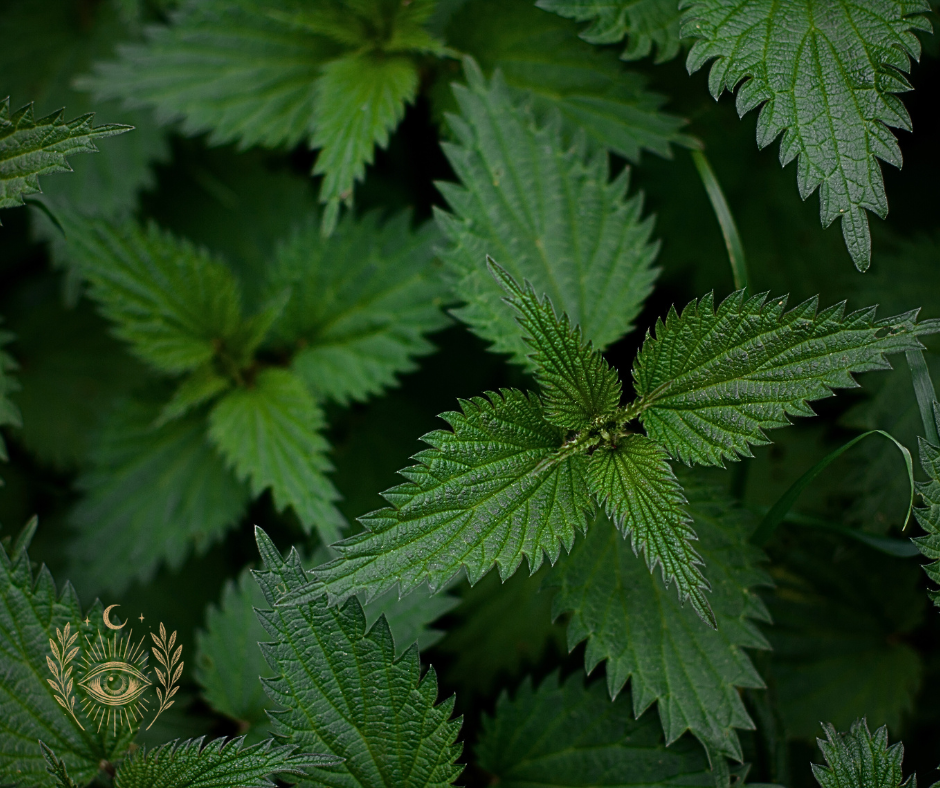
Thorn of the Verdant Veil
In the quiet places where river mist clings to the morning and the earth breathes in slow, ancient rhythms, Stinging Nettle rises like a sentinel…unassuming at a distance, formidable up close. Her sting alone recalls the memory of wild thresholds, carrying whispers of initiation, awakening, and the trembling edge between comfort and transformation. This verdant blade, armored in a thousand crystalline needles, bridges the realms of body and spirit, weaving nourishment with ferocity.
Nettle’s story is older than cultivation. Once gathered by healers who walked barefoot along forest banks and by witches who trusted their wounds to teach them, her origins are laced with tales of guardianship and hidden strength. To possess Nettle was to hold a secret of the land itself: a secret of iron-rich survival, of bones knit with minerals pulled from the deep soil, of resilience that asks for nothing soft in return. Her presence in ritual was never simply herbal; it was a vow. A willingness to face discomfort in exchange for power.
When fresh, her sting strikes like a spark against bare skin, awakening blood and breath alike. But when dried or brewed, she transforms, offering a richness that fills the body like dark, fertile earth after rain. Her infusion nourishes the blood with iron and green vitality; her smoke clears the stagnant, driving unwanted energies from the corners of the home with the sharp decisiveness of a blade. And when placed upon the altar, Nettle anchors intention with the gravity of stone while stirring the spirit with a pulse of quiet fire. Thus, she walks between two worlds rooted in nourishment yet edged in protection.
Healers and mystics have long called upon Nettle as both ally and adversary, knowing her medicine is never passive. To work with her is to invite clarity, strength, and the reclamation of boundaries. She quickens the weary, steels the uncertain, and repels the malefic with a sting that echoes through the subtle body. In every serrated leaf lies a reminder: the path to vitality is not always gentle, sometimes it awakens us with fire.
Stinging Nettle is more than a plant. She is the green thorn of sovereignty, the pulse of wild earth reminding us that power and nourishment need not be opposites. Once embraced, she teaches that strength can be carried quietly, steadily, and without apology into every threshold we cross.
Here is a deep, witch-herbalist materia magica of Stinging Nettle (Urtica dioica), written in your mystical tone and suitable for your blog, Patreon, or course materials.
Magical Correspondences & Uses
The Thorned Priestess of the Green.
Nettle is one of the oldest witch-plants known to European folk magic, woven into protective bundles, warrior charms, and spells of sovereignty. She is not a gentle ally. Her magic is sharp, electric, and edged with the authority of the wild. Where Nettle grows, magic bristles.
Below are her full magical correspondences and uses, crafted in a way that matches your existing herbal style.
Magical Correspondences
Element:
Fire (through her sting) + Earth (through her deeply nutritive, mineral-rich nature)
—Nettle carries a dual current: grounding while igniting vitality and protective force.
Planetary Ruler:
Mars — warrior energy, boundaries, personal power, banishing, and the spark of life-force returning.
Zodiac Associations:
Aries, Scorpio, Capricorn
—Aries for courage, Scorpio for shadow work, Capricorn for endurance and rebuilding.
Deities:
• Freyja (strength through suffering, feminine ferocity)
• Thor (protection and warding)
• Hecate (thresholds, banishing)
• The Morrígan (battle, sovereignty, the sting of truth)
Magical Gender:
Feminine—but specifically the feminine that bites back.
Tarot Connection:
Nine of Wands
—resilience, defended boundaries, standing your ground after hardship.
Magical Uses
1. Protection (House, Body, and Spirit)
Nettle is one of the traditional powerhouses of old-world protective magic.
Hang dried nettle above doors to keep out baneful spirits and malicious intent.
Scatter powdered nettle on window sills to create a barrier like bristling iron.
Carry a small charm bag of nettle to ward off psychic attack or projection from others.
Add nettle to protection bottles, witch jars, and spell jars to “sting” back anything sent your way.
Nettle does not politely deflect harm…she repels it with heat.
2. Boundary Enforcement & Personal Sovereignty
Nettle is a plant for witches who need to claim their space unapologetically.
Use nettle in spellwork to strengthen boundaries with draining people.
Brew nettle tea before ritual when you need to feel sharp, alert, and strongly rooted.
Add nettle to a charm for saying no with authority.
In shadow work, she confronts people-pleasing tendencies and restores internal fire.
3. Banishing & Uncrossing
A sting to drive things out.
Burn dried nettle (carefully) with rosemary or juniper to banish stale or hostile energy.
Add to uncrossing baths or floor washes for expelling heaviness, hexes, or psychic residue.
Use in cord-cutting rituals when you need courage to sever draining ties.
Nettle’s magic cuts the cord cleanly but leaves you stronger afterward.
4. Energy Rebuilding & Vitality Magic
Nettle is one of the best herbs for proof-of-life spells: bringing the body, spirit, and energy back from fatigue, burnout, or long spiritual winters.
Drink nettle infusions during times of physical depletion.
Add nettle to spellwork for resilience, longevity, and strengthening one’s life-force.
Combine with iron, garnet, or yarrow in altar offerings for vitality.
Many witches call her “green blood,” because she restores what has been lost.
5. Hex-Breaking & Reversals
Traditional folk magic holds that anything harmful sent toward Nettle rebounds.
Use nettle in reversal jars to turn malice back to source.
Combine with mirror shards or obsidian chips in protective workings.
Sprinkle nettle around spell candles during curse-breaking rituals.
Her sting creates a magical “snap” that disrupts harmful energy patterns.
6. Dreamwork & Ancestral Shadows
Less commonly known, but powerful:
Place nettle beneath the pillow (safely contained) to ward off night terrors or invasive dreams.
Use nettle smoke to clear ancestor altars before Samhain or spirit communion.
Burn nettle with mugwort to sharpen psychic boundaries during journeying.
Nettle allows the witch to walk the unseen roads without being claimed by them.
7. Craft of the Hedge Witch
Nettle is a plant that grows where the veils thin: riverbanks, borders, forgotten paths.
Hedge witches used nettle to:
Protect the liminal spaces of the homestead.
Mark sacred boundaries between property and wild land.
Cleanse tools and altars through smoke fumigation (nettling).
To this day, a sprig of nettle above the garden gate marks the land as witch-kept.
Spell Ideas
Nettle Warrior Charm
A small bag with:
• dried nettle
• a piece of garnet
• iron nail or key
• black thread
Carry for endurance, courage, and protection.
Boundary Bath
Steep nettle, rosemary, and salt.
Add to a bath or foot soak when you need to reclaim your energy and say “no” from your bones.
Banishing Smoke
Burn nettle + juniper to break up stagnant or malicious energy in the home.
Return-to-Sender Candle
Dress a black candle with nettle, wormwood, and protective oil.
Let the sting do the talking.
Herbalist Botanical Overview
Family: Urticaceae
Parts Used: Leaf, root, seed, stem (fiber)
Energetics: Cooling, drying, nourishing, astringent, gently stimulating
Stinging Nettle is one of the most important nutritive herbs in Western herbalism—an herb so rich in minerals and systemic nourishment that it borders on a food. Despite her infamous sting, Nettle is a deeply restorative plant whose actions run from the blood to the kidneys to the endocrine system. To handle her is to work with a plant that is both medicine and teacher: protective on the outside, profoundly supportive within.
Botany & Identification
Stinging Nettle (Urtica dioica) is a perennial herb that grows 2–6 feet tall, forming dense colonies in nitrogen-rich soils. She thrives in temperate regions across North America and Europe, especially along riverbanks, forest edges, disturbed soils, and old homestead grounds.
Key Botanical Traits
Leaves: Opposite, serrated, heart-shaped to lanceolate, covered with tiny hollow hairs called trichomes. Each a miniature syringe containing formic acid, histamine, serotonin, and acetylcholine (responsible for the sting).
Stem: Square to slightly ridged; fibrous, once used to make linen-like textiles.
Flowers: Tiny, greenish, formed in drooping panicles; dioecious (male and female plants separate).
Roots: Yellowish rhizomes that spread aggressively.
Seeds: Tiny, shiny clusters that ripen late summer. Used for adrenal and kidney support.
Nettle’s sting is the plant’s natural defense mechanism, humbling, as if she’s reminding you to show respect before harvesting.
Harvesting & Processing
Leaf
Best Harvest: Early spring through early summer, before flowering.
Young leaves contain the highest nutrient density and lowest bitterness.
Handle with gloves and long sleeves; once dried or heated, the sting is neutralized.
Root
Best Harvest: Fall or very early spring.
Used primarily for urinary support and androgen-related conditions.
Seed
Best Harvest: Late summer to early autumn.
Seeds must be dried carefully to preserve their oils and affinity for the kidneys and adrenal glands.
Sustainability
Nettle is abundant and resilient, but always harvest from clean, uncontaminated soil. She readily uptakes heavy metals.
Chemical Constituents
Stinging Nettle is a nutrient-dense powerhouse. Major constituents include:
Vitamins: A, C, K, and several B vitamins
Minerals: Iron, calcium, magnesium, potassium, silica, manganese
Proteins: 25–30% protein by dry weight (unusually high for a leafy plant)
Chlorophyll
Flavonoids: Quercetin, rutin, kaempferol
Tannins
Lignans (especially in the root)
Histamine & Formic Acid (in the trichomes; responsible for the sting)
This biochemical richness is what makes Nettle one of the best building and replenishing plants in Western herbalism.
Energetics
Temperature:
Cooling (especially the leaf)
Moisture:
Drying, but deeply nutritive.
Taste:
Mineral-rich, green, slightly salty, mildly bitter depending on harvest time.
Nettle invigorates without overstimulating, tones tissues without harshness, and rebuilds depleted systems with steady, food-like nourishment.
Herbal Actions
Nutritive Tonic
Nettle is a foundational blood-builder and mineral replenisher. Ideal for chronic fatigue, postpartum depletion, anemia tendencies, brittle hair/nails, and overall vitality.
Alterative (Blood Cleanser)
Supports the body in gently shifting metabolic waste, improving skin conditions and systemic stagnation.
Kidney & Urinary Tonic
Diuretic and anti-inflammatory, ideal for urinary tract issues, edema, and flushing excess uric acid.
Endocrine Support (Leaf and Seed)
Leaf: Supports adrenal recovery and stabilizes energy.
Seed: Renowned for helping restore kidney vitality and counter long-term exhaustion.
Anti-inflammatory
The flavonoid-rich leaf helps modulate inflammatory responses, especially in seasonal allergies, arthritis, and chronic joint stiffness.
Astringent
Tones tissues, supports reduction of excessive bleeding, and fortifies mucosal integrity.
Traditional & Folk Uses
Cooked like spinach in spring as a nutritive wild food.
Added to broths, soups, and teas to restore vitality after illness.
Used historically to treat joint pain by “urtication”. Lightly whipping inflamed joints with fresh nettle to stimulate circulation.
Employed in European folk medicine for kidney health, postpartum strength, and metabolic sluggishness.
Root traditionally used for male hormonal balance and urinary flow.
Seeds used in folk traditions for extreme fatigue, burnout, and “kidney weakness.”
Preparations & Dosages
Infusion (Leaf)
1 oz dried leaf per quart of hot water
Steep 4–8 hours for a dense, mineral-rich tonic
Drink 1–3 cups daily
Tincture (Leaf)
1:5, 40–50% alcohol
2–5 mL up to 3x/day
Tincture (Root)
1:5, 50–60% alcohol
2–4 mL up to 3x/day
Seed (Fresh or Dried)
1/2–1 tsp daily
Often taken with honey or folded into herbal blends
Food
Add to soups, omelets, broths, pesto, or use as a spinach substitute.
Safety Considerations
Fresh plant stings the skin, handle carefully.
Diuretic: monitor fluid balance in those taking diuretics.
Pregnancy: traditionally considered safe as food; medicinal doses should be approached with practitioner supervision.
High mineral content: may interact with medications requiring electrolyte balance monitoring.
Nettle is a safe, nourishing herb when used appropriately, but like all potent plants, she deserves respect.
Closing Thoughts
Stinging Nettle reminds us that true medicine is rarely meek. She is the quiet force rising from the riverbank, the green sentinel who asks us to meet her with presence, respect, and a willingness to transform. In her sting lives initiation; in her leaves, nourishment; in her roots, endurance. To work with Nettle is to learn the ancient rhythm of resilience—how to stand firm, replenish deeply, and defend the sacred spaces within ourselves.
As modern witches and herbalists, we honor Nettle not simply as a plant, but as a teacher. She shows us that boundaries can be protective without being cruel, that strength can be nourishing without losing its edge, and that healing often begins with the courage to face what discomfort reveals. Whether steeped into a tonic, scattered in a ward, or carried as a charm of sovereignty, Nettle bridges the distance between the physical and the mystical with unwavering clarity.
May her green fire continue to awaken your spirit, steady your body, and guide your craft. For in every serrated leaf there is a truth worth remembering: power is not always loud—sometimes it grows quietly, deeply, and with thorns to guard its bloom.