
Fermented Honey Garlic
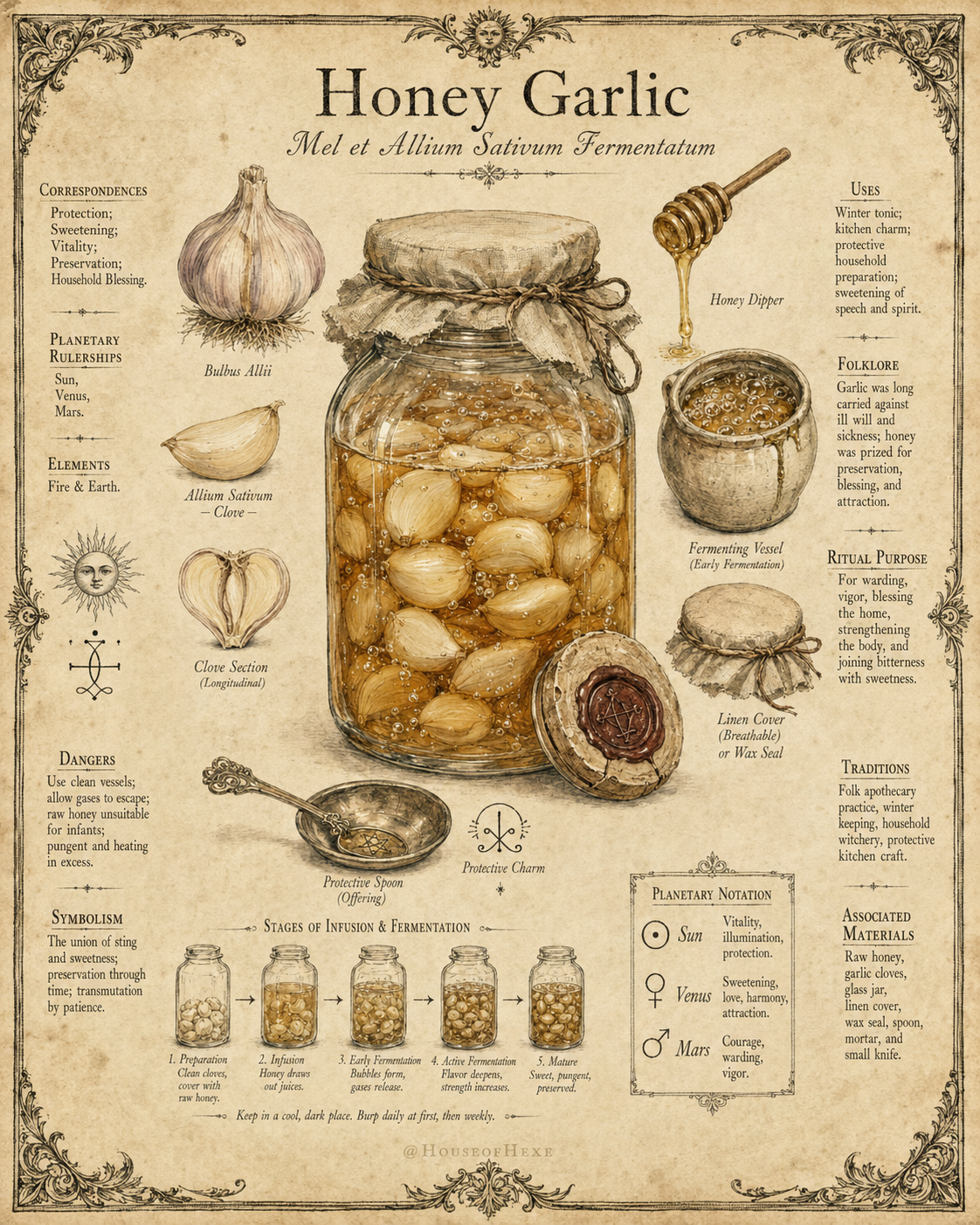
A Preparation for the Autumn Immune Apothecary
Garlic — Allium sativum
Pronunciation: GAR-lik | AL-ee-um suh-TEE-vum
It’s about time to start your Autumn Immune Apothecary.
Although the heat of summer may still linger, the preparations made now are often the ones we reach for when the days shorten and the colder months begin. Autumn has traditionally been a season of preservation: roots are lifted, herbs are dried, fruits are cooked down, vinegars are infused, and the abundance of the growing season is carefully carried forward into winter.
Fermented honey garlic belongs naturally among these preparations.
Made from little more than fresh garlic cloves and honey, it is a simple example of the kitchen and the apothecary occupying the same space. Over time, the sharp pungency of fresh garlic softens beneath the sweetness of honey. Moisture from the garlic gradually thins the honey, the cloves darken and mellow, and the preparation develops a distinctly sweet, savory, and pungent character.
It is both food and traditional household preparation, one that can be made well before the colder season arrives and kept as part of the working autumn and winter pantry.
Garlic ~ Allium sativum
Garlic is a member of the Amaryllidaceae family and has been cultivated as both food and medicine for thousands of years. Ancient writings from Egypt, Greece, and India document its historical use for a variety of health purposes, while its place in the culinary traditions of Europe, Asia, North Africa, and the Middle East has made it one of the most familiar medicinal foods in the world.
The bulb is composed of individual cloves enclosed within thin papery layers. When fresh garlic tissue is cut, crushed, or otherwise damaged, the plant's sulfur-containing chemistry begins to change. This contributes to the strong aroma and pungency for which garlic is known.
Modern research on garlic has focused heavily on cardiovascular and metabolic health. Some evidence suggests that garlic supplements may produce small reductions in cholesterol or blood pressure in certain populations, although effects vary according to preparation and study design. Garlic is also frequently marketed for immune support, particularly during cold and flu season, but clinical research in this area remains limited. It is therefore more accurate to regard garlic as a traditional medicinal food with a long history of seasonal use rather than as a proven preventative for respiratory infection.
Traditional Actions
Garlic has traditionally been described as:
Warming
Pungent
Stimulating
Diaphoretic
Expectorant
Digestive
Antimicrobial in traditional herbal practice
Circulatory stimulating
Its warming and strongly aromatic nature has historically made garlic particularly at home in the cold-season apothecary. It appears in broths, syrups, vinegars, oxymels, infused foods, and other household preparations where the boundary between nourishment and medicine becomes difficult (and perhaps unnecessary) to define.
The Role of Honey
Honey serves several purposes within this preparation.
First, it acts as the medium surrounding the fresh garlic. As the cloves release moisture, the consistency of the honey gradually changes, becoming thinner and more fluid.
Second, honey softens garlic's intense pungency. Given enough time, the cloves themselves become noticeably milder and sweeter while still retaining their characteristic garlic flavor.
Honey also carries its own extensive history within traditional medicine. It has long been used in soothing preparations for the throat and respiratory tract, and some modern evidence supports its traditional use for reducing nighttime cough in children over one year of age. Honey must never be given to infants younger than twelve months because it may contain spores associated with infant botulism.
Together, honey and garlic create a preparation that is easy to incorporate into everyday food rather than reserving it exclusively for periods of illness.
Preparing Fermented Honey Garlic
A basic preparation requires only two ingredients:
Fresh garlic cloves
Honey
Begin with a thoroughly cleaned glass jar.
Separate and peel the garlic cloves, inspecting each one carefully and discarding any that show signs of mold, rot, or significant damage. Place the cloves into the jar without packing them tightly, leaving adequate headspace.
Pour honey over the garlic until the cloves are completely surrounded.
Because garlic cloves often float during the early stages, the jar may need to be gently turned periodically to redistribute the honey and coat the exposed surfaces. As moisture moves from the fresh garlic into the honey, the mixture will gradually become thinner.
Small bubbles may also appear as the preparation changes.
Gas production can create pressure within a sealed jar, so containers undergoing active fermentation should be monitored rather than sealed and forgotten. Burp your jar (open the lid to release gas) daily until a noticable decline in pressure.
Food Safety Considerations
Fermentation is a traditional practice, but traditional does not mean exempt from food safety.
The National Center for Home Food Preservation emphasizes that fermented and preserved foods require appropriate conditions (including sufficient and uniform acidity where applicable) to prevent the growth of organisms capable of causing serious foodborne illness. It recommends using tested proportions and established preservation methods.
I have not found a standardized National Center for Home Food Preservation recipe establishing homemade fermented honey garlic as a tested shelf-stable preservation method. For conservative home practice, I treat it as a small-batch preparation rather than as a permanently shelf-stable preserve and favor refrigerated storage once the desired fermentation has been reached.
Any preparation that develops visible mold, putrid or distinctly rotten odors, or other clear signs of spoilage should be discarded.
As always, honey should not be given to children younger than twelve months.
Traditional and Household Use
Fermented honey garlic has long found a natural place within the traditions of kitchen medicine. Preparations combining garlic and honey have been used by home herbalists and folk healers as cold-season tonics, particularly during autumn and winter, and are often reached for at the first signs of seasonal respiratory illness.
Garlic itself has an extensive history of medicinal use. Ancient writings from Egypt, Greece, and India describe its use for a variety of health concerns, including respiratory and throat complaints, while modern herbal traditions continue to regard it as a warming, stimulating plant particularly suited to cold-weather preparations. Contemporary research has explored garlic extensively, although clinical research specifically examining its ability to prevent or treat the common cold remains limited.
Within folk herbalism, garlic honey is commonly taken by the spoonful as a seasonal tonic or used more frequently for short periods when illness begins to move through the household. Herbal teaching sources vary considerably in their suggested amounts…an important reminder that this is a traditional food-based preparation rather than a standardized pharmaceutical extract. Herbal Academy, for example, describes preparations ranging from a teaspoon daily as a tonic to more frequent servings during active illness, while other traditional garlic preparations use larger food-sized servings.
For an adult household preparation, one to two tablespoons per day may be used as a practical seasonal serving, either taken at once or divided throughout the day. When feeling unwell, some home herbalists choose to double their usual daily amount for a short period, according to personal tolerance.
Because homemade fermented honey garlic varies considerably in the amount of garlic contained in each spoonful, this should be understood as a traditional household serving rather than a standardized medicinal dose. Those who are sensitive to raw garlic may find larger amounts irritating to the stomach or aggravating to reflux. Garlic supplements and larger medicinal quantities may also present concerns for people taking anticoagulant medications or preparing for surgery.
Honey should never be given to an infant younger than twelve months because of the risk of infant botulism.
Beyond the Medicine Spoon
One of the best qualities of fermented honey garlic is that it never needs to be confined to the medicine cabinet.
This is, after all, kitchen medicine.
As the garlic ferments, the honey becomes thinner, deeply flavored, and increasingly savory, while the cloves themselves soften and lose some of the aggressive sharpness associated with fresh raw garlic. The finished preparation can move easily between the apothecary shelf and the dinner table.
The honey makes an excellent base for a meat glaze, particularly for chicken, pork, or roasted sausages. Combine it with mustard, vinegar, herbs, or a little soy sauce and brush it over the meat toward the end of cooking, when the sugars can caramelize without scorching.
For a simple salad dressing, whisk fermented garlic honey with olive oil, apple cider vinegar or balsamic vinegar, Dijon mustard, salt, and black pepper. The sweetness of the honey balances the acidity while the infused garlic provides much of the seasoning on its own.
It can also be used in marinades, particularly alongside vinegar, citrus, mustard, rosemary, thyme, sage, or ginger.
Drizzle a small amount over roasted carrots, winter squash, sweet potatoes, Brussels sprouts, or other autumn vegetables, adding it toward the end of roasting to create a sweet-savory glaze.
Mash one of the softened garlic cloves into a pan sauce or gravy, blend it into softened butter for bread or vegetables, or whisk it into the sauce for a stir-fry.
A spoonful can be stirred into soups and broths after cooking, where the sweetness rounds out sharp or acidic flavors. The cloves themselves may be chopped or mashed into sauces, spreads, vinaigrettes, marinades, or anywhere a softer, sweeter garlic flavor is welcome.
The honey can even be combined with mustard and a splash of vinegar for a quick sandwich or dipping sauce, or used as the foundation of a glaze for roasted root vegetables served alongside an autumn meal.
Using fermented honey garlic as food is also one of the simplest ways to maintain the old relationship between the kitchen and the household apothecary. Traditional herbalism has never required every useful plant preparation to be swallowed solemnly from a medicine spoon. Many of our oldest herbal allies have always been eaten.
Garlic is one of them.
The jar can be reached for because someone in the household is beginning to feel poorly, certainly.
But it can just as easily be reached for because there is a chicken roasting in the oven.
The Autumn Immune Apothecary
An Autumn Immune Apothecary is best understood as an act of preparation rather than reaction.
This is the season to begin considering what will be useful when colder weather arrives: dried tea herbs, soothing honeys, oxymels, vinegars, broths, steam blends, throat preparations, and the warming culinary plants that naturally return to the kitchen as summer recedes.
Not every preparation needs to be a treatment.
Some support nourishment.
Some provide comfort.
Some encourage hydration or make food more appealing when appetite is poor.
Some simply ensure that useful herbs and foods are already within reach when the household needs them.
Fermented honey garlic occupies this practical middle ground particularly well. It is not a substitute for medical care, nor should it be presented as a guaranteed method of preventing illness. It is a traditional food preparation built from two ingredients with long histories of use in the household apothecary.
And perhaps more importantly, it is made before it is needed.
Garlic in Folklore
Few culinary plants have accumulated quite as much protective folklore as garlic.
Its modern association with vampires is only one small and comparatively recent expression of a much older reputation. Throughout numerous European and Mediterranean traditions, garlic appeared in customs associated with protection from illness, harmful spirits, sorcery, the evil eye, and other forms of unwanted influence.
Strongly aromatic plants frequently occupy protective roles within folk traditions. Their scent announces their presence, and their physical qualities lend themselves naturally to the symbolic language of repelling, clearing, guarding, and strengthening.
Garlic is particularly suited to this role.
Its bulb grows beneath the earth while its individual cloves remain enclosed within layer upon layer of protective skin. When broken open, it releases an unmistakable pungency. It is nourishing, but sharp. Common, but powerful. Cultivated close to the household and stored through the colder months, it became as much a guardian of the pantry as an ingredient within it.
These characteristics undoubtedly contributed to its enduring place in household protective magic.
Magical Correspondences
Garlic
Protection
Warding
Courage
Vitality
Purification
Boundary work
Household protection
Repelling unwanted influence
Honey
Sweetening
Attraction
Blessing
Abundance
Preservation
Harmony
Reconciliation
Offerings
Planetary Associations
Mars
Sun
Venus
Elemental Associations
Fire
Earth
Garlic is most readily associated with Mars through its heat, sharpness, vigor, and protective nature. Solar correspondences may be applied where it is used for vitality, strength, illumination, and the symbolic driving away of harmful influences. Honey carries a gentler current and is frequently associated with Venus through sweetness, attraction, harmony, affection, and the softening of circumstances.
The combination creates an interesting magical formula:
Garlic protects…Honey draws…Garlic establishes the boundary…Honey determines what is welcomed across it.
Within household witchcraft, fermented honey garlic may therefore symbolize protection that does not require isolation; strength that remains capable of softness; and the ability to preserve sweetness without surrendering one's defenses. It may be prepared intentionally for a protected and well-nourished household, incorporated into seasonal kitchen magic, placed symbolically within workings concerning health and resilience, or used as part of the ritual preparation of autumn stores.
The transformation itself also carries symbolic significance. Fresh garlic begins sharp and biting. Honey begins thick and slow. Given time, each alters the other. The garlic softens. The honey thins. What began as two distinct substances becomes something that carries the qualities of both.
In this sense, fermented honey garlic is as much a preparation of patience as it is of preservation.
The autumn apothecary has always been concerned with what comes next.
It asks us to gather before the fields are bare, to preserve before the frost, and to prepare while there is still time to do so.
Fermented honey garlic is one small part of that practice: a jar prepared in abundance, allowed to transform slowly, and kept for the colder season ahead.